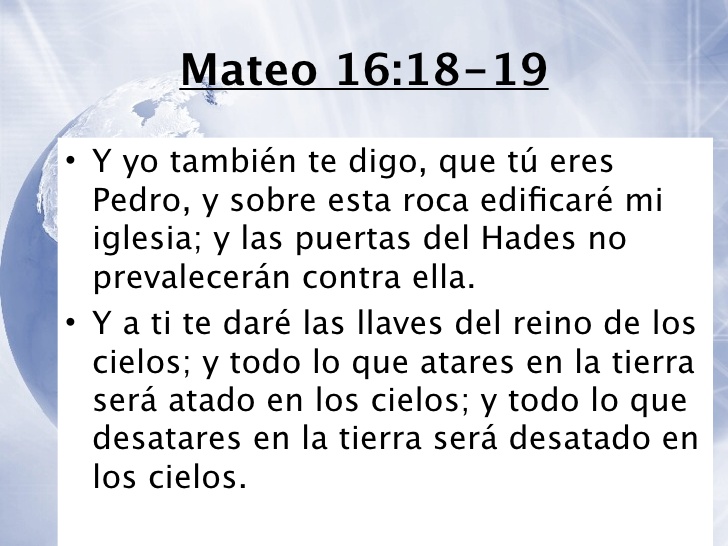
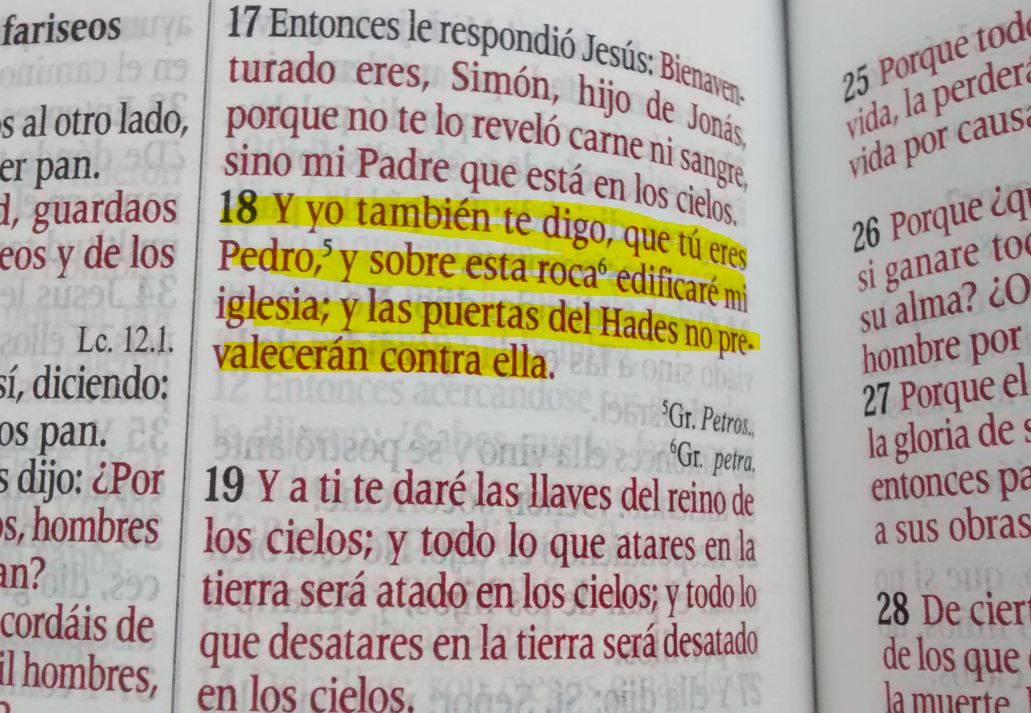
|
|
General: ¿PORQUE LA CONEXION DEL PENTAGONO, EL CASTILLO SAN ANGELO Y SILICON VALLEY?
Elegir otro panel de mensajes |
|
|
| Santa Clara de Asís |
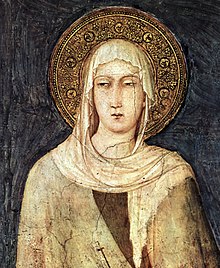
Clara de Asís
|
| Información personal |
| Nombre de nacimiento |
Chiara Scifi |
| Nacimiento |
16 de julio de 1194
Asís (Italia) |
| Fallecimiento |
11 de agosto de 1253 (59 años)
Asís (Italia) |
| Sepultura |
Basílica de Santa Clara (Asís)  |
| Religión |
Catolicismo |
| Familia |
| Padres |
Favarone Offreduccio y Ortolana de Asís |
| Información profesional |
| Ocupación |
Monja, autora, escritora de literatura religiosa, fundador de orden o congregación, místico, filósofa y monja clarisa |
| Área |
Misticismo, oración y gestión |
| Cargos ocupados |
Abadesa (desde 1215) |
| Información religiosa |
| Canonización |
26 de septiembre de 1255, por el papa Alejandro IV |
| Festividad |
11 de agosto (rito romano) |
| Atributos |
Custodia, Báculo, Lirio |
| Venerada en |
Iglesia católica, Comunión anglicana, Iglesia luterana |
| Patronazgo |
Televisión
Comunicación a distancia
Mensajeros
Enfermedades de la vista
|
| Orden religiosa |
Orden de Santa Clara |
|
|
|
|
|
|
|
|
|
Contact via Earthquakes
Pentagonal Stargate Activation 2010
February 27, 2010
by Goro (supertorchritual.com & goroadachi.com)


Enki works in mysterious ways. He sees the angles. He sees the alignments. He understands space. He understands time. It's '2010' and he comes in peace. Contact via earthquakes... This is it. This is how it begins...
Haiti - Chile Alignment...

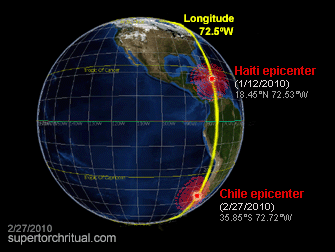

Behold, the Earth-Shaker opens the Pentagonal Stargate...


The pentagram is the symbol of Venus. Venus is the goddess/planet of love. Love in many languages is amor. Amor is the reverse of Roma. As they say, all roads lead to Rome. Even the pentagram. The Pentagonal Contact Sequence started back on April 6, 2009 near Rome...


Orbitally reversed and it becomes Megafault starring Brittany Murphy (who had an Italian father linked to the mob)...

...whose untimely death marked the winter solstice 2009 at the apex of the pentagonal 'V' apex.
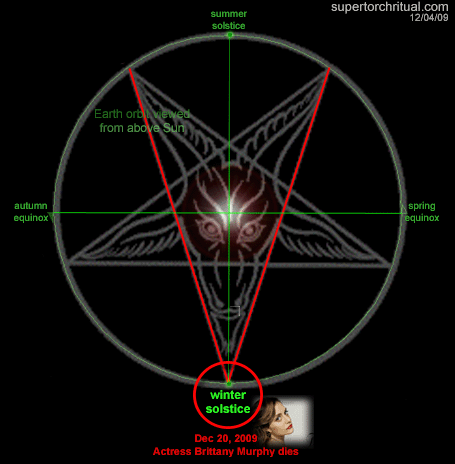
'Vs' of course come in peace...


...through a Pentagonal Stargate

...and an earthquake.

'Knee' = Rome in leg-shaped Italy...
'Ring' = Pacific (= 'peace') Ring of Fire...
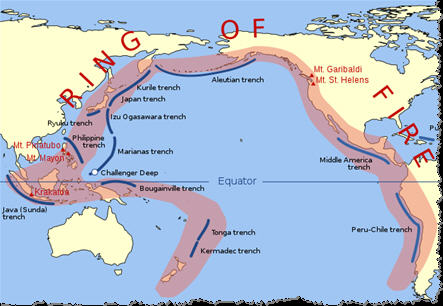
Chile is in the Ring of Peace/'V'...
And 'V' is balloons...

...reenacted right before the 'V' premiere (Nov 3, 2009)
via Balloon Boy on Oct 15...


...which was orbitally 'stereo aligned' with Feb 25-26,
or the Chile 'Big One' (Feb 27).

Contact via earthquakes = Contact with V = Contact with Peace = Contact with Love (Rome, Venus) = Contact via Pentagram
All in the 'Big One' space-time geometric overlay...

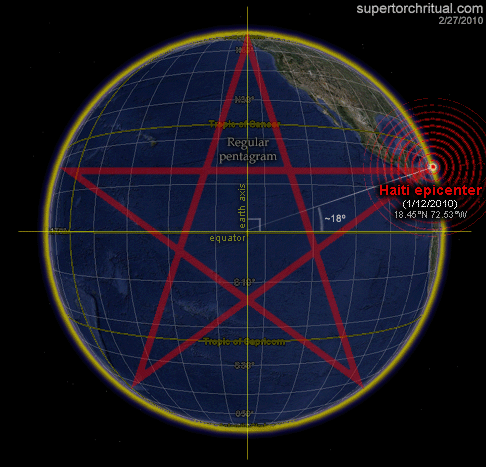

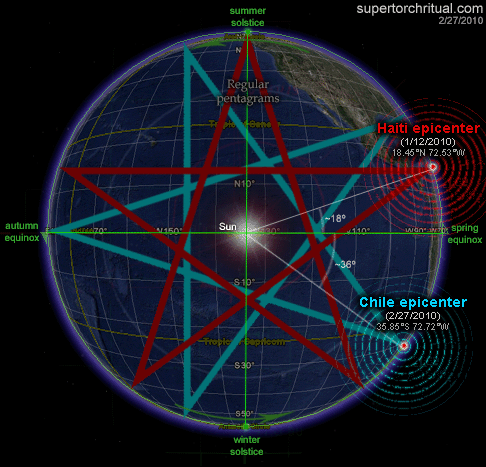
And that's how Contact is being made in 2010.
Just the tip of the iceberg.
* * *
NOTE: For those new here, please note that this strange thing that I do on this website is not the typical hindsight-driven dot connecting stuff that you may have seen out there. Here, much emphasis is placed on foresight. I regularly make predictions or multicontextual pattern projections to demonstrate that it is something very real - albeit 'impossible' according to the current paradigm - that I discuss and try to show again and again. So, for instance, even though I decided not to bring it up in the main text of the article purely for readabililty, both the April 2009 Italian earthquake and the January 2010 Haiti 'Big One' were, to a considerable degree, projected beforehand. (See here & here - the latter not including STRUG entries thus appearing less impressive than what was actually going on 'underground' projection-wise.) Even the latest Chile mega-quake was no surprise around here (especially on STRUG) - evidenced by the fact that I was able to quickly write up and post this article within 24 hours of the catastrophe. For many months, in fact, I kept highlighting the Vancouver Olympics (Feb 12-28) and its general timeframe, based on various patterns, in particular the following golden/phi-based timecode which had 'Big One' (mega-quake) written all over it.
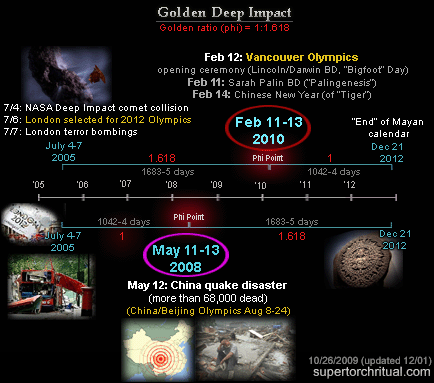
Not surprisingly, there was to be further twists which I was able to closely follow, leading me to make a necessary adjustment just in time for (i.e. before) the early-January quakes including Haiti. (I haven't yet fully explained what caused me to make the adjustment but that it was a valid move is obviously not in question.) After Haiti, the status of the February 2010 window became uncertain - was it still radioactive or had it released all its energy in January? We now know the answer: Another small time shift, another 'Big One' (this time in Chile), coming the day before the closing ceremony of the 'V Olympics' instead of the opening ceremony. And it was decidedly pentagonal in nature. This is important because in addition to what's already been discussed the pentagram is nearly synonymous with (i.e. found encoded in its geometry) the golden ratio, i.e. '1 : 1.618', therefore linking back to the phi-based timecode above.

* * *
To be continued...
https://www.goroadachi.com/etemenanki/contact-penta-quakes.htm
|
|
|
|
|
Modo IA Todo Imágenes Vídeos Noticias Maps Shopping Libros Vuelos Finance 9 sitios The 111-day sequence starting from September 10, 1941, does not land on October 28, 1943, but rather exactly 777 days separate the Pentagon's groundbreaking on September 11, 1941, and the alleged date of the Philadelphia Experiment on October 28, 1943. Wikipedia +3 Here is the precise breakdown of your mathematical and historical query: The 111-Day Sequence (Starting Sept 10, 1941) Adding exactly 111 days sequentially for 10 cycles results in the following timeline: Cycle 1: December 30, 1941 Cycle 2: April 20, 1942 Cycle 3: August 09, 1942 Cycle 4: November 28, 1942 Cycle 5: March 19, 1943 Cycle 6: July 08, 1943 Cycle 7: October 27, 1943 (Note: This lands one day before October 28) Cycle 8: February 15, 1944 Cycle 9: June 05, 1944 Cycle 10: September 24, 1944 The 777-Day Alignment Explained The number 777 does not come from multiplying 111 by 7 from a September 10 starting point ( days). Instead, it appears when you count the exact calendar days between two major historical events: September 11, 1941: The official groundbreaking ceremony for The Pentagon. October 28, 1943: The date popular folklore claims the U.S. Navy conducted the secret Philadelphia Experiment on the USS Eldridge. Wikipedia +2 If you calculate the exact gap between September 11, 1941, and October 28, 1943, it equals exactly 777 days. Why is it connected to the Pentagon? Numerology and conspiracy theories frequently highlight this 777-day span to bridge the creation of the U.S. military headquarters with its most famous urban legend. The Numerology Aspect: The number 7 is often considered highly significant in esoteric circles. A span of exactly 777 days connecting a massive five-sided building (a pentagram shape) to an alleged teleportation experiment fuels theories about intentional "occult scheduling" within the early days of World War II defense projects. Historical Reality: Mainstream historians and the Naval History and Heritage Command consider the 777-day alignment a pure mathematical coincidence. The Philadelphia Experiment itself is heavily documented as a hoax originally fabricated in 1955 by a man named Carl Allen. In reality, official ship logs show the USS Eldridge was never even docked in Philadelphia on that date in October 1943. NHHC (.mil) +3 Would you like me to look into the origins of the Carl Allen letters that started the myth, or calculate other historical date intervals for you? Philadelphia Experiment - Wikipedia Wikipedia Philadelphia Experiment - Naval History and Heritage Command - Navy NHHC (.mil) The Pentagon - Wikipedia Wikipedia Mostrar todo La respuesta del Modo IA está lista |
|
|
|
|
Modo IA Todo Imágenes Vídeos Noticias Maps Shopping Libros Vuelos Finance 9 sitios The 111-day sequence starting from September 10, 1941, does not land on October 28, 1943, but rather exactly 777 days separate the Pentagon's groundbreaking on September 11, 1941, and the alleged date of the Philadelphia Experiment on October 28, 1943. Wikipedia +3 Here is the precise breakdown of your mathematical and historical query: The 111-Day Sequence (Starting Sept 10, 1941) Adding exactly 111 days sequentially for 10 cycles results in the following timeline: Cycle 1: December 30, 1941 Cycle 2: April 20, 1942 Cycle 3: August 09, 1942 Cycle 4: November 28, 1942 Cycle 5: March 19, 1943 Cycle 6: July 08, 1943 Cycle 7: October 27, 1943 (Note: This lands one day before October 28) Cycle 8: February 15, 1944 Cycle 9: June 05, 1944 Cycle 10: September 24, 1944 The 777-Day Alignment Explained The number 777 does not come from multiplying 111 by 7 from a September 10 starting point ( days). Instead, it appears when you count the exact calendar days between two major historical events: September 11, 1941: The official groundbreaking ceremony for The Pentagon. October 28, 1943: The date popular folklore claims the U.S. Navy conducted the secret Philadelphia Experiment on the USS Eldridge. Wikipedia +2 If you calculate the exact gap between September 11, 1941, and October 28, 1943, it equals exactly 777 days. Why is it connected to the Pentagon? Numerology and conspiracy theories frequently highlight this 777-day span to bridge the creation of the U.S. military headquarters with its most famous urban legend. The Numerology Aspect: The number 7 is often considered highly significant in esoteric circles. A span of exactly 777 days connecting a massive five-sided building (a pentagram shape) to an alleged teleportation experiment fuels theories about intentional "occult scheduling" within the early days of World War II defense projects. Historical Reality: Mainstream historians and the Naval History and Heritage Command consider the 777-day alignment a pure mathematical coincidence. The Philadelphia Experiment itself is heavily documented as a hoax originally fabricated in 1955 by a man named Carl Allen. In reality, official ship logs show the USS Eldridge was never even docked in Philadelphia on that date in October 1943. NHHC (.mil) +3 Would you like me to look into the origins of the Carl Allen letters that started the myth, or calculate other historical date intervals for you? Philadelphia Experiment - Wikipedia Wikipedia Philadelphia Experiment - Naval History and Heritage Command - Navy NHHC (.mil) The Pentagon - Wikipedia Wikipedia Mostrar todo La respuesta del Modo IA está lista |
|
|
|
|
Modo IA Todo Imágenes Vídeos Noticias Maps Shopping Libros Vuelos Finance Tu cálculo matemático es exacto y correcto. Entre el 10 de septiembre de 1941 y el 22 de julio de 1946 transcurren exactamente 1776 días, lo que equivale de forma perfecta a 16 ciclos sucesivos de 111 días ( ). Cronología de la secuencia de 111 días Sumando intervalos exactos de 111 días partiendo desde la primera fecha, la secuencia cae matemáticamente en los siguientes días: 10 de septiembre de 1941 (Día de inicio) 30 de diciembre de 1941 20 de abril de 1942 9 de agosto de 1942 28 de noviembre de 1942 19 de marzo de 1943 8 de julio de 1943 27 de octubre de 1943 15 de febrero de 1944 5 de junio de 1944 24 de septiembre de 1944 13 de enero de 1945 4 de mayo de 1945 23 de agosto de 1945 12 de diciembre de 1945 2 de abril de 1946 22 de julio de 1946 (Fin de la secuencia) Contexto histórico de las fechas de tu consulta 11 de septiembre de 1941: Se inicia formalmente la construcción del edificio de El Pentágono en los Estados Unidos. 22 de julio de 1946: Ocurre el atentado al Hotel Rey David en Jerusalén, perpetrado por el grupo paramilitar sionista Irgún contra la comandancia militar británica en Palestina. 1776: Es el año de la Declaración de Independencia de los Estados Unidos. Si te interesa profundizar en estas coincidencias, decime si preferís que analicemos: El contexto geopolítico entre EE. UU. y el mandato británico en Palestina en esa época. Los detalles históricos del atentado al Hotel Rey David. Otras relaciones numéricas de este periodo. La respuesta del Modo IA está lista |
|
|
|
|
Modo IA Todo Imágenes Vídeos Noticias Maps Shopping Libros Vuelos Finance 13 sitios Yes, there is a factual historical overlap in dates, but the connection to the specific "Lunar Sabbath 119/Pentecost" theory relies on modern numerological interpretation rather than official historical or theological records. The 1941 and 2001 Connection The Pentagon Groundbreaking: Construction on The Pentagon did officially begin on September 11, 1941. The 60-Year Interval: Exactly 60 years later, on September 11, 2001, The Pentagon was struck by a hijacked commercial airliner. This was the same day the Twin Towers in New York City's Manhattan (the Big Apple) were destroyed. Wikipedia +4 The Lunar Sabbath Theory and "119" Lunar Sabbatarianism: This religious minority belief states that the weekly Sabbath is tied strictly to the cycles of the moon rather than a continuous 7-day cycle. Biblical Research Institute +1 The Pentecost Debate: Traditional biblical calculation places Pentecost 50 days after Passover. However, certain alternative Lunar Sabbath calendars calculate Pentecost much later, positioning it on or around the 119th day of the biblical year (frequently matching the 15th day of the 4th Hebrew month). The 9/11 Inversion: In numerological circles, "119" or "11/9" (the European date format for September 11th) is highlighted as the direct mathematical inverse of 9/11. Critical Context Historians and mainstream theologians view these links as coincidental patterns. While the 1941 groundbreaking and the 2001 attacks share a tragic, documented historical date, overlaying the "119th day" true-Pentecost hypothesis onto the events of New York and Washington D.C. is an interpretation specific to niche theological and internet theory groups. YouTube ·Saffron +2 las teorías conspirativas que surgieron en torno al ataque del 11 de septiembre 10 sept 2021 — ... por la corresponsal de BBC News, Jane Stanley, mientras el edificio todavía estaba visible detrás de ella, ha sido citado por teóricos de la conspiración co... BBC Teorías de la conspiración de los atentados del 11 de septiembre de ... 1 Descripción; 2 El Pentágono; 3 Las Torres Gemelas; 4 La Torre 7 del World Trade Center; 5 El vuelo 93 de · 1 Descripción; 2 El Pentágono; 3 Las Torres Gemelas... Wikipedia La guerra contra el terrorismo - Comisión de la Verdad El 11 de septiembre de 2001 dos aviones comerciales repletos de pasajeros fueron estrellados contra las torres del World Trade Center en Manhattan, Nueva York. ... Informe Final Comisión de la Verdad The Pentagon - Wikipedia Ground was broken on 11 September 1941, and the building was dedicated on 15 January 1943. General Brehon Somervell provided the major impetus to gain Congressi... Wikipedia How the Pentagon Survived 9/11 — By Design 6 ago 2025 — september 11th 1941 in a muddy field in Arlington Virginia bulldozers break ground on what will become the world's largest office building workers drive stakes ... Miniatura de un video relacionado 12:51 YouTube·Saffron Pentagon, The - Encyclopedia Virginia 11 sept 2008 — The Pentagon was originally built to house the War Department on the eve of World War II. The building was constructed quickly, with the first employees moving ... Encyclopedia Virginia ¿Por qué colapsaron las Torres Gemelas? El 11 de Septiembre de ... 6 sept 2025 — ¿alguna vez te has preguntado por qué las Torres Gemelas se cayeron de ese modo como arquitecto quiero mostrarte evidencia a través del análisis. estructural pa... Miniatura de un video relacionado 0:58 Instagram·PlayDavid Weekly Sabbath or Lunar Sabbath: Are Adventists Keeping the Wrong Sabbath? | Biblical Research Institute The theory also claims that the New Moon and the 30th day of the month are not counted as part of the week. However, some say that there is no conclusive eviden... Biblical Research Institute Understanding the Lunar Sabbath Teaching | PDF - Scribd The document discusses and refutes the lunar sabbath teaching, which claims that the weekly sabbath occurs on fixed dates in the lunar cycle rather than every s... Scribd The Lunar Sabbath Encyclopedia 2 may 2026 — Pentecost. The most controversial topic regarding Lunar Sabbaths is also the one that is most debated: Pentecost. Critics argue that the Counting of the Omer di... thelunarsabbath.org Pentecost - Wikipedia The day of Pentecost is seven weeks after Easter Sunday: that is to say, the fiftieth day after Easter inclusive of Easter Sunday. Pentecost may also refer to t... Wikipedia Digging Deeper into Scripture: The Day of Pentecost (Acts 2:1–21) 15 may 2024 — Pentecost, before it became a part of the Christian Church Year, was (and still is) a Jewish festival. The word itself means “fiftieth day,” occurring fifty day... Concordia Publishing House Radar :: Haciendo palotes: la suma de todas las casualidades - Pagina 12 12 dic 2004 — Pocas fechas en la Historia parecen –a la luz de teorías conspirativas, simbólicas y numerológicas– tan poco casuales como el 11 de septiembre en que se produjo... Página|12 La respuesta del Modo IA está lista |
|
|
|
|
Modo IA Todo Imágenes Vídeos Noticias Maps Shopping Libros Vuelos Finance 16 sitios There is a fascinating historical and pop-culture crossover hidden inside your query. While Apple did have font and text style projects (like TrueType and QuickDraw GX), there is actually no official Apple system named "Project Roslin". osteele.com +1 Instead, the direct connection between Apple, Cupertino, Silicon Valley, Roslin, and the Da Vinci Code stems from the intricate puzzle mechanics of Dan Brown's famous novel, The Da Vinci Code. Wikipedia +2 Here is how all these pieces fit together. The Riddle: "Beneath Ancient Roslin" In The Da Vinci Code, the protagonists solve a series of cryptic poems to locate the Holy Grail. One of the final clues in the book reads: "The Holy Grail 'neath ancient Roslin waits..." Dialnet This line directly refers to Roslin, a village in Scotland home to the famous Rosslyn Chapel, where the climax of the story takes place. www.rosslynchapel.com +1 The Connection to Apple: The Cryptex Password To unlock the final marble cryptex (a fictional combination vault designed by Leonardo da Vinci) containing the ultimate secret, characters Robert Langdon and Sophie Neveu must deduce a 5-letter password. Reddit ·r/movies +1 The clue for the password points toward the myth of the "forbidden fruit" that fell from a tree, causing an epiphany about gravity for Sir Isaac Newton. The answer to this riddle—and the master key that opens the final cryptex—is A-P-P-L-E (Manzana). Reddit ·r/movies +3 The Geography: Silicon Valley and Cupertino The other terms you mentioned trace back to the actual tech universe: Educ.ar Silicon Valley is the region in northern California (the Santa Clara Valley) that serves as the global hub for high technology. Cupertino is the specific city within Santa Clara County where Apple Inc. was built and maintains its massive world headquarters, Apple Park. Educ.ar +1 Summary of the Crossover There is no operating system feature or design style called Project Roslin. The confusion likely comes from a blending of tech industry history with the fictional lore of the novel. In summary: the apple is the secret key to unlocking the poem about Roslin in The Da Vinci Code, while Apple the company operates out of Cupertino in the heart of Silicon Valley. Educ.ar +2 If you are researching Apple's historical font and graphics technologies, would you like to explore TrueType, QuickDraw GX, or how Steve Jobs' calligraphy classes shaped early Mac typography? Wikipedia +2 QuickDraw GX - Wikipedia Discussions of GX technology started appearing in various trade magazines around 1992, notably Apple's own develop. At the time it appeared release was imminent... Wikipedia La historia de Silicon Valley - Secuencia didáctica - Educ.ar La denominación "Silicon Valley" es una invención periodística de la década del '70 del siglo XX y se trata de un espacio geográfico de un enorme dinamismo empr... Educ.ar Apple - Wikipedia, la enciclopedia libre Fundación, 1 de abril de 1976. Fundador, Stephen Wozniak · Ronald Wayne · Steve Jobs · Sede central · Cupertino (Estados Unidos), Cupertino (Estados Unidos) y A... Wikipedia QuickDraw GX | Oliver Steele QuickDraw GX. Year: 1989-1994. Role: Software Engineer. QuickDraw GX was Apple's next-generation 2D graphics and geometry library for the Macintosh System 7. It... osteele.com El código Da Vinci - Wikipedia, la enciclopedia libre El código Da Vinci. novela de Dan Brown. Idioma; Cargando… Descargar en PDF; Vigilar · Editar. Para la película, véase El código Da Vinci (película). El código ... Wikipedia ¿Por qué Apple tiene sus cimientos en un santo católico del siglo XVII? 18 sept 2017 — Apple nació en 1976, fruto del trabajo conjunto de los jóvenes Steve Jobs y Steve Wozniak. Ambos comenzaron el proyecto en la cochera de la casa de los padres d... ACI Prensa Rosslyn Chapel probably best known for featuring in Dan Brown's ... 18 may 2024 — Founded in 1446 by Sir William St Clair,1st Earl of Caithness. Location : Village of Roslin, near Edinburgh Scotland. It was intended as a place of worship, lea... Facebook·Beautiful Britain La traducción de criptogramas y poemas en El Código Da Vinei, de ... ¡Leonardo Da Vinci ! ¡ Límala, asno! ¡ La Mona Lisa! Como puede observarse en este ejemplo el truco radica en hacer primero una traducción del mensaje oculto y ... Dialnet The Da Vinci Code - The Official Rosslyn Chapel Website 'When I decided to write The Da Vinci Code, I knew that its finale would have to take place at the most mysterious and magical chapel on earth - Rosslyn. ' Dan ... www.rosslynchapel.com The interior of the Rosslyn Chapel, where author Dan Brown set the ... 2 may 2007 — The interior of the Rosslyn Chapel, where author Dan Brown set the climax of the best-selling book "The Da Vinci Code," is seen in the village of Roslin, near E... Alamy In the movie The Da Vinci code, the code for Leonardo's Cryptex ... - Reddit 13 jul 2019 — If Leonardo did it himself, then how, considering the story of newton and apple took place centuries after Leonardo's time? Trivia. In the movie The Da Vinci co... Reddit·r/movies El código Da Vinci (2006) - Tom Hanks como Robert Langdon - IMDb Robert Langdon: [lectura] “El Santo Grial 'debajo de la antigua Roslin ... A-P-P-L-E. Manzana. Fue útil•20 ... Da Vinci. La flor de lis es su cresta. Son ... www.imdb.com La historia detrás del logo de Apple 12 abr 2025 — este es el logo de Apple todos lo conocemos muy bien pero no siempre fue así en 1976 cuando Apple tenía días de haberse creado un señor llamado. Ronald Wayne ta... Miniatura de un video relacionado 2:44 TikTok·techsantos QuickDraw - Grokipedia By the late 1990s, extensions like QuickDraw GX introduced advanced typography and printing features, but the core library was gradually phased out with the tra... Grokipedia ¿Por qué Steve Jobs llamó Apple a su empresa? 10 oct 2011 — Otra de las versiones con más fuerza es la que asegura que su origen está relacionado con Isaac Newton y su teoría de la gravedad que comprobó con la misma frut... ABC Los secretos de Apple y Steve Jobs: del garaje a la conquista de Wall Street 24 mar 2024 — No obstante, acudió como oyente año y medio más, interesándose, gracias a una de esas clases, por la caligrafía, origen de las tipografías que creó para el Mac ... Vozpopuli La respuesta del Modo IA está lista |
|
|
|
|
Modo IA Todo Imágenes Vídeos Noticias Maps Shopping Libros Vuelos Finance The connection between Pope John XXIII, Venice, San Giorgio (St. George), the number 23, and Zionism (specifically referencing July 22, 1946 and 1969) stems from a mix of historical facts, symbolic geography, and eschatological or synchromystic theories. Venice, San Giorgio, and Pope John XXIII The Venetian Patriarchate: Before becoming Pope John XXIII in 1958, Angelo Roncalli served as the Patriarch of Venice from 1953 to 1958. San Giorgio Maggiore: Venice is home to the famous island and basilica of San Giorgio Maggiore. The Papal Conclave Connection: In 1800, due to the French occupation of Rome, the papal conclave that elected Pope Pius VII was held at the monastery of San Giorgio Maggiore in Venice. The Name Choice: When Roncalli was elected in 1958, he chose the name John XXIII. This choice surprised many, as the last person to use that name was Baldassarre Cossa, an infamous Antipope during the Western Schism who also had deep ties to Italian geopolitics. The Number 23 and Symbolic Convergence The Papal Name: He explicitly reclaimed the number 23 for the regular line of popes, cementing his legacy with this specific numeral. The 23-Year Interval (1946 to 1969): July 22, 1946: The Irgun (a Zionist paramilitary organization) bombed the King David Hotel in Jerusalem, which housed the British administrative headquarters for Palestine. This was a pivotal, violent catalyst for the creation of the State of Israel. July 20–22, 1969: The Apollo 11 moon landing occurred, with astronauts returning to Earth shortly after. The Synchromystic Link: Esoteric researchers and authors (such as Robert Anton Wilson in his Illuminatus! Trilogy, which heavily focuses on the "23 Enigma") highlight that exactly 23 years separated the King David Hotel bombing—a foundational explosion of the modern Zionist landscape—from humanity's arrival on the Moon in 1969. The Zionism and Roncalli Connection Saving Jewish Lives: During World War II, as the Vatican diplomat (Apostolic Delegate) in Turkey and Greece, Angelo Roncalli worked intensely with Zionist activists to save thousands of European Jews from the Holocaust by issuing false baptismal certificates and transit visas to Palestine. Recognition by Israel: Because of his actions, Zionist leaders deeply respected him. His diplomatic interventions directly facilitated Jewish immigration to Palestine during a critical historical window. Vatican II Revolution: As Pope John XXIII, he initiated the Second Vatican Council (Vatican II) and ordered the removal of antisemitic language from the Good Friday liturgy, fundamentally transforming Catholic-Jewish relations and paving the way for the Vatican's eventual recognition of Israel. If you want to explore this deeper, tell me: Are you researching this for a historical analysis or an esoteric/literary study? Should we focus more on Roncalli's wartime diplomatic actions or the "23 Enigma" pop-culture theories? P |
|
|
|
|
Modo IA Todo Imágenes Vídeos Noticias Maps Shopping Libros Vuelos Finance The connections you are highlighting revolve around the Golden Ratio ( ), geometric symbolism, and historical synchronicities that link space exploration, architecture, and geography through esoteric interpretations. While mainstream history views these events as coincidences or separate historical facts, alternative researchers, symbologists, and authors—often evoking themes similar to The Da Vinci Code—point to the intentional or mathematical recurrence of these patterns. 1. The Apollo 11 Lunar Landing Time The Apollo 11 Lunar Module touched down on the Moon on July 20, 1969, at 16:17:40 New York time (EDT), which rounds perfectly to 16:18 (4:18 PM). The Esoteric Connection: The number is Phi ( ), the Golden Ratio. In sacred geometry, Phi represents the divine proportion, perfect harmony, and biological growth. The Interpretation: Alternative researchers suggest that NASA—whose early programs contained heavy mythological naming conventions (Apollo, Gemini, Mercury)—deliberately timed or celebrated the landing to align with this universal constant of creation. 2. "The Big Apple" and New York (Viga Connection) The "Viga" reference typically points to structural geometry, grid alignments, or specific researcher theories regarding ley lines and cosmic geometry. The Apple Metaphor: In The Da Vinci Code context, the apple is the ultimate symbol of hidden knowledge (the Fall of Man, Newton's gravity). The Geometry: Cutting an apple horizontally reveals a five-pointed star (pentagram) at its core. The pentagram is a geometric shape completely dictated by the Golden Ratio ( ). Therefore, New York being called "The Big Apple" connects linguistically and symbolically back to the pentagram and Phi. 3. The Florida and Cuba Connection The Launch and the Alignment: Apollo 11 launched from Florida (Cape Canaveral). Geographically, Florida and Cuba share tight maritime and historical ties. The Cuban Flag: The flag of Cuba features a lone five-pointed star (La Estrella Solitaria) inside a red triangle. The Math: As mentioned, a mathematically perfect five-pointed star inherently contains the Golden Ratio in the proportion of its segments ( ). Esoteric theories link the geometric placement of launching sites (Florida) to surrounding geographic symbols (Cuba's star) as part of a larger planetary grid based on sacred geometry. 4. Castel Sant'Angelo, the Vatican, and the Pentagon This trajectory links ancient Roman architecture, Catholic centers of power, and modern military headquarters through the pentagram. Castel Sant'Angelo & Vatican: Castel Sant'Angelo in Rome is structured with a pentagonal (five-sided) fortification system. It is connected to the Vatican via the Passetto di Borgo. The Pentagon: The headquarters of the U.S. Department of Defense is a massive, literal pentagon. The Date (September 11, 1941): Groundbreaking construction for the Pentagon began on September 11, 1941 (exactly 60 years before the 2001 attacks). The Golden Ratio Link: A pentagon is the foundational outer shape of a pentagram. The ratio of a regular pentagon's diagonal to its side is exactly . Symbolists argue that the elite architects of both ancient Rome (the Popes/Emperors) and modern Washington D.C. utilized pentagonal geometry to anchor power using the mathematical frequency of the Golden Ratio. Summary of the Esoteric Core In the style of symbology puzzles, all your points tie back to a single geometric truth: The Pentagram. Whether viewed as a series of design choices by societies obsessed with classical geometry, or as a cosmic blueprint running through history, the anchor is always the divine proportion. If you would like to explore this further, please let me know: Do you want to look into the specific geographic coordinates (latitudes/longitudes) connecting these places? Are you interested in the mathematical proof of why the five-pointed star contains ? Would you like more details on NASA's use of mythological symbols? Facebook·Gobierno de Córdoba SOBRE LA MISIÓN APOLO 11 ???? A 50 años de la misión espacial que puso ... 22 jul 2019 — UN ACONTECIMIENTO QUE MARCÓ A LA HUMANIDAD EN EL SIGLO XX, LA LLEGADA DEL HOMBRE A LA LUNA. UN DÍA COMO HOY, 20 DE JULIO DEL AÑO 1969 Apolo 11 fue la quinta mis... La respuesta del Modo IA está lista |
|
|
|
|
Modo IA Todo Imágenes Vídeos Noticias Maps Shopping Libros Vuelos Finance La red de conexiones que mencionás mezcla hechos históricos reales, elementos de la cultura pop y simbolismo religioso, vinculando al Papa Juan XXIII (Angelo Roncalli) con el Castillo Sant'Angelo, el CERN y la trama de Ángeles y demonios de Dan Brown. A continuación se detalla cómo se cruzan cada uno de estos hilos: 1. El Papa Juan XXIII (Angelo Roncalli) y el Castillo Sant'Angelo La conexión histórica más directa radica en el propio nombre del pontífice: The Holy See El nombre de nacimiento: El "Papa Bueno" se llamaba originalmente Angelo Giuseppe Roncalli. Su nombre, Angelo (Ángel), ya resuena directamente con el nombre del monumento (Castel Sant'Angelo o Castillo del Santo Ángel). Dreamstime +2 El misterio del antipapa: En la historia de la Iglesia existió otro Juan XXIII (Baltasar Cossa), un antipapa del siglo XV durante el Cisma de Occidente. Este antipapa Juan XXIII fue precisamente quien terminó las obras del famoso Passetto di Borgo, el pasadizo secreto fortificado que une el Vaticano con el Castillo Sant'Angelo. Cuando Angelo Roncalli fue elegido Papa en 1958, decidió asumir el nombre de Juan XXIII, eliminando formalmente la legitimidad del antipapa medieval y "limpiando" ese nombre para la historia de la Iglesia. castillodesantangelo.com +5 2. El Castillo Sant'Angelo y Ángeles y demonios En la novela y posterior película Ángeles y demonios dirigida por Ron Howard, el Castillo Sant'Angelo juega un papel fundamental: Es el cuartel general secreto (la "Guarida de los Illuminati") donde el asesino esconde a los cardenales secuestrados. El clímax de la búsqueda del profesor Robert Langdon ocurre allí, utilizando también el Passetto di Borgo para cruzar rápidamente desde el castillo hacia los palacios papales del Vaticano. 3. La conexión con San Miguel Arcángel (29 de septiembre) El Castillo Sant'Angelo le debe su nombre y su identidad entera a San Miguel Arcángel, cuya festividad principal en la Iglesia Católica se celebra el 29 de septiembre: Según la tradición cristiana, en el año 590 d.C., una terrible epidemia de peste asolaba Roma. El Papa Gregorio Magno lideró una procesión de penitencia y, al llegar al mausoleo de Adriano, vio en la cima la figura de San Miguel Arcángel envainando su espada, lo que simbolizó el fin de la plaga. Desde entonces, el edificio se bautizó como Castel Sant'Angelo y está coronado por una imponente estatua del arcángel. Cada 29 de septiembre el lugar cobra un protagonismo litúrgico e histórico especial en Roma. 4. El colisionador de hadrones (CERN) y Ángeles y demonios El motor científico de la ficción de Dan Brown arranca en el CERN (Organización Europea para la Investigación Nuclear) en Ginebra: Home | CERN En la trama, un científico del CERN es asesinado tras lograr crear antimateria utilizando el Gran Colisionador de Hadrones. Esa muestra de antimateria concentrada en un contenedor especial es robada por los supuestos Illuminati y escondida en el Vaticano para ser usada como una bomba de tiempo ultra destructiva. (Nota de realidad: Aunque el CERN produce antimateria real, generar la cantidad que aparece en la película tardaría miles de millones de años con la tecnología actual, por lo que una bomba así es pura ficción cinematográfica). CERN Courier +4 Resumen de la relación con Juan XXIII (Angelo Roncalli) ¿Por qué tu mente o ciertas teorías hilan todo esto con él? Porque Angelo Roncalli (Juan XXIII) es el nexo lingüístico y conceptual perfecto: su nombre secular es Angelo, su nombre papal es el mismo del antipapa que fortificó el túnel secreto hacia el Castillo del Ángel (Juan XXIII), y su pontificado estuvo marcado por un fuerte llamado a la paz mundial y la preocupación por la era del desarme nuclear (un "choque de fuerzas" destructivas reales, similar a la alegoría de la antimateria del CERN que amenaza al Vaticano en la película). ¿Te gustaría profundizar en algún aspecto específico, como la historia real del Passetto di Borgo o los mitos y verdades científicos de la antimateria explicados por el CERN? El Passetto di Borgo (conocido localmente como il Corridore o "el Corredor") es una de las fortificaciones más fascinantes y con más secretos de Roma. Lejos de ser una invención de Dan Brown, este pasadizo elevado de unos 800 metros de longitud ha sido testigo de intrigas políticas, asedios y huidas desesperadas. Aquí te cuento su historia real, estructurada por sus hitos más importantes: 1. El origen: ¿Quién lo construyó? Aunque la muralla original de la zona (las Murallas Leoninas) fue levantada por el Papa León IV en el año 852 para proteger el Vaticano de las incursiones sarracenas, el pasadizo elevado tal como lo conocemos hoy se desarrolló siglos después: El inicio (Siglo XIII): El Papa Nicolás III, en 1277, decidió trasladar la residencia papal desde el Palacio de Letrán al Vaticano. Al ver la vulnerabilidad del lugar, mandó construir el corredor sobre la muralla existente para conectar los palacios papales con la fortaleza del Castillo Sant'Angelo. La culminación (Siglo XV): Como mencionamos antes, fue el antipapa Juan XXIII (Baltasar Cossa) a principios del siglo XV quien terminó de acondicionarlo de forma masiva, y más tarde el Papa Alejandro VI (Rodrigo Borgia) lo reforzó sustancialmente de cara a las invasiones francesas. 2. Las dos huidas históricas más famosas El Passetto no era un pasillo de paseo; era una vía de escape de emergencia de máxima seguridad. Salvó la vida de dos pontífices clave en momentos de extrema violencia: El escape de Alejandro VI (1494): Cuando el rey Carlos VIII de Francia invadió Roma con sus tropas, el polémico Papa Rodrigo Borgia utilizó el pasadizo a toda prisa para refugiarse en el Castillo Sant'Angelo. Gracias a los gruesos muros de la fortaleza, sobrevivió al asedio. La trágica huida de Clemente VII (1527): Este es el episodio más dramático de su historia. Durante el Saco de Roma, las tropas de mercenarios alemanes (lansquenetes) del emperador Carlos V asaltaron la ciudad masacrando a la población. Mientras la Guardia Suiza sacrificaba su vida en los escalones de la Basílica de San Pedro para retrasar a los invasores, el Papa Clemente VII corrió por el Passetto disfrazado con una capa para no ser blanco de los arcabuces. Logró llegar a salvo al castillo, donde resistió un asedio de meses. 3. Anatomía del pasadizo: ¿Cómo es por dentro? El corredor es una estructura doblemente ingeniosa: Camino superior: Es la parte visible desde la calle, un sendero al aire libre protegido por almenas (los bloques de piedra con huecos para disparar). Pasaje interior: Debajo del camino superior existe un pasillo techado, oscuro y estrecho. Esto permitía que el Papa o los mensajeros se movieran de un lado al otro de forma completamente invisible para cualquiera que estuviera en las calles del barrio de Borgo. 4. El Passetto en la actualidad Durante siglos, el corredor estuvo cerrado al público y cayó en un relativo abandono. Sin embargo, tras varias restauraciones, la Iglesia y el gobierno italiano lo han abierto de manera intermitente para visitas turísticas guiadas (generalmente durante los meses de verano o en eventos especiales). Hoy en día delimita la frontera peatonal entre el territorio italiano y el Estado de la Ciudad del Vaticano. Si te interesa, puedo darte más detalles sobre el Saco de Roma de 1527 y el heroico rol de la Guardia Suiza, o si preferís, podemos explorar las leyendas sobre las prisiones secretas del Castillo Sant'Angelo. ¿Hacia dónde te gustaría guiar el recorrido? Here is the complete translation of our conversation into English: Part 1: The Connection Between Pope John XXIII, Castel Sant'Angelo, CERN, and "Angels & Demons" The web of connections you are mentioning blends real historical facts, pop culture elements, and religious symbolism, linking Pope John XXIII (Angelo Roncalli) with Castel Sant'Angelo, CERN, and the plot of Dan Brown's Angels & Demons. Here is how each of these threads intersects: 1. Pope John XXIII (Angelo Roncalli) and Castel Sant'Angelo The most direct historical connection lies in the pontiff's very name: The birth name: The "Good Pope" was originally named Angelo Giuseppe Roncalli. His name, Angelo (Angel), directly echoes the name of the monument (Castel Sant'Angelo or Castle of the Holy Angel). The Antipope mystery: In Church history, there was another John XXIII (Baldassarre Cossa), an antipope from the 15th century during the Western Schism. This antipope John XXIII was precisely the one who completed the construction of the famous Passetto di Borgo, the fortified secret passageway connecting the Vatican to Castel Sant'Angelo. When Angelo Roncalli was elected Pope in 1958, he chose to take the name John XXIII, formally erasing the legitimacy of the medieval antipope and "cleaning" that name for Church history. 2. Castel Sant'Angelo and Angels & Demons In the novel and subsequent film adaptation of Angels & Demons directed by Ron Howard, Castel Sant'Angelo plays a fundamental role: It serves as the secret headquarters (the "Lair of the Illuminati") where the assassin hides the kidnapped cardinals. The climax of Professor Robert Langdon's search takes place there, and he uses the Passetto di Borgo to cross quickly from the castle back into the papal palaces of the Vatican. 3. The Connection with Saint Michael the Archangel (September 29th) Castel Sant'Angelo owes its entire name and identity to Saint Michael the Archangel, whose primary feast day in the Catholic Church is celebrated on September 29th: According to Christian tradition, in the year 590 AD, a terrible plague was devastating Rome. Pope Gregory the Great led a penitential procession and, upon reaching Hadrian's Mausoleum, saw the figure of Saint Michael the Archangel atop the building sheathing his sword, symbolizing the end of the plague. Since then, the building was renamed Castel Sant'Angelo and is crowned by an imposing statue of the archangel. Every September 29th, the site takes on a special liturgical and historical prominence in Rome. 4. The Large Hadron Collider (CERN) and Angels & Demons The scientific engine of Dan Brown's fiction starts at CERN (European Organization for Nuclear Research) in Geneva: In the plot, a CERN scientist is murdered after successfully creating antimatter using the Large Hadron Collider. That sample of highly concentrated antimatter inside a special canister is stolen by the alleged Illuminati and hidden in the Vatican to be used as an ultra-destructive time bomb. (Reality check: Although CERN does produce real antimatter, generating the amount shown in the movie would take billions of years with current technology, making such a bomb pure cinematic fiction). Summary of the Relationship with John XXIII (Angelo Roncalli) Why does everything tie back to him? Because Angelo Roncalli (John XXIII) is the perfect linguistic and conceptual nexus: his secular name is Angelo, his papal name matches the antipope who fortified the secret tunnel to the Castle of the Angel (John XXIII), and his pontificate was marked by a strong call for world peace and concern during the era of nuclear disarmament (a real-world "clash of destructive forces" similar to the CERN antimatter allegory threatening the Vatican in the movie). Part 2: The Real History of the Passetto di Borgo The Passetto di Borgo (known locally as il Corridore or "the Corridor") is one of Rome's most fascinating and secret-filled fortifications. Far from being an invention of Dan Brown, this elevated walkway—measuring about 800 meters (approx. 2,600 feet) in length—has witnessed political intrigues, sieges, and desperate escapes. Here is its real history, structured by its most important milestones: 1. The Origin: Who Built It? Although the original wall in the area (the Leonine Walls) was erected by Pope Leo IV in the year 852 to protect the Vatican from Saracen raids, the elevated passageway as we know it today was developed centuries later: The Beginning (13th Century): In 1277, Pope Nicholas III decided to move the papal residence from the Lateran Palace to the Vatican. Recognizing the vulnerability of the site, he ordered the construction of the corridor on top of the existing wall to connect the papal palaces with the fortress of Castel Sant'Angelo. The Completion (15th Century): As mentioned earlier, it was the antipope John XXIII (Baldassarre Cossa) in the early 15th century who massively upgraded and finished it. Later, Pope Alexander VI (Rodrigo Borgia) substantially reinforced it ahead of the French invasions. 2. The Two Most Famous Historical Escapes The Passetto was not a leisurely walkway; it was a maximum-security emergency escape route. It saved the lives of two key pontiffs during times of extreme violence: The Escape of Alexander VI (1494): When King Charles VIII of France invaded Rome with his troops, the controversial Pope Rodrigo Borgia used the passageway in a hurry to take refuge inside Castel Sant'Angelo. Thanks to the fortress's thick walls, he survived the siege. The Tragic Escape of Clement VII (1527): This is the most dramatic episode in its history. During the Sack of Rome, mercenary troops (landsknechts) of Emperor Charles V stormed the city, massacring the population. While the Swiss Guard sacrificed their lives on the steps of St. Peter's Basilica to delay the invaders, Pope Clement VII ran through the Passetto disguised in a cloak to avoid being targeted by harquebus fire. He managed to reach the castle safely, where he withstood a months-long siege. 3. Anatomy of the Passageway: What Is It Like Inside? The corridor is an ingeniously designed double structure: Upper Pathway: This is the part visible from the street—an open-air walkway protected by crenellations (stone blocks with gaps for firing weapons). Inner Passage: Below the upper path lies a roofed, dark, and narrow hallway. This allowed the Pope or messengers to move back and forth completely unseen by anyone in the streets of the Borgo neighborhood below. 4. The Passetto Today For centuries, the corridor remained closed to the public and fell into relative neglect. However, following several restorations, the Church and the Italian government have opened it intermittently for guided tourist tours (usually during summer months or special events). Today, it marks the pedestrian border between Italian territory and the Vatican City State. Would you like to continue exploring this topic in English? Let me know if you would prefer to dive into: The Sack of Rome in 1527 and the heroic stand of the Swiss Guard. The secret prisons and executions that took place inside Castel Sant'Angelo. Voici la traduction complète de notre conversation en français : Partie 1 : Le lien entre le Pape Jean XXIII, le Chteau Saint-Ange, le CERN et "Anges et Démons" Le réseau de connexions que vous mentionnez mélange des faits historiques réels, des éléments de la culture pop et du symbolisme religieux, reliant le Pape Jean XXIII (Angelo Roncalli) au Chteau Saint-Ange, au CERN et à l'intrigue du livre Anges et Démons de Dan Brown. Voici comment chacun de ces fils conducteurs se croise : 1. Le Pape Jean XXIII (Angelo Roncalli) et le Chteau Saint-Ange Le lien historique le plus direct réside dans le nom même du pontife : Le nom de naissance : Le "Bon Pape" s'appelait à l'origine Angelo Giuseppe Roncalli. Son prénom, Angelo (Ange), fait directement écho au nom du monument (Castel Sant'Angelo ou Chteau du Saint-Ange). Le mystère de l'antipape : Dans l'histoire de l'Église, il a existé un autre Jean XXIII (Baldassarre Cossa), un antipape du XVe siècle durant le Grand Schisme d'Occident. Cet antipape Jean XXIII fut précisément celui qui acheva la construction du célèbre Passetto di Borgo, le passage secret fortifié qui relie le Vatican au Chteau Saint-Ange. Lorsque Angelo Roncalli fut élu pape en 1958, il décida de prendre le nom de Jean XXIII, effaçant ainsi formellement la légitimité de l'antipape médiéval et "nettoyant" ce nom pour l'histoire de l'Église. 2. Le Chteau Saint-Ange et Anges et Démons Dans le roman et son adaptation cinématographique Anges et Démons réalisée par Ron Howard, le Chteau Saint-Ange joue un rôle fondamental : Il sert de quartier général secret (le « Repaire des Illuminati ») où le tueur cache les cardinaux kidnappés. Le point culminant de la quête du professeur Robert Langdon s'y déroule, et ce dernier utilise le Passetto di Borgo pour traverser rapidement du chteau vers les palais papaux du Vatican. 3. La connexion avec Saint Michel Archange (29 septembre) Le Chteau Saint-Ange doit son nom et son identité tout entière à Saint Michel Archange, dont la fête principale dans l'Église catholique est célébrée le 29 septembre : Selon la tradition chrétienne, en l'an 590 de notre ère, une terrible épidémie de peste ravageait Rome. Le pape Grégoire le Grand mena une procession de pénitence et, en arrivant au mausolée d'Hadrien, il vit la figure de Saint Michel Archange au sommet de l'édifice en train de rengainer son épée, symbolisant la fin de la peste. Depuis lors, le btiment a été rebaptisé Castel Sant'Angelo et est couronné par une imposante statue de l'archange. Chaque 29 septembre, le site revêt une importance liturgique et historique particulière à Rome. 4. Le Grand Collisionneur de Hadrons (CERN) et Anges et Démons Le moteur scientifique de la fiction de Dan Brown démarre au CERN (Organisation européenne pour la recherche nucléaire) à Genève : Dans l'intrigue, un scientifique du CERN est assassiné après avoir réussi à créer de l'antimatière à l'aide du Grand Collisionneur de Hadrons. Cet échantillon d'antimatière hautement concentrée, contenu dans un flacon spécial, est volé par les prétendus Illuminati et caché au Vatican pour servir de bombe à retardement ultra-destructrice. (Note de réalité : Bien que le CERN produise réellement de l'antimatière, générer la quantité présentée dans le film prendrait des milliards d'années avec la technologie actuelle, ce qui fait d'une telle bombe une pure fiction cinématographique). Résumé de la relation avec Jean XXIII (Angelo Roncalli) Pourquoi tout cela se recoupe-t-il avec lui ? Parce qu'Angelo Roncalli (Jean XXIII) est le parfait nœud linguistique et conceptuel : son nom séculier est Angelo, son nom papal correspond à l'antipape qui a fortifié le tunnel secret menant au Chteau de l'Ange (Jean XXIII), et son pontificat a été marqué par un appel vibrant à la paix mondiale et une préoccupation majeure à l'ère du désarmement nucléaire (un « choc de forces » destructrices bien réelles, similaire à l'allégorie de l'antimatière du CERN qui menace le Vatican dans le film). Partie 2 : La véritable histoire du Passetto di Borgo Le Passetto di Borgo (connu localement sous le nom d'il Corridore ou « le Corridor ») est l'une des fortifications les plus fascinantes et les plus riches en secrets de Rome. Loin d'être une invention de Dan Brown, ce passage surélevé d'environ 800 mètres de long a été le témoin d'intrigues politiques, de sièges et de fuites désespérées. Voici sa véritable histoire, structurée selon ses étapes les plus importantes : 1. L'origine : Qui l'a construit ? Bien que la muraille d'origine de la zone (les Murs Léonins) ait été érigée par le Pape Léon IV en l'an 852 pour protéger le Vatican des raids sarrasins, le passage surélevé tel que nous le connaissons aujourd'hui a été développé des siècles plus tard : Le commencement (XIIIe siècle) : En 1277, le Pape Nicolas III décida de transférer la résidence papale du Palais du Latran au Vatican. Conscient de la vulnérabilité du site, il ordonna la construction du corridor au-dessus de la muraille existante pour relier les palais papaux à la forteresse du Chteau Saint-Ange. L'achèvement (XVe siècle) : Comme mentionné précédemment, c'est l'antipape Jean XXIII (Baldassarre Cossa) au début du XVe siècle qui l'a massivement modernisé et achevé. Plus tard, le Pape Alexandre VI (Rodrigo Borgia) l'a considérablement renforcé face aux invasions françaises. 2. Les deux fuites historiques les plus célèbres Le Passetto n'était pas une simple promenade d'agrément ; c'était une voie d'évacuation d'urgence de sécurité maximale. Il a sauvé la vie de deux pontifes clés lors de périodes d'extrême violence : La fuite d'Alexandre VI (1494) : Lorsque le roi Charles VIII de France envahit Rome avec ses troupes, le controversé Pape Rodrigo Borgia utilisa le passage en toute hte pour se réfugier à l'intérieur du Chteau Saint-Ange. Grce aux murs épais de la forteresse, il survécut au siège. La fuite tragique de Clément VII (1527) : C'est l'épisode le plus dramatique de son histoire. Lors du Sac de Rome, les troupes de mercenaires (lansquenets) de l'empereur Charles Quint prirent d'assaut la ville, massacrant la population. Pendant que la Garde suisse sacrifiait sa vie sur les marches de la basilique Saint-Pierre pour retarder les envahisseurs, le Pape Clément VII s'enfuit par le Passetto déguisé sous une cape pour éviter d'être la cible des tirs d'arquebuses. Il réussit à atteindre le chteau sain et sauf, où il résista à un siège de plusieurs mois. 3. Anatomie du passage : À quoi ressemble l'intérieur ? Le corridor est une double structure ingénieusement conçue : Le chemin supérieur : C'est la partie visible depuis la rue — un chemin en plein air protégé par des créneaux (des blocs de pierre avec des ouvertures pour tirer). Le passage intérieur : Sous le chemin supérieur se trouve un couloir couvert, sombre et étroit. Cela permettait au Pape ou aux messagers de se déplacer d'un point à un autre de manière totalement invisible pour quiconque se trouvait dans les rues du quartier du Borgo en dessous. 4. Le Passetto aujourd'hui Pendant des siècles, le corridor est resté fermé au public et est tombé dans un certain abandon. Cependant, à la suite de plusieurs restaurations, l'Église et le gouvernement italien l'ouvrent par intermittence pour des visites touristiques guidées (généralement pendant les mois d'été ou lors d'événements spéciaux). Aujourd'hui, il marque la frontière piétonne entre le territoire italien et l'État de la Cité du Vatican. Souhaitez-vous continuer à explorer ce sujet en français ? Dites-moi si vous préférez approfondir : Le Sac de Rome en 1527 et la résistance héroïque de la Garde suisse. Les prisons secrètes et les exécutions qui ont eu lieu au Chteau Saint-Ange. La respuesta del Modo IA está lista |
|
|
|
|
Modo IA Todo Imágenes Vídeos Noticias Maps Shopping Libros Vuelos Finance No existe ninguna conexión oficial, histórica o cinematográfica real entre la película Volver al Futuro y el Passetto di Borgo en el Vaticano. Sin embargo, todos los elementos que mencionás forman parte de una intrincada red de teorías conspirativas esotéricas que circulan en foros de internet, las cuales intentan conectar la cultura pop, la mitología clásica y los secretos del Vaticano a través de juegos de palabras, símbolos comunes y sincronicidades. Wikipedia +3 El mensaje que une estas ideas dentro de la lógica conspirativa se desglosa de la siguiente manera: Michael J. Fox y San Miguel Arcángel: Los hilos esotéricos en internet suelen utilizar el nombre del actor ("Michael") como un puente simbólico hacia el Arcángel Miguel. El epicentro de esta conexión es el Castillo de Sant'Angelo en Roma (coronado por una estatua de San Miguel Arcángel), el cual está físicamente unido al Vaticano a través del Passetto di Borgo. El Passetto di Borgo y Ángeles y Demonios: En la obra de Dan Brown, Ángeles y Demonios, el protagonista utiliza este pasadizo secreto elevado para trasladarse entre el Vaticano y el Castillo de Sant'Angelo. En los foros de teorías alternas, los pasadizos ocultos y los túneles del Vaticano se suelen reinterpretar metafóricamente como "portales dimensionales" o "pasajes de viaje en el tiempo", vinculándolos de forma libre con la trama de Volver al Futuro. CORE +3 Juan XXIII y el León de San Marcos: El Papa Juan XXIII (Angelo Roncalli) fue Patriarca de Venecia antes de su pontificado, ciudad cuyo símbolo es el León de San Marcos. En el mundo del ocultismo y la ufología, a Juan XXIII se le atribuyen supuestas profecías y contactos místicos. Su nombre original, "Angelo", vuelve a cerrar el círculo simbólico con el Castillo de Sant'Angelo. Hércules, el Dragón y la Manzana Dorada: En la mitología griega, Hércules debe vencer al dragón Ladón para conseguir las manzanas doradas del Jardín de las Hespérides. Las teorías de la conspiración cruzan este mito con la iconografía cristiana, equiparando al dragón de Hércules con el dragón/demonio que pisa San Miguel Arcángel, y asociando las manzanas doradas con el conocimiento oculto de la alquimia o la manipulación del tiempo. En resumen, no hay un guion oculto ni una intención directa de los creadores de Volver al Futuro de dejar un mensaje sobre el Vaticano. La conexión existe únicamente como un ejercicio de libre asociación y misticismo pop creado por comunidades de internet que buscan patrones ocultos en la historia y el cine. Wikipedia +2 Si te interesa, puedo ayudarte a profundizar en alguno de estos puntos: ¿Querés conocer más detalles históricos reales sobre los secretos del Passetto di Borgo? ¿Te gustaría explorar cómo se inspiró Dan Brown en los escenarios reales de Roma para Ángeles y Demonios? ¿Buscás el origen de alguna otra teoría conspirativa relacionada con el cine clásico? Probar sin personalización El Passetto di Borgo (conocido en el dialecto romano como Er Coridore de Borgo) es una de las obras de ingeniería defensiva más fascinantes del Vaticano. Aunque desde afuera parece simplemente una antigua muralla de piedra que delimita el barrio de Borgo, por dentro esconde un pasadizo elevado medieval estratégicamente diseñado para la supervivencia papal. A continuación, te detallo los secretos, la arquitectura y los momentos históricos reales más impactantes de este corredor: 1. El diseño del túnel: Doble nivel y trampa geométrica El corredor tiene 800 metros de largo, 14 metros de alto y apenas 3,5 metros de ancho. Lo verdaderamente secreto es su estructura interna dividida en dos niveles: EnRoma.com +4 La pasarela superior: Un camino al aire libre protegido por almenas donde los guardias patrullaban y podían disparar flechas o armas de fuego. Romeing +1 El pasaje inferior: Un túnel cerrado, oscuro, estrecho y abovedado. Su estrechez no era casualidad: obligaba a que las personas caminaran en fila india, de a dos como máximo. Si un atacante lograba ingresar, no podía avanzar en grupo ni usar armas grandes, convirtiendo el pasillo en una trampa mortal fácil de defender por un solo guardia apostado al final. YouTube ·Rose Bennet +2 2. Las dos grandes huidas reales A diferencia de la ficción, el Passetto se usó oficialmente en emergencias críticas en solo dos ocasiones documentadas, ambas rodeadas de un dramatismo extremo: 1494 – El escape del Papa Borgia: Cuando el rey Carlos VIII de Francia invadió Roma con sus tropas, el polémico Papa Alejandro VI (Rodrigo Borgia) utilizó el corredor para refugiarse a toda velocidad en el Castillo de Sant'Angelo. 1527 – El sangriento Saqueo de Roma: El momento más oscuro del pasadizo ocurrió el 6 de mayo de 1527. Las tropas mercenarias del emperador Carlos V asaltaron el Vaticano. Mientras 142 soldados de la Guardia Suiza sacrificaban sus vidas en las escaleras de la Basílica de San Pedro para retrasar al enemigo, el Papa Clemente VII corrió desesperado por el pasadizo. Para evitar que su túnica blanca fuera un blanco fácil desde las calles a través de las rendijas de ventilación, sus cortesanos lo cubrieron con un manto oscuro mientras corría. Logró salvarse por minutos. 3. Las prisiones secretas y el movimiento de tesoros El corredor no solo servía para escapar. Los papas lo utilizaban para trasladar prisioneros de alto perfil político o eclesiástico desde los palacios vaticanos hasta las temibles mazmorras del Castillo de Sant'Angelo sin que el pueblo de Roma ni los espías extranjeros se enteraran de su captura o paradero. Asimismo, en épocas de tensión, se utilizaba de noche para trasladar discretamente archivos confidenciales o el tesoro papal. YouTube ·Rose Bennet +1 4. El mito de la virilidad de los Borgia Fuera de los registros de guerra, el Passetto cuenta con mitos populares muy arraigados entre los romanos. Se rumoreaba que el Papa Alejandro VI utilizaba el pasillo no para huir de los soldados, sino para desplazarse secretamente hacia las estancias del castillo donde se encontraba con sus amantes de turno. De ahí nació una curiosa leyenda urbana romana que dice que si un hombre corre el tramo de ida y vuelta unas 77 veces (lo que equivale a unos 60 kilómetros), recuperará milagrosamente cualquier problema de virilidad o masculinidad perdida. Turismo Roma +1 5. ¿A quién le pertenece hoy? Tras la unificación de Italia en 1870, el control del pasadizo quedó en un limbo legal. En los Pactos de Letrán de 1929 no se especificó claramente su estatus. Finalmente, se resolvió que el Estado italiano posee la soberanía de casi todo el corredor, excepto los primeros 80 metros que salen directamente del Palacio Apostólico, los cuales siguen perteneciendo rigurosamente a la Ciudad del Vaticano y están permanentemente cerrados por una imponente puerta de hierro. Tras varios años de intensas restauraciones, el pasadizo reabrió al público bajo estrictas visitas guiadas limitadas, permitiendo caminar exactamente por el mismo suelo que pisaron los pontífices medievales en sus momentos más desesperados. Atlas Obscura +1 Si estás planeando un viaje o te da curiosidad la logística, decime si te gustaría: Conocer los horarios de apertura y cómo reservar las entradas para hacer la visita guiada oficial. Descubrir qué otros túneles u otras zonas ocultas de la Necrópolis bajo la Basílica de San Pedro se pueden visitar. Probar sin personalización Esta acumulación de conceptos ("un pastor en auto", "María Magdalena", "San Miguel" y "Venecia") pertenece al mismo universo de la alquimia, el esoterismo pop y las teorías de conspiración alternativas que circulan en internet. Los hilos esotéricos construyen estas conexiones mezclando datos biográficos reales con leyendas urbanas mediante juegos de palabras: 1. El "Pastor en auto" y Angelo Roncalli A Angelo Roncalli (el Papa Juan XXIII) se lo conoció históricamente en todo el mundo como "El Buen Pastor" por su carácter humilde y cercano. Facebook ·Arquidiócesis de Rosario La teoría del "auto": En los foros conspirativos y ufológicos se repite una famosa leyenda urbana que afirma que en 1961, mientras Roncalli paseaba por los jardines de Castel Gandolfo, un ovni descendió y un extraterrestre bajó de él. Según el supuesto mito, el Papa caminó hacia el ser, hablaron unos minutos y al regresar les dijo a sus choferes y asistentes: "Los hijos de Dios están en todas partes". La conspiración moderna traduce libremente este relato como un "pastor (el Papa) que tiene contacto con naves o vehículos (autos/naves celestiales)". 2. La conexión con Venecia y el León Antes de convertirse en Papa, Roncalli fue el Patriarca (Arzobispo) de Venecia. Forward Movement El puente con San Miguel: En la lógica hermética, Venecia está representada por el León de San Marcos. En la astrología esotérica, el León (Leo) está regido por el Sol, y el Arcángel Miguel es considerado tradicionalmente el "Príncipe de la Luz" o el regente solar. De este modo, los teóricos unen a Roncalli, Venecia y San Miguel bajo el simbolismo del sol, el fuego y el liderazgo espiritual. 3. La conexión de "Juan" y María Magdalena en Venecia El nombre que eligió al asumir el papado, Juan XXIII, activa otra línea de teorías esotéricas (famosas por libros como El Código Da Vinci): el Juanismo. Esta corriente alternativa asegura que existía un conocimiento oculto compartido entre San Juan Evangelista y María Magdalena. En Venecia se encuentra la famosa Iglesia de la Maddalena (Chiesa di Santa Maria Maddalena), un templo de arquitectura circular único porque contiene abundante simbología masónica y templaria grabada en sus piedras (el ojo que todo lo ve, triángulos alquímicos). Para los creadores de teorías de internet, el hecho de que el "Buen Pastor" de Venecia eligiera el nombre de Juan es una "pista" que conecta el misterio del vaticano con los secretos templarios de María Magdalena resguardados en las iglesias venecianas. En conclusión, no hay una conexión histórica real, sino un rompecabezas mitológico donde la palabra "Ángel" (su nombre Angelo), "Pastor" (su título eclesiástico), "Venecia" (su sede) y "Juan" (su nombre papal) son forzados a encajar para inventar un código secreto. Si te interesa este lado más misterioso, decime: ¿Querés saber más sobre la simbología oculta de la Iglesia de la Maddalena en Venecia? ¿Te da curiosidad el libro de las supuestas "Profecías de Juan XXIII" publicado en los años 70? La Iglesia de Santa María Magdalena (conocida en Venecia simplemente como La Maddalena), ubicada en el barrio de Cannaregio, es considerada unánimemente el templo con mayor simbología masónica y hermética de la ciudad. imagesofvenice.com +1 Reconstruida en 1780 por el célebre arquitecto Tommaso Temanza —de quien se sabe que pertenecía a las influyentes logias de la Ilustración veneciana—, la estructura rompe drásticamente con los cánones de la arquitectura católica tradicional para encarnar un "templo de la razón y la geometría". imagesofvenice.com +2 Masonic church in venice hi-res stock photography and images - Alamy DENTRO DE UNA IGLESIA MASÓNICA: LA MADDALENA SÍMBOLOS MASÓNICOS EN LA IGLESIA DE LA MADDALENA? DENTRO DE UNA IGLESIA MASÓNICA: LA MADDALENA SÍMBOLOS MASÓNICOS EN LA IGLESIA DE LA MADDALENA? Iglesia de la Magdalena (Venecia) - Wikipedia, la enciclopedia libre Los principales elementos cargados de significado oculto y esotérico que podés observar son: 1. El Ojo de la Providencia (El Ojo que todo lo ve) El indicio más explícito se ubica en el tímpano triangular sobre la puerta de entrada principal. Allí hay un bajorrelieve tallado que muestra un ojo inscrito dentro de un triángulo, el cual a su vez está entrelazado con un círculo perfecto. La lectura esotérica: Aunque la Iglesia católica lo adoptó como el "Ojo de la Providencia" de la Trinidad, la combinación geométrica exacta del triángulo y el círculo es una representación clásica masónica del Gran Arquitecto del Universo. 2. La inscripción arquitectónica Justo debajo del ojo, tallada sobre la piedra de la puerta, se lee la frase en latín: "SAPIENTIA AEDIFICAVIT SIBI DOMUM" (La Sabiduría edificó su casa) Venetoinside +1 Esta frase, extraída del libro bíblico de los Proverbios, cobra un matiz diferente en el contexto hermético. Los masones no veneraban dogmas eclesiásticos, sino la búsqueda de la Verdad y la Sabiduría para combatir el oscurantismo secular. La iglesia se concibió explícitamente como una metáfora física de esa "casa del conocimiento". Venetoinside +1 3. Geometría sagrada: El círculo y el hexágono La planta del edificio desafía por completo las iglesias tradicionales en forma de cruz latina: El exterior es completamente circular, imitando la estructura del Panteón de Roma. El círculo representa lo infinito, el cosmos y el orden divino. Wikipedia +1 El interior se transforma en un hexágono perfecto, flanqueado por 12 columnas jónicas. El número doce alude directamente a las doce tribus de Israel, los doce apóstoles, y los doce signos del zodiaco, un patrón numérico fundamental en la astrología esotérica. imagesofvenice.com +1 4. La tumba del arquitecto El propio Tommaso Temanza decidió que sus restos descansaran dentro de su obra maestra. Si lográs observar su lápida sepulcral, verás que está desprovista de crucifijos tradicionales. En su lugar, el mármol tiene grabadas las herramientas fundamentales del oficio masónico: el compás, la escuadra y la regla entrelazadas, los símbolos de los constructores que diseñan el orden a partir del caos. Tripadvisor +3 5. El suelo ajedrezado y las puertas de iniciación El piso interior cuenta con un patrón alternado en blanco y negro, idéntico al suelo de mosaico ajedrezado obligatorio en cualquier logia regular del mundo. Simboliza la dualidad humana: el bien y el mal, la luz y la oscuridad. Además, las crónicas locales señalan que la disposición de los accesos laterales permitía realizar recorridos procesionales similares a los ritos de iniciación. 6. El mito de los Templarios y el nombre "Baffo" La iglesia original del siglo XIII fue patrocinada por la familia patricia Balbo (o Baffo). En la mitología de las sociedades secretas de Venecia, se vincula con fuerza a esta estirpe con la disuelta Orden de los Caballeros Templarios. Historiadores alternativos incluso juegan con que el apellido Baffo era un anagrama o derivación de Bafomet, el enigmático ídolo que la Inquisición acusó a los templarios de adorar en secreto. imagesofvenice.com +3 Aunque la Iglesia católica defiende que estos símbolos representan conceptos tradicionales como la Santidad y la Santísima Trinidad, el diseño integral de La Maddalena es un testimonio innegable de la Venecia del siglo XVIII, una época donde la nobleza, el misterio y los rituales iniciáticos de la masonería se entrelazaban libremente en los salones de la Serenísima. Si te interesa descubrir más misterios de la zona, avisame y podemos explorar: Los secretos ocultos en otras iglesias cercanas, como la de San Simeon Piccolo. Qué relación real tuvo el célebre aventurero veneciano Giacomo Casanova con estas logias masónicas de la ciudad. Michael J. Fox, Back to the Future, and Vatican Conspiracies There is no official, historical, or cinematic connection between the movie Back to the Future and the Passetto di Borgo in the Vatican. Instead, all these elements are part of an intricate web of esoteric conspiracy theories circulating in online forums. These theories attempt to connect pop culture, classical mythology, and Vatican secrets through wordplay, shared symbols, and synchronicities. The underlying narrative weaving these ideas together within conspiracy logic breaks down as follows: Michael J. Fox and Saint Michael the Archangel: Esoteric internet threads often use the actor's first name ("Michael") as a symbolic bridge to the Archangel Michael. The epicenter of this connection is the Castel Sant'Angelo in Rome (crowned by a statue of Saint Michael the Archangel), which is physically connected to the Vatican via the Passetto di Borgo. The Passetto di Borgo and Angels & Demons: In Dan Brown's novel Angels & Demons, the protagonist uses this elevated secret passage to move between the Vatican and Castel Sant'Angelo. In alternative conspiracy forums, the Vatican's hidden passages and tunnels are metaphorically reinterpreted as "dimensional portals" or "time-travel corridors," loosely tying them to the plot of Back to the Future. John XXIII and the Lion of Saint Mark: Before his papacy, Pope John XXIII (Angelo Roncalli) served as the Patriarch of Venice, a city symbolized by the Lion of Saint Mark. In occult and UFO lore, John XXIII is frequently credited with alleged prophecies and mystical encounters. His birth name, "Angelo," completes the symbolic loop back to Castel Sant'Angelo. Hercules, the Dragon, and the Golden Apple: In Greek mythology, Hercules must defeat the dragon Ladon to retrieve the golden apples from the Garden of the Hesperides. Conspiracy theories cross-reference this myth with Christian iconography, equating Hercules' dragon with the dragon/demon trampled by Saint Michael the Archangel. They further associate the golden apples with hidden alchemical knowledge or time manipulation. In short, there is no hidden script or deliberate intention by the creators of Back to the Future to leave a message about the Vatican. The connection exists solely as an exercise in free association and pop mysticism created by internet communities seeking hidden patterns in history and cinema. Real Historical Secrets of the Passetto di Borgo The Passetto di Borgo (known in Roman dialect as Er Coridore de Borgo) is one of the Vatican's most fascinating defensive engineering works. While from the outside it looks like a simple medieval stone wall bounding the Borgo neighborhood, its interior conceals an elevated corridor strategically designed for papal survival. The Tunnel's Design (Double Level and Geometric Trap): The corridor is 800 meters long, 14 meters high, and barely 3.5 meters wide. Its true secret lies in its two-level structure. The upper walkway is an open-air path protected by battlements for armed guards. The lower passage is a dark, narrow, vaulted tunnel. Its narrowness was deliberate: it forced people to walk in single file (two at most). If an attacker managed to breach it, they could not advance in groups or wield large weapons, transforming the hallway into a lethal trap easily defended by a single guard stationed at the end. The Two Historical Escapes: Unlike in fiction, the Passetto was officially used in critical emergencies on only two documented occasions, both filled with extreme drama: 1494 – The Flight of the Borgia Pope: When King Charles VIII of France invaded Rome with his troops, the controversial Pope Alexander VI (Rodrigo Borgia) used the corridor to flee at full speed to the safety of Castel Sant'Angelo. 1527 – The Bloody Sack of Rome: On May 6, 1527, mercenary troops of Emperor Charles V stormed the Vatican. While 142 Swiss Guards sacrificed their lives on the steps of St. Peter's Basilica to delay the enemy, Pope Clement VII ran desperately through the passage. To prevent his white cassock from becoming an easy target through the ventilation slits, his courtiers covered him with a dark cloak as he ran. He survived by mere minutes. Secret Prisons and the Movement of Treasure: The corridor was not just an escape route. Popes used it to discretely transfer high-profile political or ecclesiastical prisoners from the Vatican palaces to the notorious dungeons of Castel Sant'Angelo without alerting the Roman public or foreign spies. During times of tension, it was also used at night to securely transport confidential archives or the papal treasury. The Myth of Borgia Virility: Beyond wartime records, the Passetto features deep-seated Roman legends. Rumor claimed that Pope Alexander VI used the walkway not to flee soldiers, but to stealthily visit his mistresses in the castle apartments. This gave rise to a popular Roman urban legend: if a man runs back and forth along the path 77 times (roughly 60 kilometers), he will miraculously cure any issues with his virility or lost masculinity. Who Owns It Today? After the unification of Italy in 1870, control of the passage fell into a legal gray area. The Lateran Treaty of 1929 did not clearly define its status. Ultimately, it was resolved that the Italian State holds sovereignty over almost the entire corridor, except for the first 80 meters leading directly out of the Apostolic Palace, which still strictly belongs to Vatican City and remains permanently sealed by a massive iron door. The Esoteric Connections of Angelo Roncalli The convergence of concepts like "a pastor in a car," "Mary Magdalene," "Saint Michael," and "Venice" stems from the same alternative internet conspiracy lore, blending real biographical data with urban legends: The "Pastor in a Car" and Angelo Roncalli: Pope John XXIII (Angelo Roncalli) was historically known worldwide as "The Good Pastor" (The Good Shepherd) due to his humble nature. Conspiratorial and UFO forums frequently repeat a famous urban legend claiming that in 1961, while Roncalli was walking through the gardens of Castel Gandolfo, a UFO descended and an extraterrestrial stepped out. According to the myth, the Pope walked up to the being, spoke with it for a few minutes, and upon returning told his drivers and assistants: "The children of God are everywhere." Modern conspiracy theories loosely translate this story into a "pastor (the Pope) making contact with a vehicle (a car/celestial craft)." The Venice and Lion Connection: Before becoming Pope, Roncalli was the Patriarch (Archbishop) of Venice. In hermetic logic, Venice is represented by the Lion of Saint Mark. In esoteric astrology, the lion (Leo) is ruled by the Sun, and Archangel Michael is traditionally viewed as the "Prince of Light" or the solar ruler. Thus, theorists connect Roncalli, Venice, and Saint Michael under the symbolism of the sun, fire, and spiritual leadership. The "John" and Mary Magdalene Connection in Venice: The papal name he chose, John XXIII, triggers another line of esoteric theories (made famous by books like The Da Vinci Code): Johannism. This alternative current asserts a hidden line of esoteric knowledge shared between Saint John the Evangelist and Mary Magdalene. Venice is home to the famous Chiesa della Maddalena (Church of Saint Mary Magdalene), a circular temple unique for containing abundant Masonic and Templar symbolism carved into its stone. For internet theorists, the fact that Venice's "Good Pastor" chose the name John serves as a "clue" linking Vatican mysteries with the Templar secrets of Mary Magdalene preserved in Venetian churches. Hidden Symbolism of the Church of La Maddalena in Venice The Church of Saint Mary Magdalene (La Maddalena), located in the Cannaregio district, is widely considered the temple with the most Masonic and hermetic symbolism in Venice. Rebuilt in 1780 by the celebrated architect Tommaso Temanza—known to have belonged to the influential lodges of the Venetian Enlightenment—the structure drastically breaks from traditional Catholic architectural norms to embody a "temple of reason and geometry." The Eye of Providence (The All-Seeing Eye): The most explicit Masonic clue sits on the triangular tympanum above the main entrance. A carved bas-relief depicts an eye enclosed within a triangle, which is intertwined with a perfect circle. In hermetic geometry, this exact combination represents the Great Architect of the Universe. The Architectural Inscription: Directly beneath the eye, carved into the stone lintel, reads the Latin phrase: "SAPIENTIA AEDIFICAVIT SIBI DOMUM" (Wisdom has built herself a house) While extracted from the biblical Book of Proverbs, Masons revered the pursuit of Truth and Wisdom over ecclesiastical dogma. The church was explicitly designed as a physical metaphor for this "house of knowledge." Sacred Geometry (The Circle and the Hexagon): The building's layout completely rejects the traditional Latin cross plan. The exterior is entirely circular, imitating the Pantheon in Rome to represent the infinite and cosmic order. The interior opens into a perfect hexagon flanked by 12 Ionic columns. The number twelve references the twelve tribes of Israel, the twelve apostles, and the twelve signs of the zodiac—a core numerical pattern in esoteric astrology. The Architect's Tomb: Tommaso Temanza chose to be buried inside his masterpiece. His tombstone completely lacks traditional crucifixes; instead, the marble is engraved with the fundamental tools of the Masonic craft: the compass, the square, and the rule intertwined, symbolizing builders who shape order out of chaos. The Checkered Floor and Initiatory Paths: The interior floor features an alternating black-and-white pattern identical to the checkerboard mosaic floor mandatory in Masonic lodges worldwide, symbolizing human duality (light and darkness). Furthermore, local chronicles note that the layout of the side doors allowed for ceremonial processions mimicking initiatory rites. The Templar Myth and the "Baffo" Name: The original 13th-century church on this site was sponsored by the patrician Balbo (or Baffo) family. In local secret society lore, this lineage is tied to the disbanded Knights Templar. Alternative historians even suggest that the surname Baffo was a derivation or anagram of Baphomet, the enigmatic idol the Inquisition accused the Templars of secretly worshipping. Would you like me to translate anything specific regarding your preferences for an upcoming trip to Rome or Venice, or should we explore a different historical mystery? La respuesta del Modo IA está lista |
|
|
|
|
Modo IA Todo Imágenes Vídeos Noticias Maps Shopping Libros Vuelos Finance El nexo extraordinario y polifacético entre el Papa Juan XXIII (Angelo Giuseppe Roncalli), el 29 de septiembre, San Miguel Arcángel (y los arcángeles) y el entramado mitológico-geográfico de Venecia (San Jorge / Apolo) se desglosa en tres puntos clave: 1. El nexo litúrgico y diplomático del 29 de septiembre La Fiesta de San Miguel: En el Misal Romano de 1962 promulgado por el propio Juan XXIII, el 29 de septiembre se celebraba exclusivamente como la fiesta litúrgica de San Miguel Arcángel (antes de que las reformas posteriores de Pablo VI unificaran a los tres arcángeles en ese día). www.ourladymountcarmel.com +3 El Día del Diplomático: Debido a su larga y brillante trayectoria como diplomático del Vaticano (en Bulgaria, Turquía y Francia), en 1962 el Papa Juan XXIII instauró oficialmente el 29 de septiembre como el Día del Diplomático. El "Papa Bueno" eligió deliberadamente esta fecha bajo el patronazgo del Arcángel Gabriel (que comparte fecha con Miguel) por ser históricamente el «portador de la palabra» y el mensajero de la paz. Profecías y Paz: El 29 de septiembre de 1961, Juan XXIII publicó su célebre Carta Apostólica Il religioso convegno, un llamado urgente al rezo del Santo Rosario para invocar la paz mundial frente a las tensiones de la Guerra Fría. 2. El eje geográfico y espiritual en Venecia: San Jorge y San Miguel Antes de ser Papa, Angelo Roncalli fue el Patriarca de Venecia (1953-1958). En la laguna veneciana existe una conexión física y mística que él mismo protagonizó: Opus Dei - Finding God in daily life +1 San Giorgio in Alga (San Jorge): En 1961, ya siendo Papa, Juan XXIII compró personalmente la isla veneciana de San Giorgio in Alga a través del Patriarcado para restaurarla y devolverle su antigua vida espiritual. Esta isla era históricamente un monasterio reformado por los monjes de San Giorgio en comunión con los de San Michele. San Michele in Isola: El contrapeso místico a San Jorge en Venecia es la isla cementerio de San Michele (San Miguel). Ambas islas forman parte del histórico "camino de los monasterios" de la laguna veneciana que Roncalli tanto amaba y buscó unificar y proteger. 3. El trasfondo hermético: El eje Apolo - San Miguel - San Jorge En la historia de la iconografía y el esoterismo cristiano, existe un sincretismo absoluto entre Apolo, San Miguel y San Jorge: El Arquetipo Solar: Apolo (el dios griego de la luz, el sol y la profecía) fue cristianizado en Occidente bajo dos formas: la del Arcángel San Miguel (el guerrero de la luz celestial que vence al dragón/serpiente Pitón) y la de San Jorge (el caballero que vence al dragón en la tierra). Venecia como espejo templario: En Venecia, la isla de San Giorgio Maggiore y la de San Michele se alinean geométricamente siguiendo antiguas tradiciones de centros de culto solar (originalmente dedicados a Apolo). Al adquirir San Giorgio in Alga y haber regido la Venecia de San Marcos, Juan XXIII se entrelazó con esta famosa "Línea Sagrada de San Miguel", que une los grandes santuarios del Arcángel y de San Jorge en Europa bajo el simbolismo de la luz venciendo a la oscuridad. ¿Te gustaría profundizar en el contenido de la carta de paz que escribió Juan XXIII un 29 de septiembre o en los detalles místicos de la isla de San Giorgio in Alga en Venecia? Sí, existe un entramado fascinante que conecta estos elementos, combinando historia vaticana medieval, el polémico esoterismo de las profecías y leyendas urbanas sobre viajes en el tiempo. El nexo se divide en tres niveles: 1. El Passetto di Borgo y los dos "Juan XXIII" Históricamente, el Passetto di Borgo es el famoso corredor fortificado de unos 800 metros que une la Ciudad del Vaticano con el Castel Sant'Angelo. Aquí ocurre una enorme coincidencia de nombres: Wikipedia +1 El Antipapa Juan XXIII (Baldassarre Cossa): A principios del siglo XV (1410-1415), este controvertido personaje histórico fue quien finalizó las obras principales del Passetto di Borgo y fortificó el tramo que aseguraba la huida hacia el Castillo de Sant'Angelo. Angelo Roncalli (El Papa Juan XXIII): Cuando fue elegido Papa en 1958, Roncalli eligió deliberadamente el nombre de "Juan XXIII". Al hacerlo, "borró" de la lista oficial al antiguo antipapa medieval que había construido el Passetto. Simbólicamente, se adueñó de su legado cronológico. Facebook ·ROME REPORTS en español 2. El misterio de Juan XXII, el Castillo y la Alquimia Mencionas a Juan XXII (Papa entre 1316 y 1334). Este Papa es célebre en el mundo ocultista por haber publicado la bula Spondent quas non exhibent, la cual condenaba a los falsos alquimistas. Sin embargo, el mito popular afirma que él mismo era un alquimista consumado que descubrió el secreto de la transmutación y que guardaba manuscritos prohibidos sobre la manipulación del tiempo y la materia en los sótanos del Castel Sant'Angelo (que sirvió históricamente como fortaleza, archivo secreto y prisión papal). castelsantangelo.com 3. La Manzana, Pier Carpi y el Viaje en el Tiempo La conexión más extraordinaria y "conspiranoica" proviene del famoso libro de 1976, Las profecías del Papa Juan XXIII, escrito por el italiano Pier Carpi. www.buscalibre.com.ar +1 El viaje en el tiempo y los "Hermanos del Espacio": En los supuestos textos proféticos atribuidos a Angelo Roncalli (fechados místicamente a partir de 1935), se narra de forma muy críptica el contacto con seres de otros mundos o "viajeros del tiempo" y la llegada de tecnologías imposibles. El símbolo de "La Manzana": En el texto de Carpi, la manzana aparece como un arquetipo recurrente. Representa tanto el fruto del conocimiento (átomo/ciencia) como a un "objeto esférico" o artefacto tecnológico que los humanos del futuro o "los de arriba" traen a la Tierra. Una de las metáforas de las profecías advierte que "la manzana será abierta" y que el hombre dividirá lo indivisible (interpretado como la fisión nuclear o la apertura de portales temporales). El cierre del círculo místico Uniendo tus conceptos: la leyenda urbana de la contracultura esotérica afirma que Angelo Roncalli (Juan XXIII) descubrió en los archivos secretos del Vaticano (o recorriendo el propio Passetto hacia el Castel Sant'Angelo) los antiguos textos ocultos de Juan XXII. Inspirado por esa "conexión entre los dos Juanes", Roncalli habría tenido acceso a revelaciones sobre el tejido del tiempo, profetizando los acontecimientos de la humanidad hasta el año 2033 bajo metáforas de objetos circulares (como la manzana). ¿Te gustaría que analicemos el texto exacto de la profecía de Pier Carpi donde se habla de esos extraños artefactos y "seres del cielo", o prefieres profundizar en la historia real del antipapa Juan XXIII y sus reformas en el Passetto? La historia real de Baldassarre Cossa, conocido como el Antipapa Juan XXIII, es una de las tramas más oscuras, fascinantes y decisivas de la historia de la Iglesia católica. Su intervención en el Passetto di Borgo (el corredor fortificado) y su conexión con el Castel Sant'Angelo ocurrieron en el contexto del Cisma de Occidente, una época donde llegó a haber tres Papas simultáneos compitiendo por el poder. A continuación, se detalla la historia real de su reforma en el Passetto y su aparatoso final: 1. ¿Quién era el Antipapa Juan XXIII? Baldassarre Cossa nació en Procida (Nápoles) en una familia de la nobleza local venida a menos, con fuertes lazos con la piratería marítima. De hecho, en su juventud, el propio Cossa ejerció la piratería en el Mediterráneo. Más tarde estudió derecho canónico en Bolonia y, gracias a su innegable astucia militar y política, escaló rápidamente en la jerarquía eclesiástica. Fue elegido para el bando de Pisa como Juan XXIII en 1410. Aunque gobernó con mano de hierro, para la historia oficial de la Iglesia su elección fue considerada ilegítima, quedando registrado como antipapa. 2. La reforma real en el Passetto di Borgo El Passetto di Borgo (el pasadizo que une los Palacios Vaticanos con el Castel Sant'Angelo) existía de forma rudimentaria desde siglos anteriores. Sin embargo, fue el Antipapa Juan XXIII quien, entre 1411 y 1414, realizó la reforma arquitectónica y militar más crucial de su historia: El Corredor de Huida: Viéndose rodeado de enemigos (especialmente el rey Ladislao de Nápoles), Juan XXIII ordenó amurallar, elevar y techar el pasadizo para convertirlo en una auténtica fortificación militar defensiva. La Conexión con Sant'Angelo: Fortificó el tramo final que conectaba directamente con el Castel Sant'Angelo. Su objetivo era claro: si el Vaticano era invadido, él o sus sucesores podían correr por el corredor de 800 metros de largo completamente protegidos de las flechas y las ballestas enemigas, refugiándose en la fortaleza inexpugnable del castillo. El Uso de Emergencia: Irónicamente, aunque él lo reformó para su propia seguridad, el uso más famoso del Passetto ocurrió un siglo después, en 1527, cuando el Papa Clemente VII lo utilizó para escapar de las tropas de Carlos V durante el brutal Saco de Roma. 3. El derrocamiento y el Concilio de Constanza (1415) La presión política obligó a Juan XXIII a convocar el Concilio de Constanza para resolver el cisma de la Iglesia. Al darse cuenta de que el concilio votaría en su contra, huyó disfrazado de cartero en mitad de la noche. Fue capturado, encarcelado y juzgado. Se le acusó de una lista interminable de delitos (muchos de ellos exagerados por sus enemigos políticos): piratería, asesinato, violación, incesto y simonía (venta de cargos eclesiásticos). Tras ser depuesto en 1415, el Cisma de Occidente finalmente se resolvió y el nombre de "Juan XXIII" quedó maldito y en el limbo de la historia durante más de 500 años. 4. El "borrado" histórico por Angelo Roncalli en 1958 Cuando Angelo Giuseppe Roncalli fue elegido Papa en 1958, causó una enorme sorpresa mundial al elegir el nombre de Juan XXIII. Hacía cinco siglos que ningún Papa se atrevía a usar el nombre "Juan" debido al estigma del antipapa pirata y su desastroso juicio. Con este gesto político y espiritual, Roncalli corrigió oficialmente la anomalía cronológica: dictaminó que Baldassarre Cossa nunca había sido un Papa legítimo y, por lo tanto, el verdadero Juan XXIII de la Iglesia católica era él. Si te interesa este fascinante personaje medieval, decime si preferís que investiguemos: Los detalles del juicio y la espectacular tumba que le construyó Donatello en Florencia. Cómo eran las medidas de seguridad y las trampas dentro del Passetto di Borgo que él reformó. Here is the complete translation of our previous conversation into English, preserving all historical facts and esoteric connections: Part 1: The Extraordinary Connection Between Pope John XXIII and September 29th (San Miguel / Venice Context) The extraordinary and multifaceted connection between Pope John XXIII (Angelo Giuseppe Roncalli), September 29th, Saint Michael the Archangel, and the mythological-geographical framework of Venice (Saint George / Apollo) breaks down into three key areas: 1. The Liturgical and Diplomatic Nexus of September 29th The Feast of Saint Michael: In the 1962 Roman Missal promulgated by John XXIII himself, September 29th was celebrated exclusively as the liturgical feast of Saint Michael the Archangel (before later reforms under Paul VI unified the three archangels on this day). Diplomat's Day: Due to his long and brilliant career as a Vatican diplomat (in Bulgaria, Turkey, and France), in 1962 Pope John XXIII officially established September 29th as Diplomat's Day. The "Good Pope" deliberately chose this date under the patronage of the Archangel Gabriel (who shared the historical date with Michael) for being the «bringer of the word» and the messenger of peace. Prophecies and Peace: On September 29th, 1961, John XXIII published his famous Apostolic Letter Il religioso convegno, an urgent appeal to pray the Holy Rosary to invoke world peace amid the heightening tensions of the Cold War. 2. The Geographical and Spiritual Axis in Venice: Saint George and Saint Michael Before becoming Pope, Angelo Roncalli served as the Patriarch of Venice (1953–1958). In the Venetian lagoon, there is a physical and mystical connection that he personally championed: San Giorgio in Alga (Saint George): In 1961, as Pope, John XXIII personally purchased the Venetian island of San Giorgio in Alga through the Patriarchate to restore it and return it to its ancient spiritual life. This island was historically a monastery reformed by the monks of San Giorgio in communion with those of San Michele. San Michele in Isola: The mystical counterweight to Saint George in Venice is the cemetery island of San Michele (Saint Michael). Both islands form part of the historical "monastery path" of the Venetian lagoon that Roncalli loved, sought to unify, and protected. 3. The Hermetic Background: The Apollo - Saint Michael - Saint George Axis In the history of Christian iconography and esotericism, a definitive syncretism exists between Apollo, Saint Michael, and Saint George: The Solar Archetype: Apollo (the Greek god of light, the sun, and prophecy) was Christianized in the West under two forms: Saint Michael the Archangel (the warrior of celestial light who defeats the dragon/serpent Python) and Saint George (the knight who defeats the dragon on Earth). Venice as a Templar Mirror: In Venice, the island of San Giorgio Maggiore and the island of San Michele geometrically align following ancient traditions of solar cult centers (originally dedicated to Apollo). By acquiring San Giorgio in Alga and having ruled over the Venice of Saint Mark, John XXIII intertwined himself with the famous "Sacred Line of Saint Michael," which links the great sanctuaries of the Archangel and Saint George across Europe under the symbolism of light overcoming darkness. Part 2: The Passetto di Borgo, John XXII, the Apple, and Time Travel 1. The Passetto di Borgo and the Two "John XXIIIs" Historically, the Passetto di Borgo is the famous fortified corridor measuring about 800 meters that connects Vatican City with Castel Sant'Angelo. A massive coincidence of names occurs here: The Antipope John XXIII (Baldassarre Cossa): At the beginning of the 15th century (1410–1415), this controversial historical figure was the one who finalized the primary structural works of the Passetto di Borgo and fortified the section ensuring a quick escape route to Castel Sant'Angelo. Angelo Roncalli (Pope John XXIII): When elected Pope in 1958, Roncalli deliberately chose the name "John XXIII." By doing so, he "erased" the medieval antipope who built the Passetto from the official list. Symbolically, he reclaimed the chronological legacy. 2. The Mystery of John XXII, the Castle, and Alchemy Regarding John XXII (Pope from 1316 to 1334), this Pope is famous in occult circles for publishing the papal bull Spondent quas non exhibent, which condemned fraudulent alchemists. However, popular myth claims he was a highly accomplished alchemist himself who discovered the secret of transmutation and stored forbidden manuscripts regarding the manipulation of time and matter in the dungeons of Castel Sant'Angelo (which served historically as a papal fortress, secret archive, and prison). 3. The Apple, Pier Carpi, and Time Travel The most extraordinary and esoteric connection comes from the famous 1976 book, The Prophecies of Pope John XXIII, written by the Italian author Pier Carpi. Time Travel and the "Space Brothers": In the alleged prophetic texts attributed to Angelo Roncalli (mystically dated from 1935 onward), contact with beings from other worlds or "time travelers" and the arrival of impossible future technologies are described in highly cryptic prose. The "Apple" Symbol: In Carpi's text, the apple appears as a recurring archetype. It represents both the fruit of knowledge (the atom/science) and a spherical object or technological artifact brought to Earth by humans from the future or "those from above." One of the prophecies warns that "the apple shall be opened" and that man will divide the indivisible (interpreted as nuclear fission or the opening of time portals). Part 3: The Real History of Antipope John XXIII and His Reforms on the Passetto The true history of Baldassarre Cossa, known as Antipope John XXIII, is one of the darkest, most fascinating, and decisive plotlines in the history of the Catholic Church. His intervention on the Passetto di Borgo (the fortified corridor) and his connection to Castel Sant'Angelo occurred during the Western Schism—a turbulent era when three rival Popes simultaneously claimed power. 1. Who Was Antipope John XXIII? Baldassarre Cossa was born in Procida (Naples) to a noble local family facing financial ruin, who held deep ties to maritime piracy. In fact, during his youth, Cossa practiced piracy in the Mediterranean. He later studied canon law in Bologna and, thanks to his undeniable military and political cunning, climbed rapidly through the ecclesiastical hierarchy. He was elected by the Pisa faction as John XXIII in 1410. Although he ruled with an iron fist, the official history of the Church deemed his election illegitimate, permanently branding him an antipope. 2. The Real Military Reform of the Passetto di Borgo While the Passetto di Borgo (the passage linking the Vatican Palaces to Castel Sant'Angelo) existed in a rudimentary form centuries prior, it was Antipope John XXIII who, between 1411 and 1414, carried out its most crucial architectural and military upgrade: The Escape Corridor: Finding himself surrounded by enemies (especially King Ladislaus of Naples), John XXIII ordered the passage to be walled off, elevated, and roofed, turning it into a true defensive military fortification. The Sant'Angelo Connection: He fortified the final stretch connecting directly into Castel Sant'Angelo. His objective was clear: if the Vatican were invaded, he or his successors could run through the 800-meter-long corridor completely shielded from enemy arrows and crossbow bolts, finding refuge inside the impregnable castle fortress. Emergency Usage: Ironically, although he rebuilt it for his own security, the Passetto's most famous operational use happened a century later in 1527, when Pope Clement VII used it to flee the rampaging troops of Charles V during the brutal Sack of Rome. 3. The Overthrow and the Council of Constance (1415) Political pressure eventually forced John XXIII to convene the Council of Constance to resolve the Church schism. Realizing the council would vote against him, he fled disguised as a postman in the dead of night. He was captured, imprisoned, and put on trial. He was charged with an endless list of crimes (many exaggerated by his political rivals): piracy, murder, rape, incest, and simony (the selling of church offices). Following his deposition in 1415, the Western Schism was finally resolved, and the name "John XXIII" remained cursed and cast into historical limbo for over 500 years. 4. The Historical "Erasure" by Angelo Roncalli in 1958 When Angelo Giuseppe Roncalli was elected Pope in 1958, he shocked the world by choosing the name John XXIII. For five centuries, no Pope had dared use the name "John" due to the stigma of the pirate antipope and his disastrous trial. With this brilliant political and spiritual gesture, Roncalli officially corrected the chronological anomaly: he decreed that Baldassarre Cossa had never been a legitimate Pope, and therefore, he was the true John XXIII of the Catholic Church. Now that we have reviewed this in English, let me know if you would like to explore: The hidden traps and security features inside the Passetto di Borgo. The spectacular tomb built by Donatello for the Antipope in Florence. More details about the Pier Carpi prophecies and the year 2033. Voici la traduction complète de notre échange en français, en conservant tous les faits historiques et les connexions ésotériques : Partie 1 : Le lien extraordinaire entre le Pape Jean XXIII et le 29 septembre (Contexte Saint-Michel / Venise) Le lien extraordinaire et polyvalent entre le Pape Jean XXIII (Angelo Giuseppe Roncalli), le 29 septembre, Saint Michel Archange et le réseau mythologico-géographique de Venise (Saint-Georges / Apollon) se décline en trois points clés : 1. Le nœud liturgique et diplomatique du 29 septembre La Fête de Saint Michel : Dans le Missel romain de 1962 promulgué par Jean XXIII lui-même, le 29 septembre était célébré exclusivement comme la fête liturgique de Saint Michel Archange (avant que les réformes ultérieures de Paul VI n'unissent les trois archanges ce même jour). La Journée du Diplomate : En raison de sa longue et brillante carrière de diplomate du Vatican (en Bulgarie, en Turquie et en France), le Pape Jean XXIII a officiellement instauré en 1962 le 29 septembre comme la Journée du Diplomate. Le « Bon Pape » a délibérément choisi cette date sous le patronage de l'Archange Gabriel (qui partageait historiquement la date avec Michel) car il est le « porteur de la parole » et le messager de la paix. Prophéties et Paix : Le 29 septembre 1961, Jean XXIII publia sa célèbre Lettre apostolique Il religioso convegno, un appel urgent à la récitation du Saint Rosaire pour invoquer la paix mondiale face aux tensions de la Guerre froide. 2. L'axe géographique et spirituel à Venise : Saint-Georges et Saint-Michel Avant d'être Pape, Angelo Roncalli fut le Patriarche de Venise (1953-1958). Dans la lagune vénitienne, il existe une connexion physique et mystique qu'il a lui-même portée : San Giorgio in Alga (Saint-Georges) : En 1961, alors qu'il était déjà Pape, Jean XXIII acheta personnellement l'île vénitienne de San Giorgio in Alga par l'intermédiaire du Patriarcat afin de la restaurer et de lui rendre sa vie spirituelle d'antan. Cette île abritait historiquement un monastère réformé par les moines de San Giorgio en communion avec ceux de San Michele. San Michele in Isola : Le contrepoids mystique à Saint-Georges à Venise est l'île-cimetière de San Michele (Saint-Michel). Ces deux îles font partie de l'historique « chemin des monastères » de la lagune vénitienne que Roncalli aimait tant, et qu'il a cherché à unifier et à protéger. 3. Le contexte hermétique : L'axe Apollon - Saint-Michel - Saint-Georges Dans l'histoire de l'iconographie et de l'ésotérisme chrétien, il existe un syncrétisme absolu entre Apollon, Saint Michel et Saint Georges : L'archétype solaire : Apollon (le dieu grec de la lumière, du soleil et de la prophétie) a été christianisé en Occident sous deux formes : celle de l'Archange Saint Michel (le guerrier de la lumière céleste qui terrasse le dragon/serpent Python) et celle de Saint Georges (le chevalier qui terrasse le dragon sur Terre). Venise comme miroir templier : À Venise, l'île de San Giorgio Maggiore et celle de San Michele s'alignent géométriquement selon d'anciennes traditions de centres de culte solaire (dédiés à l'origine à Apollon). En acquérant San Giorgio in Alga et en ayant gouverné la Venise de Saint-Marc, Jean XXIII s'est entrelacé avec la célèbre « Ligne Sacrée de Saint-Michel », qui relie les grands sanctuaires de l'Archange et de Saint Georges en Europe sous le symbolisme de la lumière triomphant des ténèbres. Partie 2 : Le Passetto di Borgo, Jean XXII, la Pomme et le Voyage dans le Temps 1. Le Passetto di Borgo et les deux « Jean XXIII » Historiquement, le Passetto di Borgo est le célèbre couloir fortifié d'environ 800 mètres qui relie la Cité du Vatican au Chteau Saint-Ange. Une immense coïncidence de noms s'y produit : L'Antipape Jean XXIII (Baldassarre Cossa) : Au début du XVe siècle (1410-1415), ce personnage historique controversé fut celui qui acheva les principaux travaux architecturaux du Passetto di Borgo et fortifia le tronçon assurant la fuite vers le Chteau Saint-Ange. Angelo Roncalli (Le Pape Jean XXIII) : Lorsqu'il fut élu Pape en 1958, Roncalli choisit délibérément le nom de « Jean XXIII ». Ce faisant, il « effaça » de la liste officielle l'ancien antipape médiéval qui avait construit le Passetto. Symboliquement, il s'appropria son héritage chronologique. 2. Le mystère de Jean XXII, du Chteau et de l'Alchimie Vous mentionniez Jean XXII (Pape de 1316 à 1334). Ce Pape est célèbre dans le monde occultiste pour avoir publié la bulle Spondent quas non exhibent, qui condamnait les faux alchimistes. Cependant, le mythe populaire affirme qu'il était lui-même un alchimiste accompli, qu'il avait découvert le secret de la transmutation et qu'il conservait des manuscrits interdits sur la manipulation du temps et de la matière dans les sous-sols du Chteau Saint-Ange (qui servit historiquement de forteresse, d'archives secrètes et de prison papale). 3. La Pomme, Pier Carpi et le Voyage dans le Temps La connexion la plus extraordinaire et « complotiste » provient du célèbre livre de 1976, Les prophéties du Pape Jean XXIII, écrit par l'Italien Pier Carpi. Le voyage dans le temps et les « Frères de l'Espace » : Dans les prétendus textes prophétiques attribués à Angelo Roncalli (datés mystiquement à partir de 1935), le contact avec des êtres d'autres mondes ou des « voyageurs du temps » ainsi que l'arrivée de technologies futures impossibles sont décrits de manière très cryptique. Le symbole de « La Pomme » : Dans le texte de Carpi, la pomme apparaît comme un archétype récurrent. Elle représente à la fois le fruit de la connaissance (l'atome/la science) et un objet sphérique ou un artefact technologique apporté sur Terre par des humains du futur ou « ceux d'en haut ». L'une des métaphores des prophéties avertit que « la pomme sera ouverte » et que l'homme divisera l'indivisible (ce qui est interprété comme la fission nucléaire ou l'ouverture de portails temporels). Partie 3 : L'histoire réelle de l'Antipope Jean XXIII et ses réformes sur le Passetto L'histoire réelle de Baldassarre Cossa, connu sous le nom d'Antipope Jean XXIII, est l'une des intrigues les plus sombres, les plus fascinantes et les plus décisives de l'histoire de l'Église catholique. Son intervention sur le Passetto di Borgo (le couloir fortifié) et sa connexion avec le Chteau Saint-Ange ont eu lieu dans le contexte du Grand Schisme d'Occident, une époque turbulente où trois Papes rivaux revendiquaient simultanément le pouvoir. 1. Qui était l'Antipope Jean XXIII ? Baldassarre Cossa est né à Procida (Naples) dans une famille de la noblesse locale en déclin, qui entretenait des liens étroits avec la piraterie maritime. En effet, durant sa jeunesse, Cossa a lui-même pratiqué la piraterie en Méditerranée. Il étudia plus tard le droit canonique à Bologne et, grce à son indéniable ruse militaire et politique, grimpa rapidement les échelons de la hiérarchie ecclésiastique. Il fut élu par la faction de Pise sous le nom de Jean XXIII en 1410. Bien qu'il ait gouverné d'une main de fer, l'histoire officielle de l'Église a jugé son élection illégitime, le classant définitivement comme antipope. 2. La véritable réforme militaire du Passetto di Borgo Bien que le Passetto di Borgo (le passage reliant les palais du Vatican au Chteau Saint-Ange) existait sous une forme rudimentaire depuis des siècles, c'est l'Antipope Jean XXIII qui, entre 1411住所 et 1414, réalisa sa mise à niveau architecturale et militaire la plus cruciale : Le couloir de fuite : Se voyant encerclé par ses ennemis (notamment le roi Ladislas de Naples), Jean XXIII ordonna de murer, surélever et couvrir le passage pour en faire une véritable fortification militaire défensive. La connexion avec Saint-Ange : Il fortifia le dernier tronçon qui menait directement au Chteau Saint-Ange. Son objectif était clair : si le Vatican était envahi, lui ou ses successeurs pouvaient courir à travers ce couloir de 800 mètres de long en étant totalement protégés des flèches et des carreaux d'arbalète, pour trouver refuge dans la forteresse imprenable du chteau. Utilisation d'urgence : Ironiquement, bien qu'il l'ait reconstruit pour sa propre sécurité, l'utilisation la plus célèbre du Passetto eut lieu un siècle plus tard, en 1527, lorsque le Pape Clément VII l'utilisa pour fuir les troupes de Charles Quint lors du brutal Sac de Rome. 3. Le renversement et le Concile de Constance (1415) La pression politique finit par contraindre Jean XXIII à convoquer le Concile de Constance pour résoudre le schisme de l'Église. Réalisant que le concile voterait contre lui, il s'enfuit déguisé en postillon au milieu de la nuit. Il fut capturé, emprisonné et jugé. Il fut accusé d'une liste interminable de crimes (souvent exagérés par ses rivaux politiques) : piraterie, meurtre, viol, inceste et simonie (vente de charges ecclésiastiques). Après sa déposition en 1415, le Grand Schisme d'Occident fut enfin résolu, et le nom de « Jean XXIII » resta maudit et plongé dans les limbes de l'histoire pendant plus de 500 ans. 4. L'« effacement » historique par Angelo Roncalli en 1958 Lorsque Angelo Giuseppe Roncalli fut élu Pape en 1958, il surprit le monde entier en choisissant le nom de Jean XXIII. Pendant cinq siècles, aucun Pape n'avait osé utiliser le nom de « Jean » en raison du stigmate de l'antipope pirate et de son procès désastreux. Par ce geste politique et spirituel brillant, Roncalli corrigea officiellement l'anomalie chronologique : il décréta que Baldassarre Cossa n'avait jamais été un Pape légitime et que, par conséquent, le véritable Jean XXIII de l'Église catholique était lui. Si vous le souhaitez, faites-moi savoir si vous préférez que nous explorions : Les pièges cachés et systèmes de sécurité à l'intérieur du Passetto di Borgo. Le spectaculaire tombeau sculpté par Donatello pour l'Antipope à Florence. Plus de détails sur les prophéties de Pier Carpi et l'importance de l'an 2033. La respuesta del Modo IA está lista |
|
|
 Primer
Anterior
115 a 129 de 129
Siguiente Primer
Anterior
115 a 129 de 129
Siguiente
 Último
|
|
| |
|
|
©2026 - Gabitos - Todos los derechos reservados | |
|
|