|
|
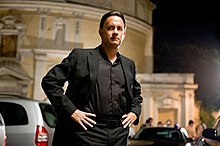
Robert Langdon
.
Professor
Robert Langdon |
|
| First appearance |
Angels & Demons (2000) |
| Last appearance |
Origin (2017) |
| Created by |
Dan Brown |
| Portrayed by |
|
| Voiced by |
Robert Clotworthy |
| Gender |
Male |
| Title |
Professor |
| Occupation |
Professor of Religious Iconology and Symbology at Harvard University |
| Family |
Unnamed father (deceased) |
| Relatives |
Howard Langdon (great-grandfather) |
Robert Langdon is a fictional character created by author Dan Brown for his Robert Langdon book series: Angels & Demons (2000), The Da Vinci Code (2003), The Lost Symbol (2009), Inferno (2013) and Origin (2017).[1] He is a Harvard University professor of Religious Iconology and "symbology" (a fictional field related to the study of historic symbols, which is not methodologically connected to the actual discipline of semiotics).
Tom Hanks portrays Langdon in the Robert Langdon film series, starting with the 2006 film adaptation of The Da Vinci Code, reprising the role in the 2009 film adaptation of Angels & Demons, and again in the 2016 film adaptation of Inferno,[2] while Ashley Zukerman plays a younger version of the character in the TV series, The Lost Symbol.
Character development
[edit]
Dan Brown created the character as a fictional alter ego of himself or "the man he wishes he could be". Brown himself was born June 22, 1964, in Exeter, New Hampshire, and the fictional Langdon is described as having been born on June 22, also in Exeter, and attending the same school as Brown did, Phillips Exeter Academy. Initially it is established that Langdon is a successful scholar who Brown named after John Langdon,[3] a professor of typography at Drexel University who is known for his creation of ambigrams. An example of Langdon's ambigrams appeared on the cover of the first edition of Brown's novel Angels & Demons, and other ambigrams featured throughout that novel were also designed by Langdon. On the acknowledgments page, Brown calls Langdon "one of the most ingenious and gifted artists alive … who rose brilliantly to my impossible challenge and created the ambigrams for this novel". John Langdon also created the logo for the fictitious Depository Bank of Zurich, which appears in The Da Vinci Code film.
In an interview, Brown said that Joseph Campbell was an inspiration for the character of Langdon:
His writings on semiotics, comparative religion and mythology in particular "The Power of Myth" and "The Hero With a Thousand Faces" helped inspire the framework on which I built my character, Robert Langdon... I remember admiring Campbell's matter-of-fact responses and wanting my own character Langdon to project that same respectful understanding when faced with complex spiritual issues.
— Dan Brown[4]
Robert Langdon, born in Exeter, New Hampshire, United States, is described as looking like "Harrison Ford in Harris tweed",[5] with his standard attire being a turtleneck, Harris Tweed jacket, khakis, and collegiate cordovan loafers, which he wears in all instances, from lectures to social events.[6] A frequently referred to accessory is his Mickey Mouse watch, a gift from his parents on his tenth birthday.[7] He drives an automatic Saab 900S.[8][9]
Langdon was a diver at Phillips Exeter Academy in prep school and played water polo at Princeton University where he went for college. He suffers from claustrophobia, as he fell into a well when he was 7 years old. His father died when he was 12, and his new mentor father-figure became Peter Solomon,[10] Secretary of the Smithsonian Institution.[11]
Known for a brilliant problem-solving mind and his genius, Langdon has an eidetic memory. As professor at Harvard University, he teaches religious iconology and the fictional field of symbology. As a hobby, it is specifically mentioned that Langdon is a great swimmer and swam laps (50) daily, a "morning ritual", at Harvard's athletic facilities (hence the lap swimming scene in Angels & Demons). Langdon also mentions he was raised a Catholic, but that he will never understand God; in Angels & Demons, he mentions to the Camerlengo that faith is a gift he has yet to receive.
In the books, the events of The Da Vinci Code follow those of Angels & Demons; this was reversed in the movies, where the latter's adaptation is written to be the sequel to the former.[12]
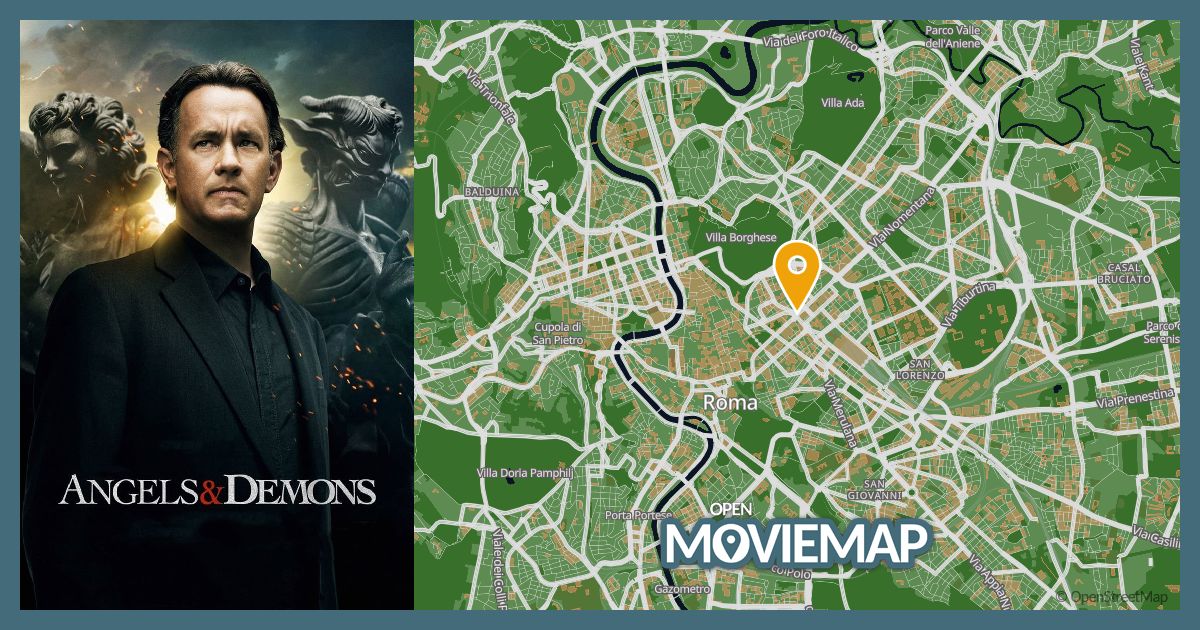
In Angels & Demons, Robert Langdon is called to CERN headquarters in Switzerland to find about the religious symbological implications of the death of CERN's finest and best-known physicist, Leonardo Vetra, a Catholic priest who has been branded with the Illuminati symbol. When he starts to investigate the murder, his obsession with history comes into play. Langdon is later joined in the investigation by Vittoria Vetra (Leonardo's adopted daughter) and they start their journey to the Vatican to unlock the mystery behind the Illuminati, an anti-Catholic secret society which, according to the plot, has deeply infiltrated many global institutions, political, economical and religious. Langdon and Vetra solve the mystery of the Illuminati by following the Path of Illumination[13] and in so doing explain the disappearances of four Cardinals during a papal conclave, the murder of Leonardo Vetra, and the theft of antimatter (a substance that can be used for mass destruction). At the end of the novel, Langdon ends up having a relationship with Vittoria Vetra. In the last few sentences of Angels & Demons, Vittoria Vetra asks him if he has ever had a divine experience. When he replies in the negative, Vittoria slips off her terrycloth robe, saying, "You've never been to bed with a yoga master, have you?" Their relationship, however, is only referred to in The Da Vinci Code, mentioning the fact that Langdon had last seen Vittoria a year previously.
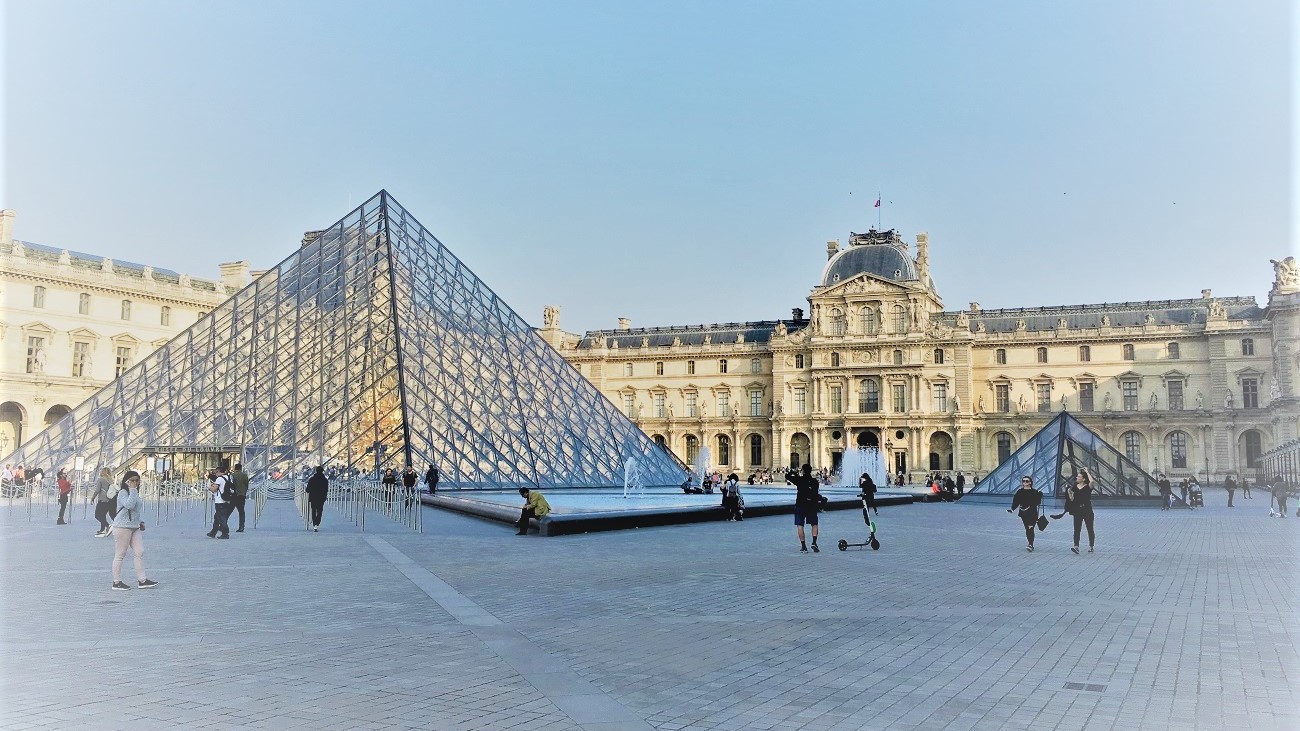
In the beginning of 2003's The Da Vinci Code, Robert Langdon is in Paris to give a lecture on his work. Having made an appointment to meet with Jacques Saunière, the curator of the Louvre, he is startled to find the French police at his hotel room door. They inform him that Saunière has been murdered and they would like his immediate assistance at the Louvre to help them solve the crime. Unknown to Langdon, he is in fact the prime suspect in the murder and has been summoned to the scene of the crime so that the police may extract a confession from him. While he is in the Louvre, he meets Sophie Neveu, a young cryptologist from the DCPJ. When Langdon and Sophie get the chance to talk in private, he finds out that Jacques Saunière is her grandfather. Saunière instructs Sophie to 'find Robert Langdon', according to the message he left for her in the floor. Hence, Sophie believes he is innocent of her grandfather's murder.
He spends the rest of the novel dodging the police and trying to solve the mystery of an ancient secret society, the Priory of Sion, which was once headed by Leonardo da Vinci. At the end of the novel, Langdon uncovers the mystery behind Mary Magdalene and the Holy Grail also called Sangreal, derived from either the Spanish "San Greal" (the Holy Grail), or the French "Sang real" (royal blood). Slightly before the moment he discovers the final resting place of the Holy Grail, he is seen in a romantic light by Sophie Neveu, and two agree to meet again in Florence, where Langdon will be for a lecture. The two share a kiss after which, in the epilogue, Langdon unearths the mystery of the Sangreal.
In The Lost Symbol, Robert Langdon has an adventure with the concepts of Freemasonry in Washington D.C. Tricked into visiting the nation's Capitol, Robert Langdon spends twelve hours racing through the monuments and buildings of the USA's forefathers, searching for the truth about the secret society of the Masons. Behind new doors lie secrets that promise to change the way people view science and politics, now threatened by Zachary Solomon, the renegade, estranged son of Robert Langdon's friend, Peter Solomon, who has himself been kidnapped by Zachary, now going by the name "Mal'akh". Robert Langdon is the last line of defense. With help from Katherine Solomon (Zachary's sister), Warren Bellamy (the Architect of the Capitol) and Inoue Sato (the director of the Office of Security).
In Inferno, Langdon wakes up in an Italian hospital with no memory of the events that led him to be in Italy. Soon he realizes that someone is trying to kill him. Langdon travels from Florence to Venice, and Istanbul with Doctor Sienna Brooks to prevent a biological attack by looking for a deadly virus that was planted by a client of a shadowy consulting group called The Consortium. In the course of this, Langdon must decipher clues employing allusions to the works of Sandro Botticelli, Giorgio Vasari and Dante Alighieri, the writer of Inferno, the first chapter of the epic poem The Divine Comedy, around which much of the plot revolves.
The fifth book in the series, Origin was released on October 3, 2017.[14] Robert Langdon arrives at the ultramodern Guggenheim Museum Bilbao to attend a major announcement—the unveiling of a discovery that "will change the face of science forever." The evening's host is Edmond Kirsch, a forty-year-old billionaire and futurist whose dazzling high-tech inventions and audacious predictions have made him a renowned global figure. Kirsch, who was one of Langdon's first students at Harvard two decades earlier, is about to reveal an astonishing breakthrough . . . one that will answer two of the fundamental questions of human existence.
As the event begins, Langdon and several hundred guests find themselves captivated by an utterly original presentation, which Langdon realizes will be far more controversial than he ever imagined. But the meticulously orchestrated evening suddenly erupts into chaos, and Kirsch's precious discovery teeters on the brink of being lost forever. Reeling and facing an imminent threat, Langdon is forced into a desperate bid to escape Bilbao. With him is Ambra Vidal, the elegant museum director who worked with Kirsch to stage the provocative event. Together they flee to Barcelona on a perilous quest to locate a cryptic password that will unlock Kirsch's secret.
Navigating the corridors of hidden history and extreme religion, Langdon and Vidal must evade an enemy whose power seems to emanate from Spain's Royal Palace itself, and who will stop at nothing to silence Edmond Kirsch. On a trail marked by modern art and enigmatic symbols, Langdon and Vidal uncover clues that ultimately bring them face-to-face with Kirsch's shocking discovery.[14]
Between The Da Vinci Code, The Lost Symbol, and Inferno, Langdon is said to have written seven books:
- The Symbology of Secret Sects
- The Art of the Illuminati: Part 1
- The Lost Language of Ideograms
- Religious Iconology
- Symbols of the Lost Sacred Feminine
- Christian Symbols in the Muslim World
- Christianity and the Sacred Feminine
At that same point in the trilogy, Langdon is preparing the manuscript for his fifth book, to be titled Symbols of the Lost Sacred Feminine. It is later revealed in The Lost Symbol that Symbols of the Lost Sacred Feminine was published and created 'quite a scandal'. The book Christianity and the Sacred Feminine, mentioned in Origin had reportedly been denounced by the Vatican, "which, in the aftermath, promptly became a bestseller," as quoted by the AI assistant Winston.
|
|
|
 Primer
Anterior
2 a 14 de 14
Siguiente
Primer
Anterior
2 a 14 de 14
Siguiente
 Último
|
|
|
Different cyclotron size: a) Lawrence ́s first one, b) Venezuela First one (courtesy of Dorly Coehlo), c) Fermi National Laboratory at CERN. And size matters, and Cyclotrons win as best hospital candidates due to Reactors are bigger, harder and difficult to be set in a hospital installation. Can you imagine a nuclear reactor inside a health installation? Radiation Protection Program will consume all the budget available. Size, controlled reactions, electrical control, made cyclotrons easy to install, and baby cyclotrons come selfshielded so hospital don ́t need to spend money in a extremely large bunker. Now on, we are going to talk about our first experience with the set up of a baby cyclotron for medical uses inside the first PET installation in Latin America. “Baby” means its acceleration “D” diameters are suitable to be set inside a standard hospital room dimensions, with all its needs to be safetly shielded for production transmision and synthetized for human uses for imaging in Nuclear Medicine PET routine. When we ask why Cyclotrons are better than reactors for radioisotopes production to be used in Medicine, we also have to have in mind that they has: 1. Less radioactive waste 2. Less harmful debris
https://www.researchgate.net/figure/Different-cyclotron-size-a-Lawrence-s-first-one-b-Venezuela-First-one-courtesy-of_fig3_221906035
 |
|
|
|
|
Hagia Sophia
From Wikipedia, the free encyclopedia
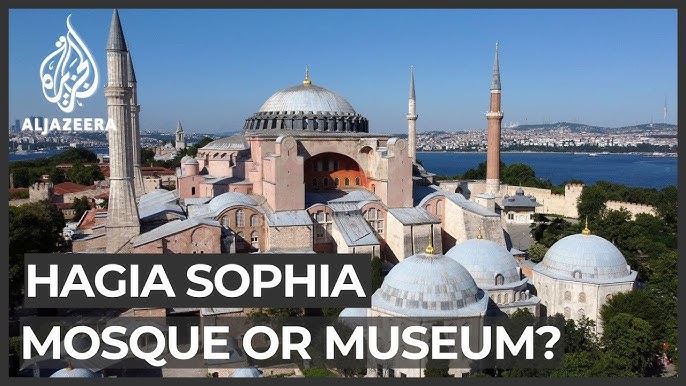
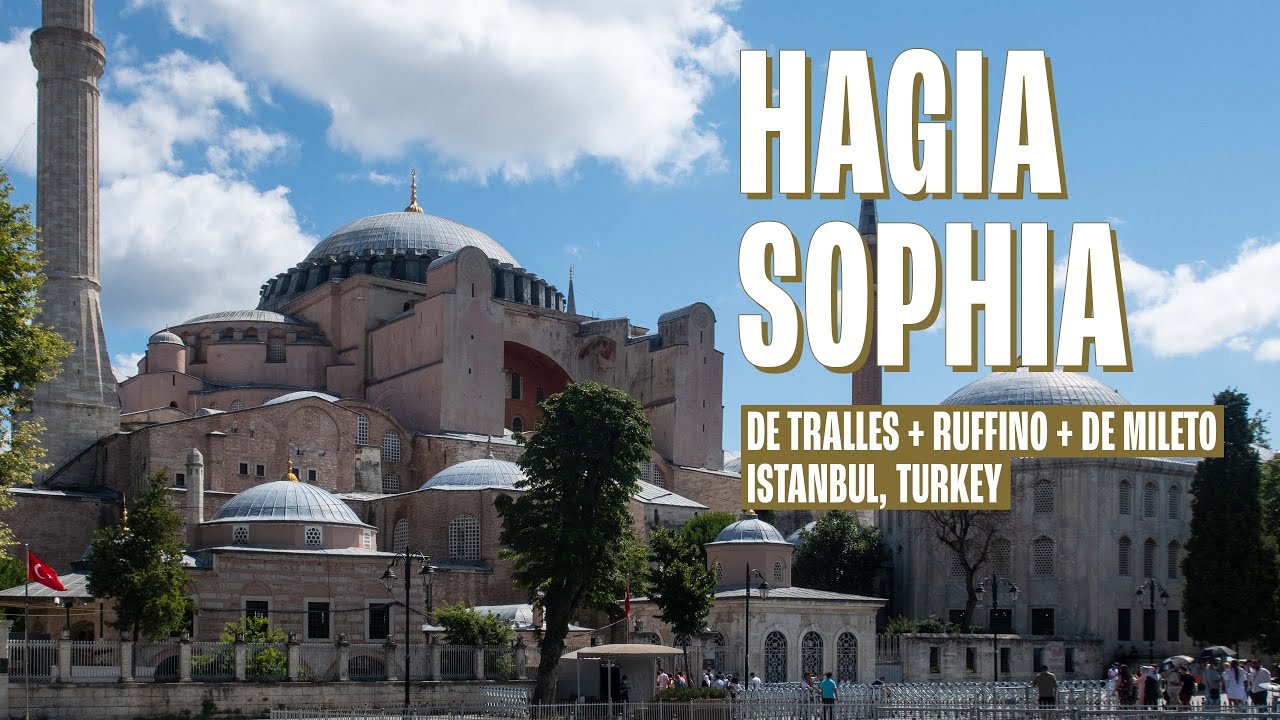
Hagia Sophia (Turkish: Ayasofya; Ancient Greek: Ἁγία Σοφία, romanized: Hagía Sophía; Latin: Sancta Sapientia; lit. 'Holy Wisdom'), officially the Hagia Sophia Grand Mosque (Turkish: Ayasofya-i Kebir Cami-i Şerifi; Greek: Μεγάλο Τζαμί της Αγίας Σοφίας),[3] is a mosque and former church serving as a major cultural and historical site in Istanbul, Turkey. The last of three church buildings to be successively erected on the site by the Eastern Roman Empire, it was completed in AD 537. The site was an Eastern rite church from AD 360 to 1453, except for a brief time as a Latin Catholic church between the Fourth Crusade and 1261.[4] After the fall of Constantinople in 1453, it served as a mosque until 1935, when it became a museum. In 2020, the site once again became a mosque.
The current structure was built by the Byzantine emperor Justinian I as the Christian cathedral of Constantinople for the Byzantine Empire between 532 and 537, and was designed by the Greek geometers Isidore of Miletus and Anthemius of Tralles.[5] It was formally called the Church of God's Holy Wisdom (Greek: Ναὸς τῆς Ἁγίας τοῦ Θεοῦ Σοφίας, romanized: Naòs tês Hagías toû Theoû Sophías)[6][7] and upon completion became the world's largest interior space and among the first to employ a fully pendentive dome. It is considered the epitome of Byzantine architecture[8] and is said to have "changed the history of architecture".[9] The present Justinianic building was the third church of the same name to occupy the site, as the prior one had been destroyed in the Nika riots. As the episcopal see of the ecumenical patriarch of Constantinople, it remained the world's largest cathedral for nearly a thousand years, until the Seville Cathedral was completed in 1520. Beginning with subsequent Byzantine architecture, Hagia Sophia became the paradigmatic Orthodox church form, and its architectural style was emulated by Ottoman mosques a thousand years later.[10] It has been described as "holding a unique position in the Christian world"[10] and as an architectural and cultural icon of Byzantine and Eastern Orthodox civilization.[10][11][12]
The religious and spiritual centre of the Eastern Orthodox Church for nearly one thousand years, the church was dedicated to the Holy Wisdom.[13][14][15] It was where the excommunication of Patriarch Michael I Cerularius was officially delivered by Humbert of Silva Candida, the envoy of Pope Leo IX in 1054, an act considered the start of the East–West Schism. In 1204, it was converted during the Fourth Crusade into a Catholic cathedral under the Latin Empire, before being returned to the Eastern Orthodox Church upon the restoration of the Byzantine Empire in 1261. Enrico Dandolo, the doge of Venice who led the Fourth Crusade and the 1204 Sack of Constantinople, was buried in the church.
After the fall of Constantinople to the Ottoman Empire in 1453,[16] it was converted to a mosque by Mehmed the Conqueror and became the principal mosque of Istanbul until the 1616 construction of the Sultan Ahmed Mosque.[17][18] Upon its conversion, the bells, altar, iconostasis, ambo, and baptistery were removed, while iconography, such as the mosaic depictions of Jesus, Mary, Christian saints and angels were removed or plastered over.[19] Islamic architectural additions included four minarets, a minbar and a mihrab. The Byzantine architecture of the Hagia Sophia served as inspiration for many other religious buildings including the Hagia Sophia in Thessaloniki, Panagia Ekatontapiliani, the Şehzade Mosque, the Süleymaniye Mosque, the Rüstem Pasha Mosque and the Kılıç Ali Pasha Complex. The patriarchate moved to the Church of the Holy Apostles, which became the city's cathedral.
The complex remained a mosque until 1931, when it was closed to the public for four years. It was re-opened in 1935 as a museum under the secular Republic of Turkey, and the building was Turkey's most visited tourist attraction as of 2019.[20]
In July 2020, the Council of State annulled the 1934 decision to establish the museum, and the Hagia Sophia was reclassified as a mosque. The 1934 decree was ruled to be unlawful under both Ottoman and Turkish law as Hagia Sophia's waqf, endowed by Sultan Mehmed, had designated the site a mosque; proponents of the decision argued the Hagia Sophia was the personal property of the sultan. The decision to designate Hagia Sophia as a mosque was highly controversial. It resulted in divided opinions and drew condemnation from the Turkish opposition, UNESCO, the World Council of Churches and the International Association of Byzantine Studies, as well as numerous international leaders, while several Muslim leaders in Turkey and other countries welcomed its conversion into a mosque.
Church of Constantius II
[edit]
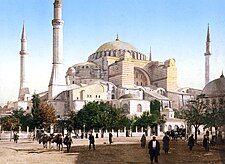 Hagia Sophia, Istanbul, Turkey, ca. 1897.
The first church on the site was known as the Magna Ecclesia (Μεγάλη Ἐκκλησία, Megálē Ekklēsíā, 'Great Church')[21][22] because of its size compared to the sizes of the contemporary churches in the city.[13] According to the Chronicon Paschale, the church was consecrated on 15 February 360, during the reign of the emperor Constantius II (r. 337–361) by the Arian bishop Eudoxius of Antioch.[23][24] It was built next to the area where the Great Palace was being developed. According to the 5th-century ecclesiastical historian Socrates of Constantinople, the emperor Constantius had c. 346 "constructed the Great Church alongside that called Irene which because it was too small, the emperor's father [Constantine] had enlarged and beautified".[25][23] A tradition which is not older than the 7th or 8th century reports that the edifice was built by Constantius' father, Constantine the Great (r. 306–337).[23] Hesychius of Miletus wrote that Constantine built Hagia Sophia with a wooden roof and removed 427 (mostly pagan) statues from the site.[26] The 12th-century chronicler Joannes Zonaras reconciles the two opinions, writing that Constantius had repaired the edifice consecrated by Eusebius of Nicomedia, after it had collapsed.[23] Since Eusebius was the bishop of Constantinople from 339 to 341, and Constantine died in 337, it seems that the first church was erected by Constantius.[23]
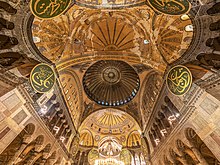 View of the dome interior
  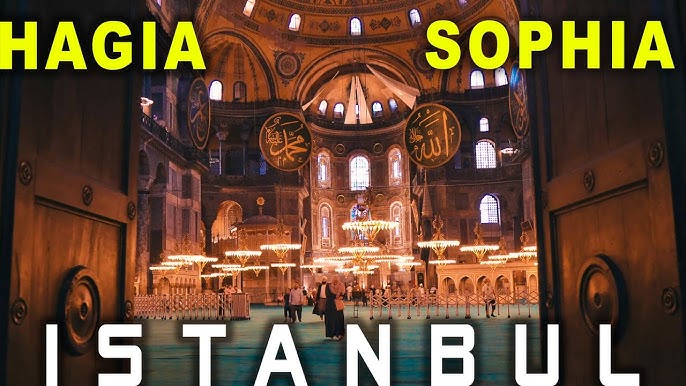 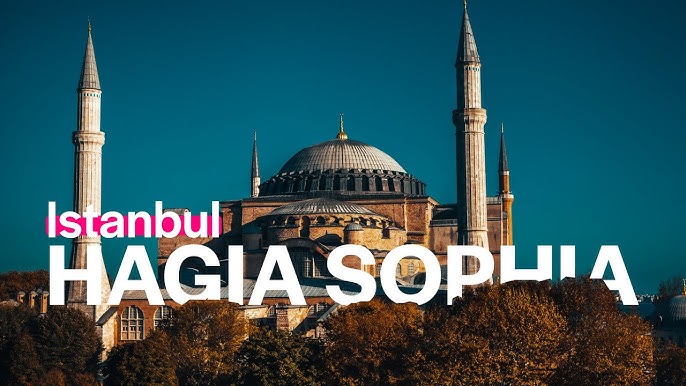 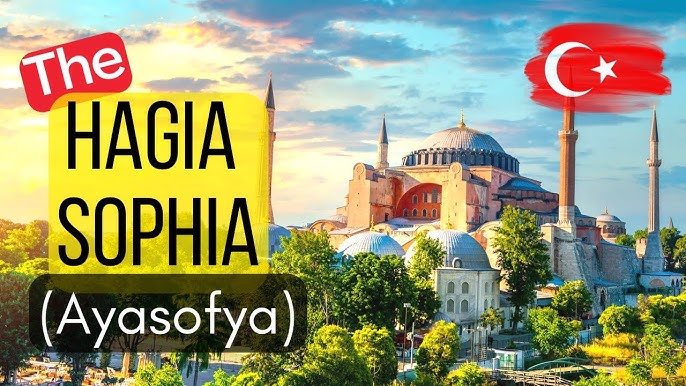 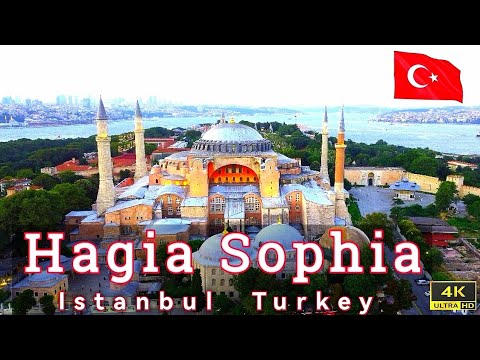   |
|
|
|
|
I love the adventure stories with twisted plots, mysteries, puzzles. That is why I love the stories created by Dan Brown and his major character Professor Robert Langdon who was very well played by Tom Hanks in the series of successful movies. Moreover, in my travel adventures I managed to visit most of the countries, places, museums, etc, and even CERN, which are described in the books and movies. And when I watch the movies I travel back in time together with Professor Langdon.
So, today I invite you to solve great mysteries of Leonardo, Illuminati, and Dante. It’s time to refresh your knowledge of history and arts. Welcome aboard!
Jacques Saunière, a Louvre curator, is pursued through the Grand Gallery by an albino Catholic monk named Silas, who demands the location of the Priory’s “keystone” to find and destroy the Holy Grail. Saunière gives him a false lead and is murdered. The police find his body posed like Da Vinci’s Vitruvian Man. Police captain Bezu Fache has his lieutenant, Jérôme Collet, summon American symbologist Robert Langdon, who is in Paris for a lecture on the interpretation of symbols, to examine Saunière’s body.
Langdon is shown the body and a secret message, readable only by blacklight. It contains an out-of-order Fibonacci sequence. Sophie Neveu, a police cryptographer and Saunière’s granddaughter, tells Langdon that Fache planted a tracker on him after finding the words, “P.S. Find Robert Langdon” at the end of Saunière’s secret message. Fache believes that Langdon murdered Saunière. Sophie throws away the tracker, distracting the police while they sneak around the Louvre, finding more clues in Leonardo da Vinci’s works. Langdon deduces that Saunière was the grand master of the Priory of Sion. And our adventure begins.
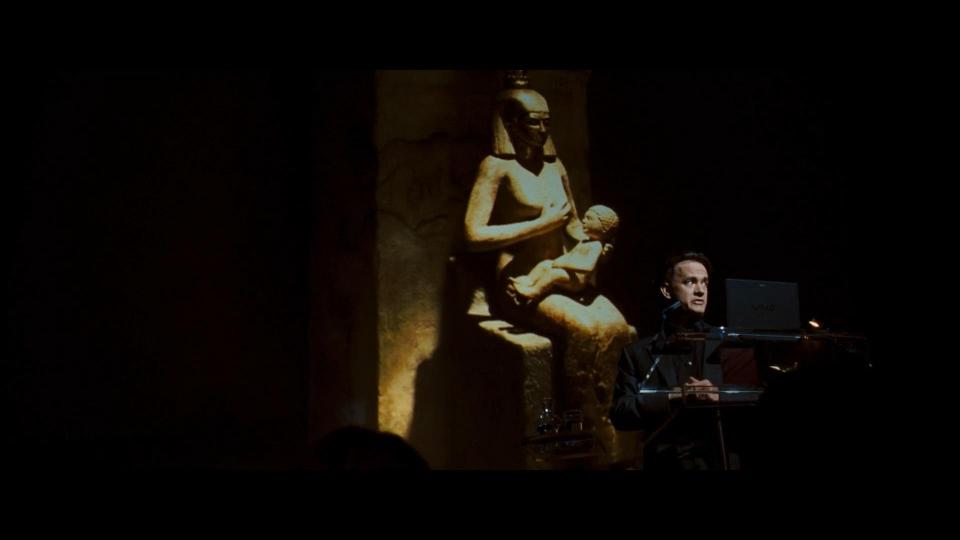
We meet Professor Robert Langdon for the first time during his lecture. He uses Sony laptop for his presentation.
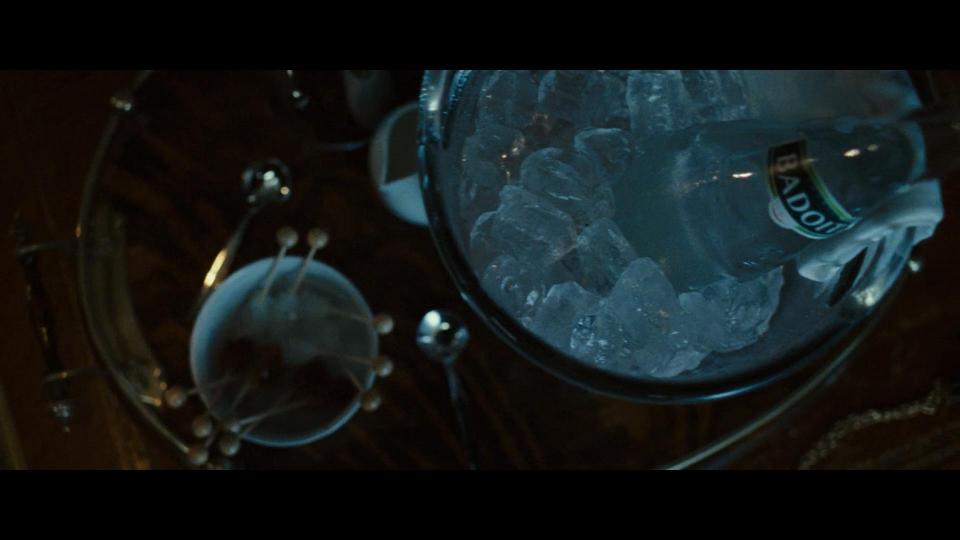
In one of the next scenes of the movie we can clearly see the van with Bosch logo. Same is for the famous French water – Badoit. We can see it in a bucket full of ice.
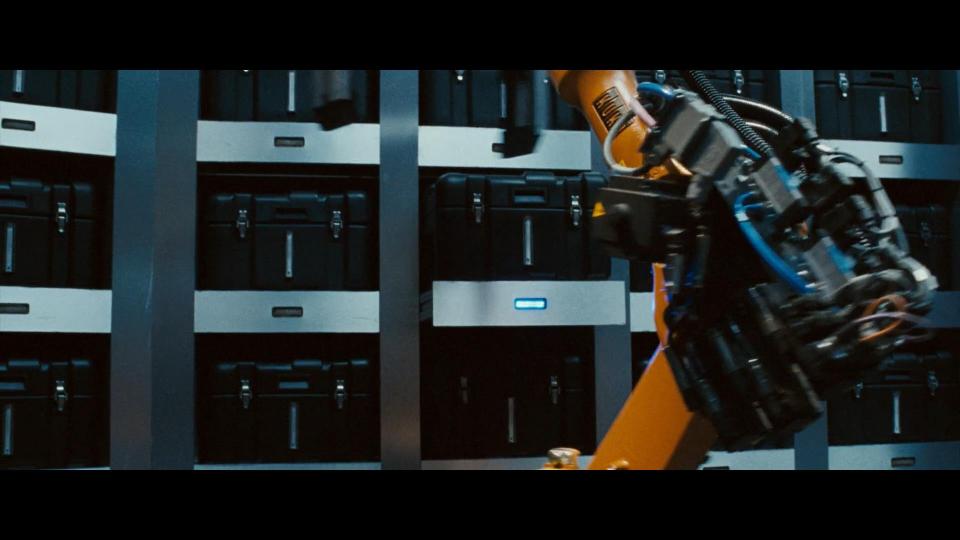
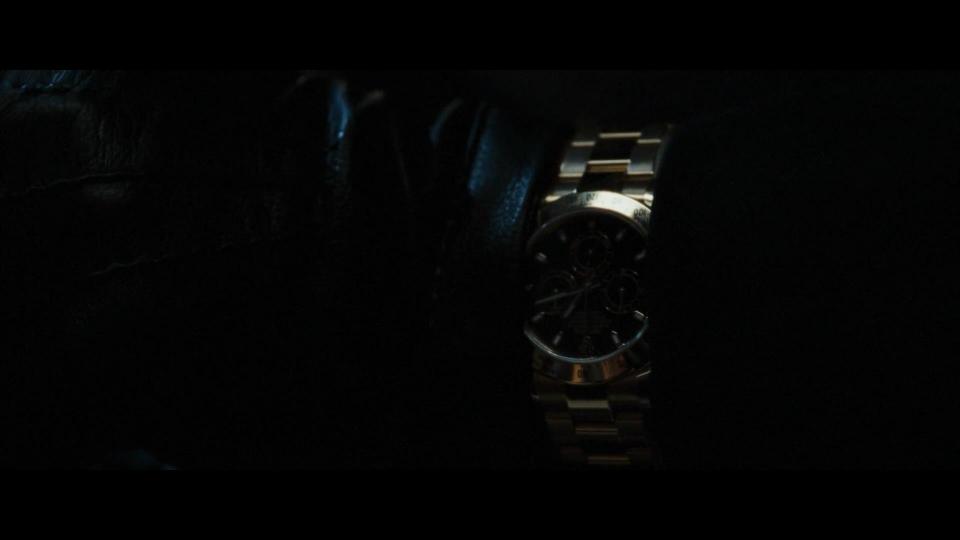
When Robert Langdon and Sophie Neveu (Audrey Tautou) come to the bank to retrieve the cryptex, we can see how KUKA robot picks the right box that belonged to Jacques Saunière. When the bank employee helps the main characters to pass the police, we can get a glimpse of his Rolex watch.
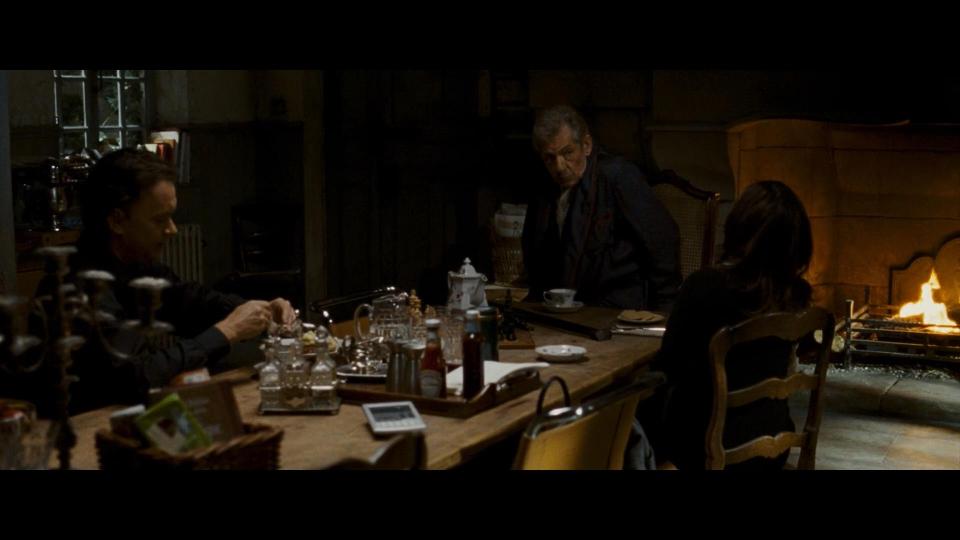
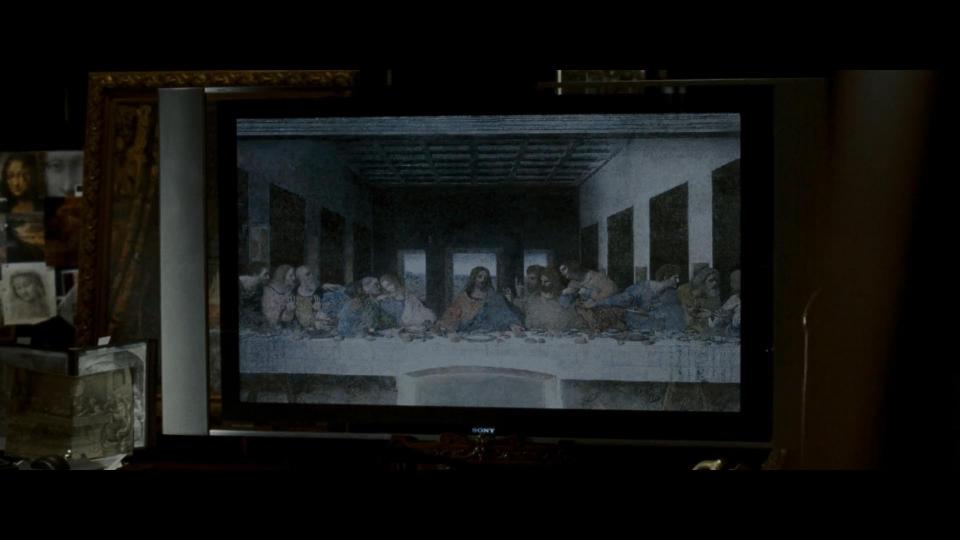
At Sir Leigh Teabing’s (Ian McKellen) house our guests learn more about The Last Supper painting secrets. Their host is also a fan of Sony, so we may see various TV sets and displays in the house. While enjoying their evening tea, we can as well see Heinz there, of course.
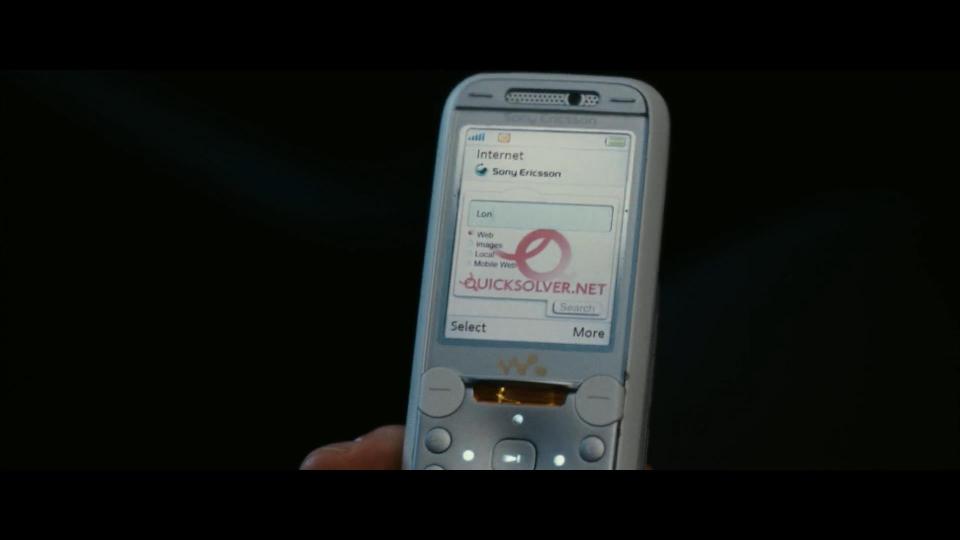
When Robert Langdon and Sophie look for a tomb in London, they borrow a Sony Ericsson smartphone to search for more information.
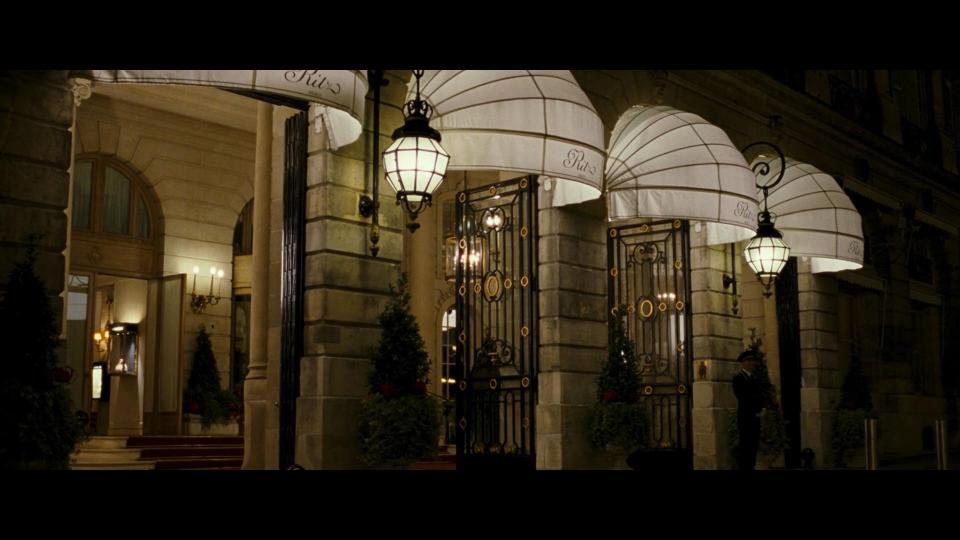
In the final scene of the movie we see that Robert lives in Ritz hotel in Paris, and from there he starts his evening walk to follow the Arago medallions and come to the Louvre.
The Catholic Church mourns the sudden death of Pope Pius XVI, and prepares for the papal conclave to elect his successor in Vatican City. Father Patrick McKenna (Ewan McGregor), the camerlengo, takes temporary control of the Vatican during the sede vacante period.
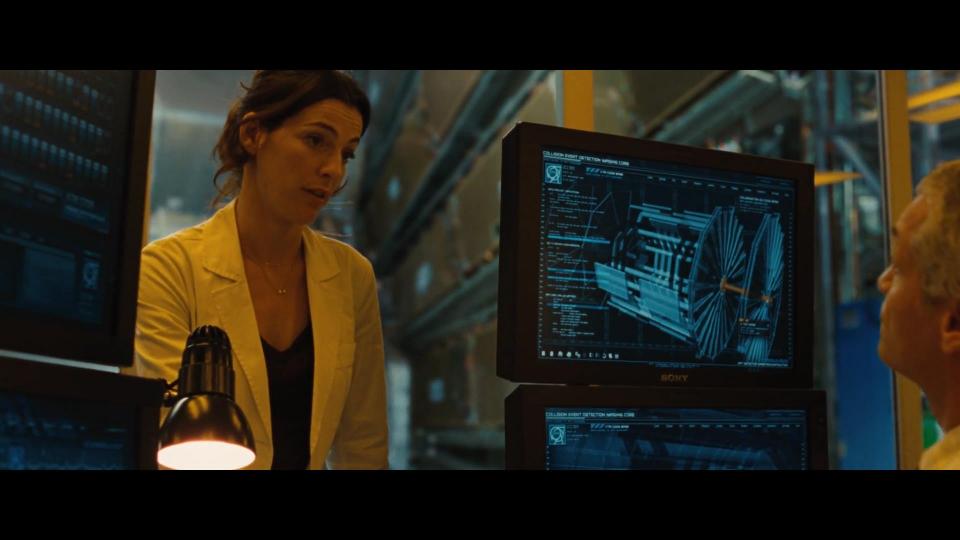
Meanwhile, at CERN, scientists Father Silvano Bentivoglio and Dr. Vittoria Vetra (Ayelet Zurer) create three canisters of antimatter. As Vetra goes to evaluate the experiment, she discovers that Silvano has been murdered, and one of the canisters was stolen. Shortly thereafter, four of the preferiti, the favored candidates to be elected pope, are kidnapped by a man claiming to represent the Illuminati. He sends the Vatican a warning, claiming he will murder each of the cardinals from 8 p.m. to midnight, when the stolen antimatter will explode and destroy the city, hidden somewhere within.
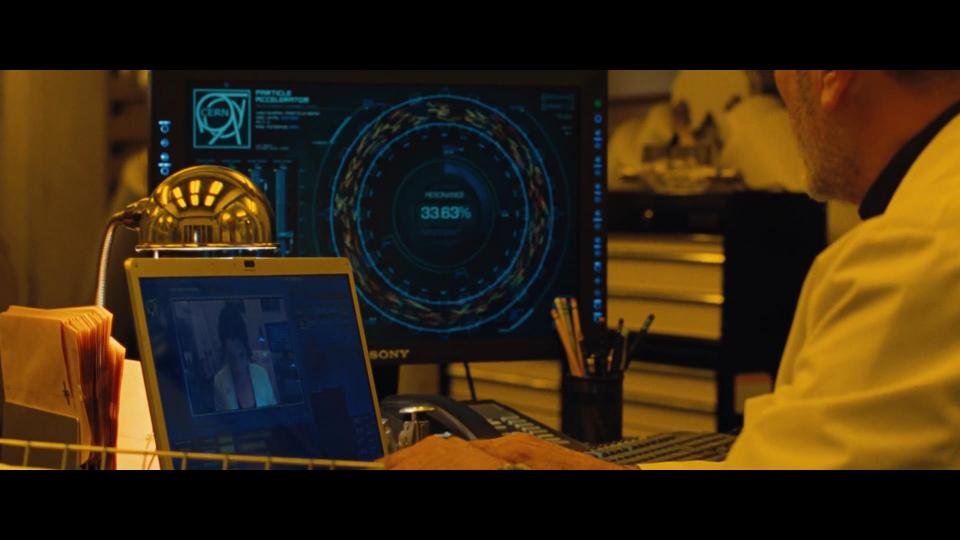
Unlike two other movies, there are only few product placements in Angels & Demons. And they can be divided in two categories – Sony and TV channels.
That is why we see Sony computers and displays in the first scene in CERN.
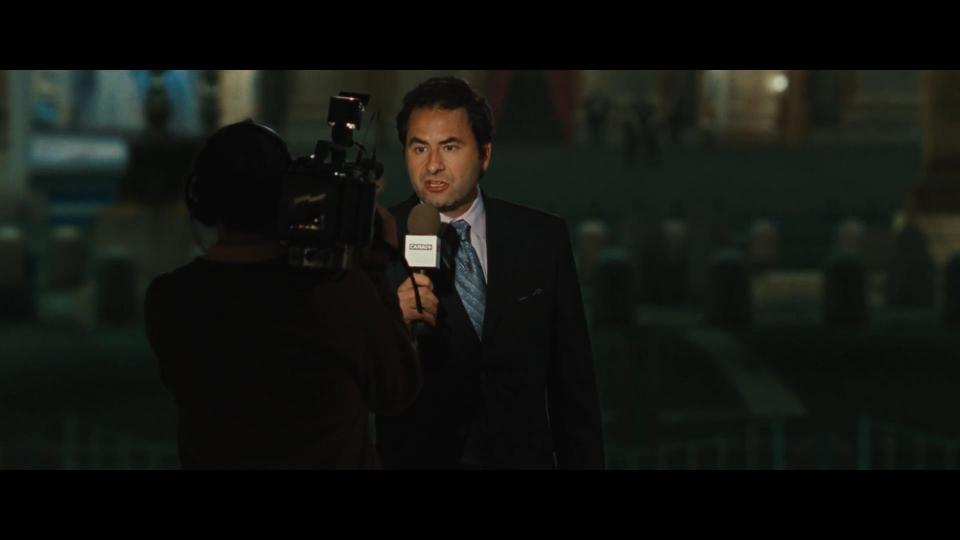
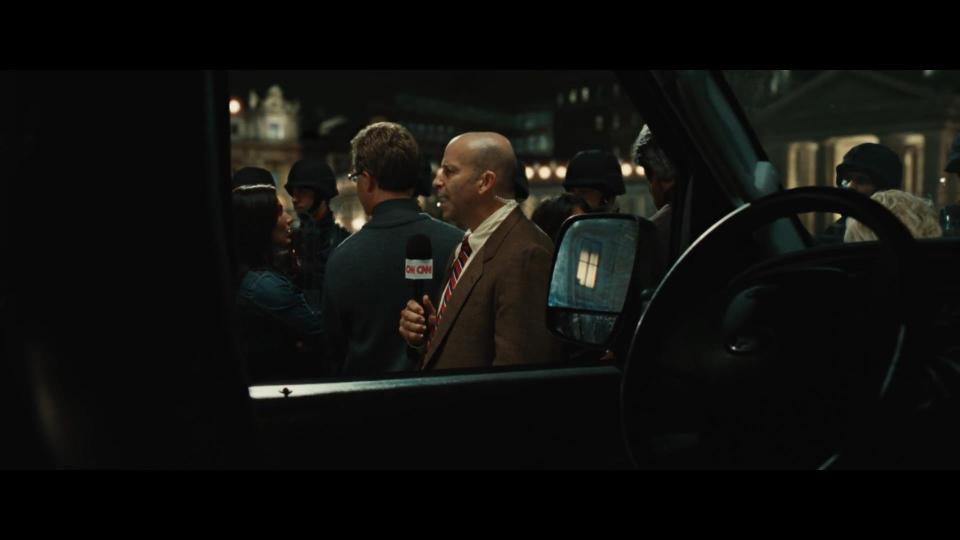
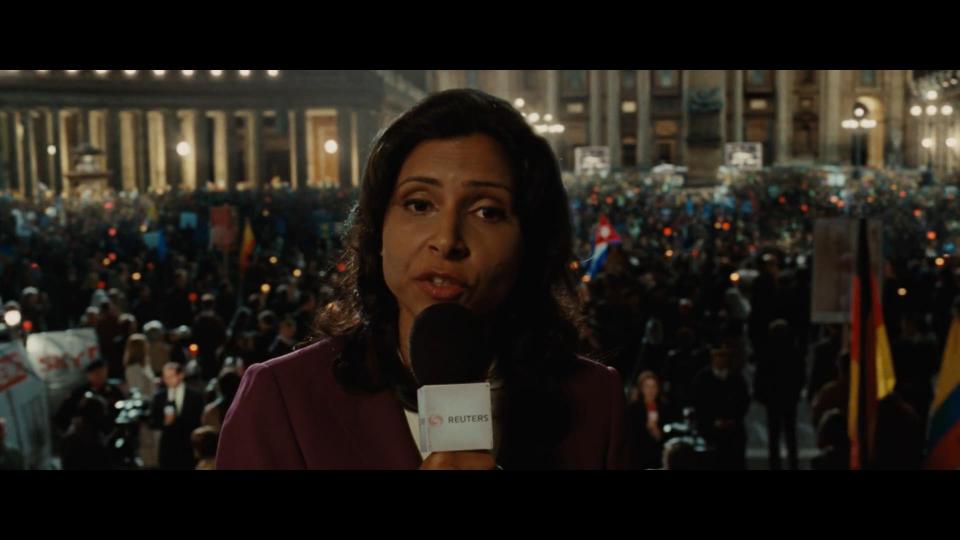
And when the events of the movie accelerate, we can see various TV channels broadcasting from Vatican City. These are Canal+, CNN, and Reuters.
And this is it for Angels & Demons. More product placements are waiting in Inferno.
Some time after helping the Vatican dealing with an antimatter threat, Harvard University professor Robert Langdon awakens in a hospital room in Florence, Italy, with no memory of what has transpired over the last few days, but being plagued with hellish visions. Dr. Sienna Brooks (Felicity Jones), the doctor tending to him, reveals that he is suffering from amnesia as a result of a bullet wound to the head. An orderly says the police are there to question Langdon but the officer turns out to be Vayentha, an assassin, who shoots the orderly while coming up the hallway. Brooks helps Langdon to escape, and they flee to her apartment.
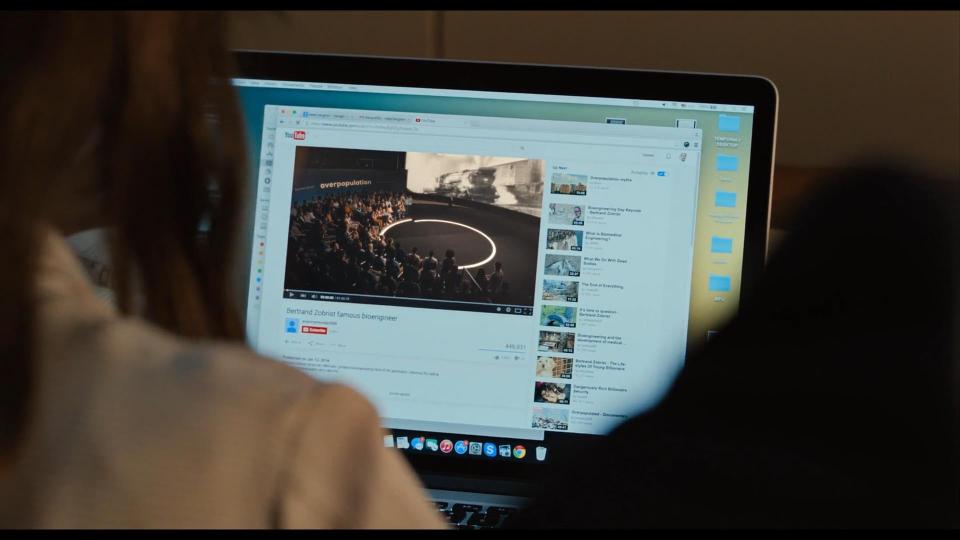
Among Langdon’s personal belongings, Langdon and Brooks find a Faraday pointer, a miniature image projector with a modified version of Sandro Botticelli’s Map of Hell, which itself is based on Dante’s Inferno. They soon realize this is the first clue in a trail left by Bertrand Zobrist, a dangerously unstable villain who believed that rigorous measures were necessary to reduce the Earth’s growing population, and who committed suicide three days earlier after being chased by armed government agents.
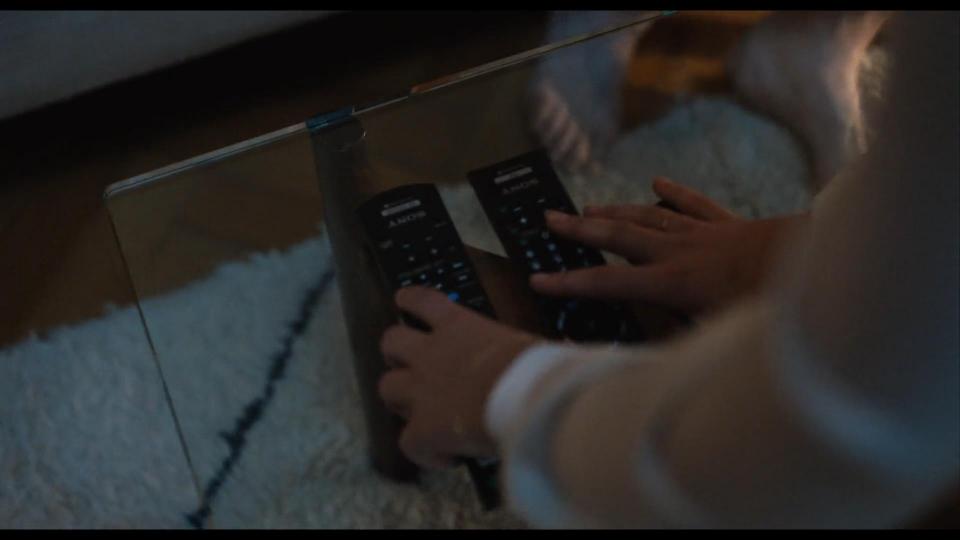
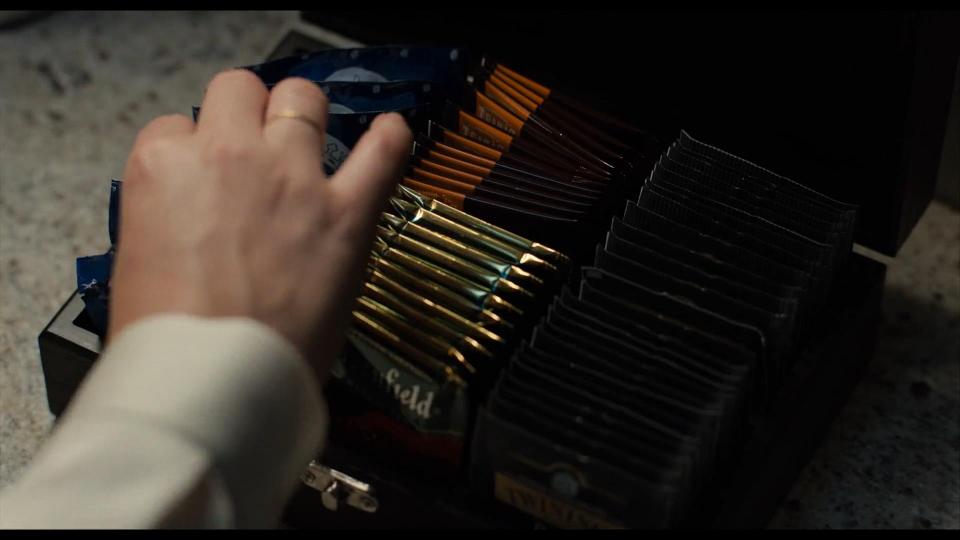
When Robert Langdon wakes up in Sienna’s house, we can find various brands across her apartment. First of all we see Sony TV remote controls. And when Professor asks for coffee, Sienna goes to the kitchen where we spot tea brands like Greenfield and Twinings.
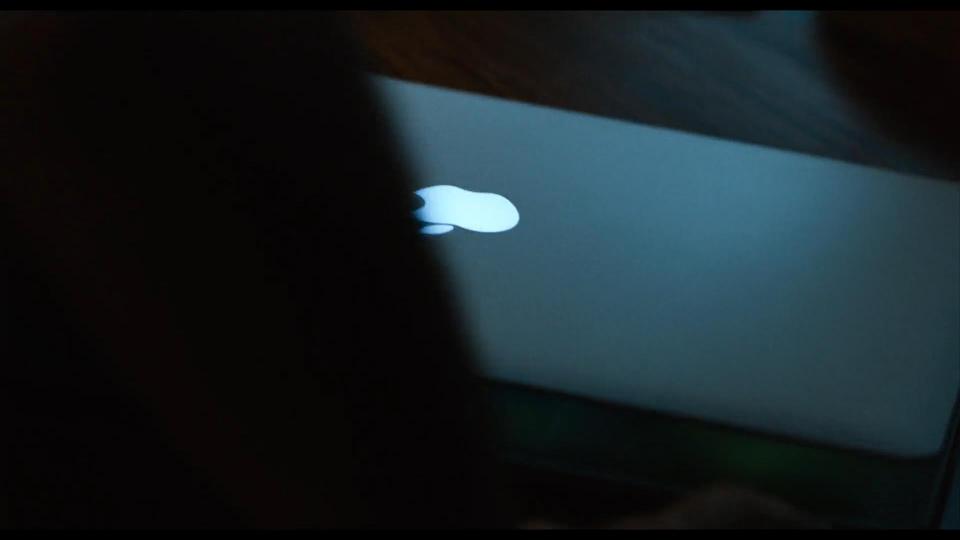
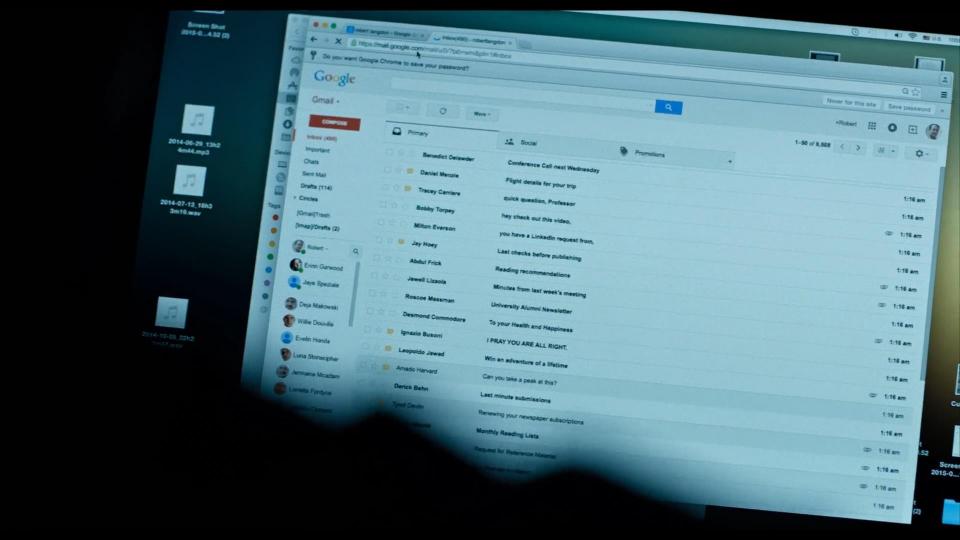
While Sienna is looking for some clothes for Robert, he decides to use her Apple MacBook to check his Google mail.
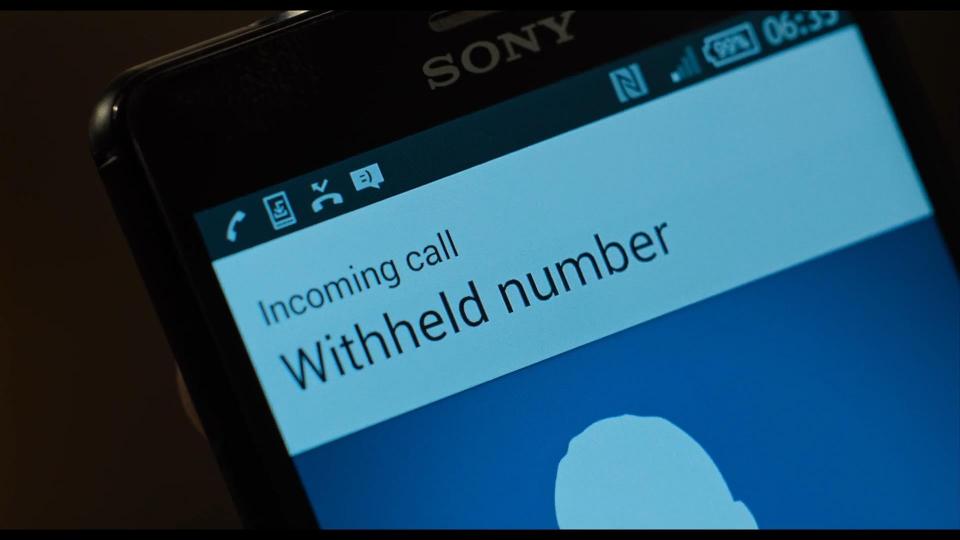
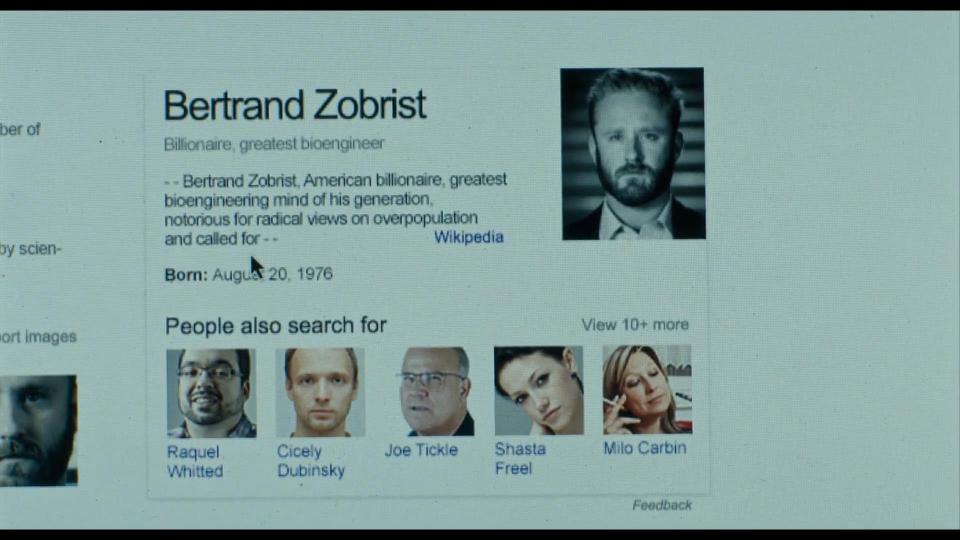
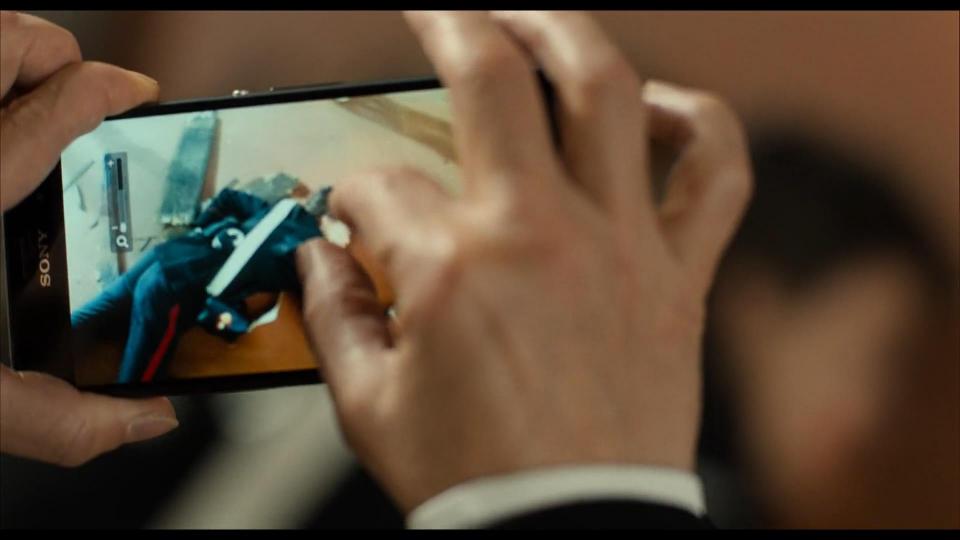
When Robert and Sienna decide to call to the consulate, we see that Sienna uses Sony smartphone. When they realize that they can trust no one, they start their investigation. First, they search for the information about Zobrist. Google, Wikipedia, and YouTube are very helpful even in the movies.
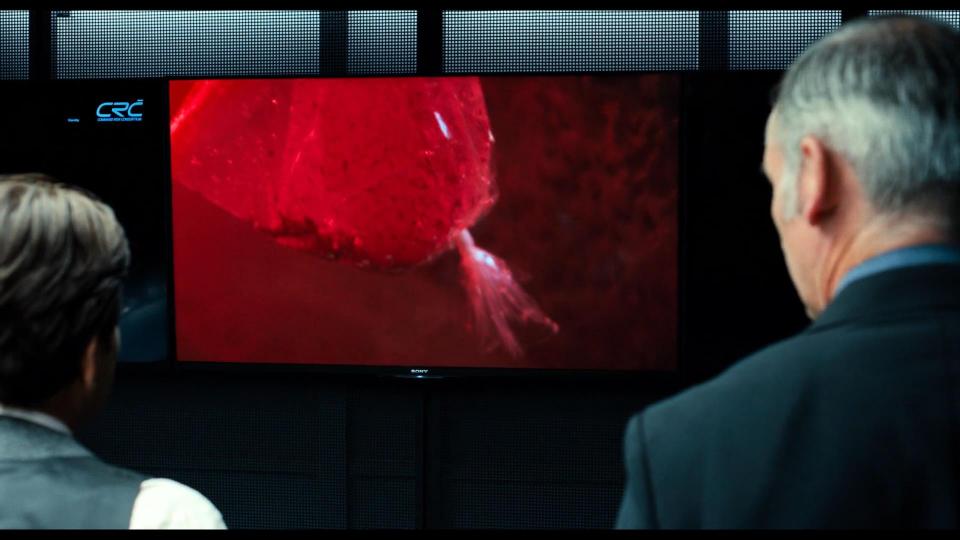
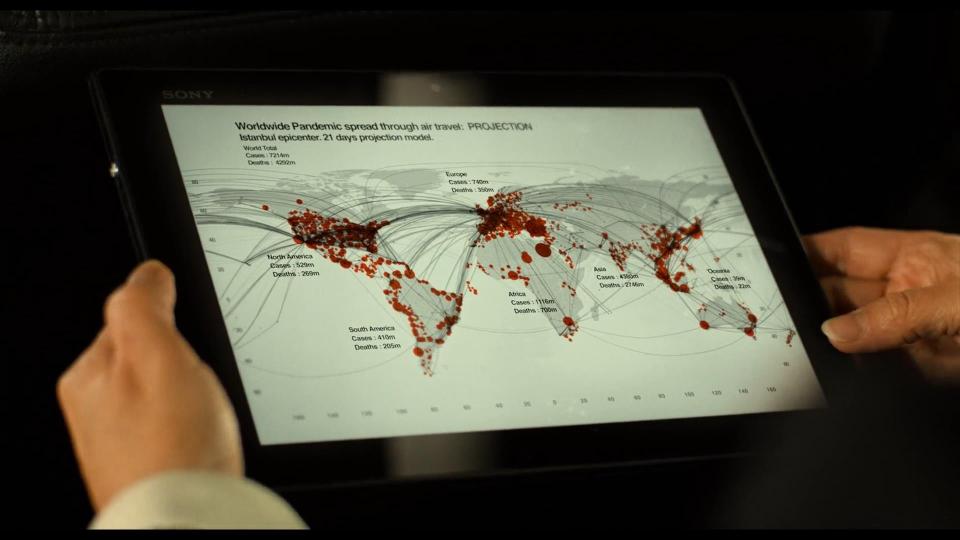
Later in the movie we see more Sony product placements – a TV set in Command Risk Consortium, a smartphone and a tablet used by Elizabeth Sinskey.
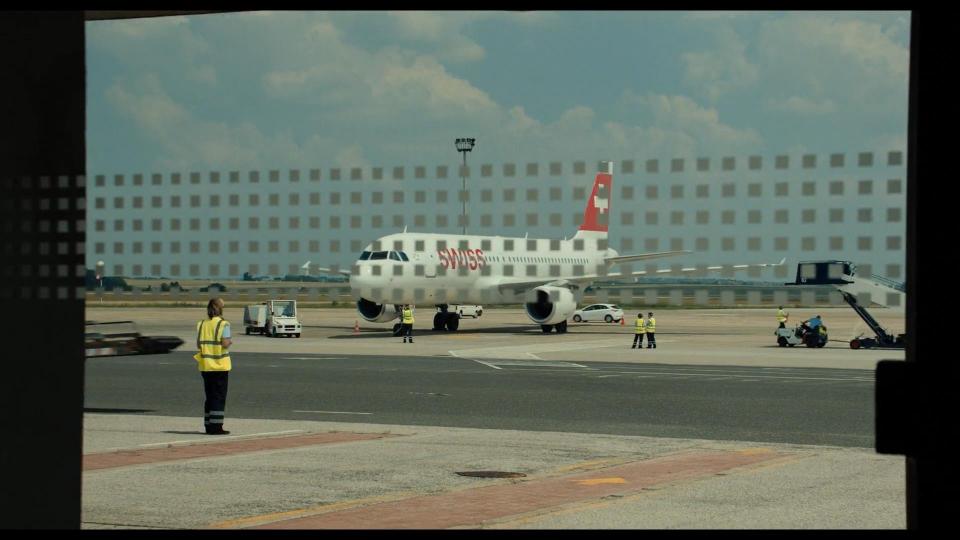
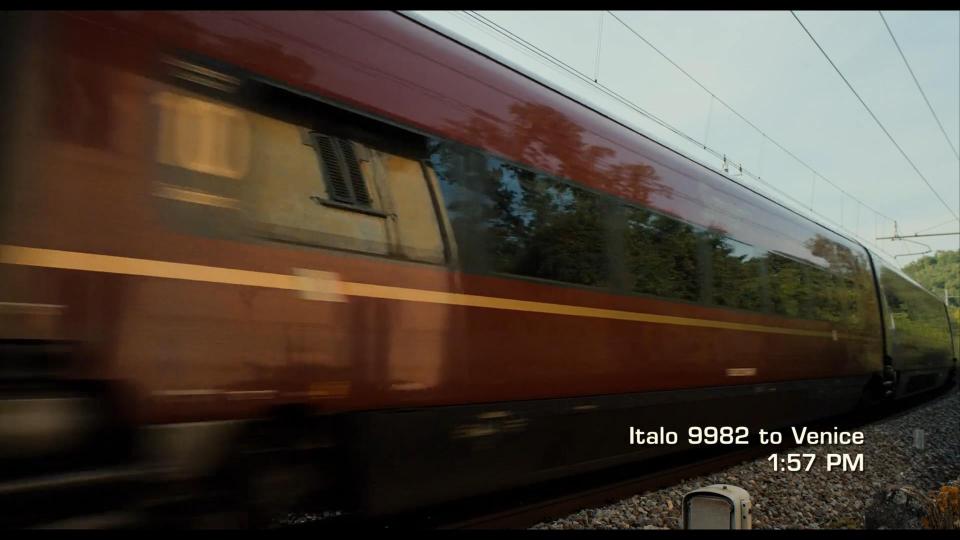
When Robert Langdon and Sienna Brooks try to escape from their enemies with the help of Christoph Bouchard, they make everyone believe they are going to fly to Switzerland via Swiss, but instead they take an Italo speed train to Venice.
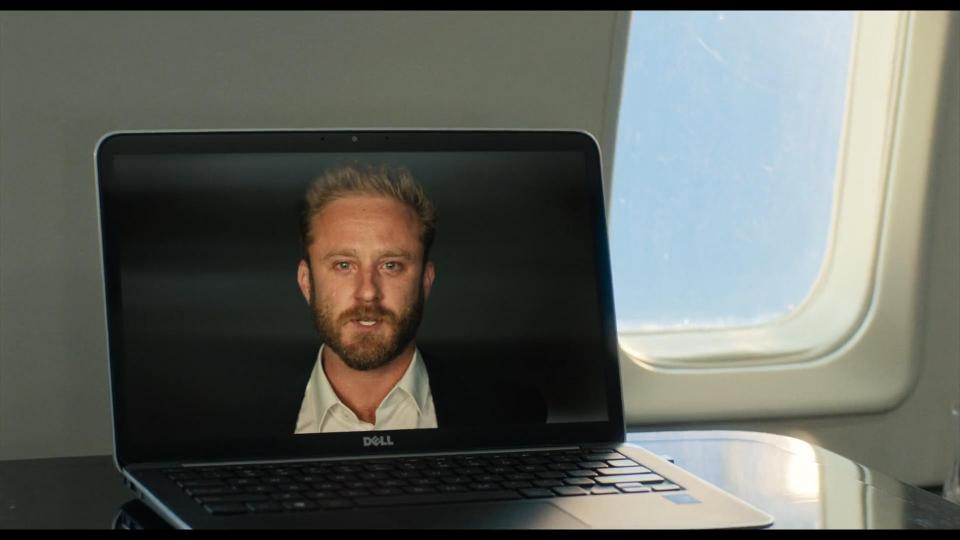
When finally the truth is revealed and memory is restored, Robert and Elizabeth go to Istanbul to stop Sienna from unleashing the virus. Elizabeth shares Zobrist’s message with Robert. They watch it together on a Dell laptop.
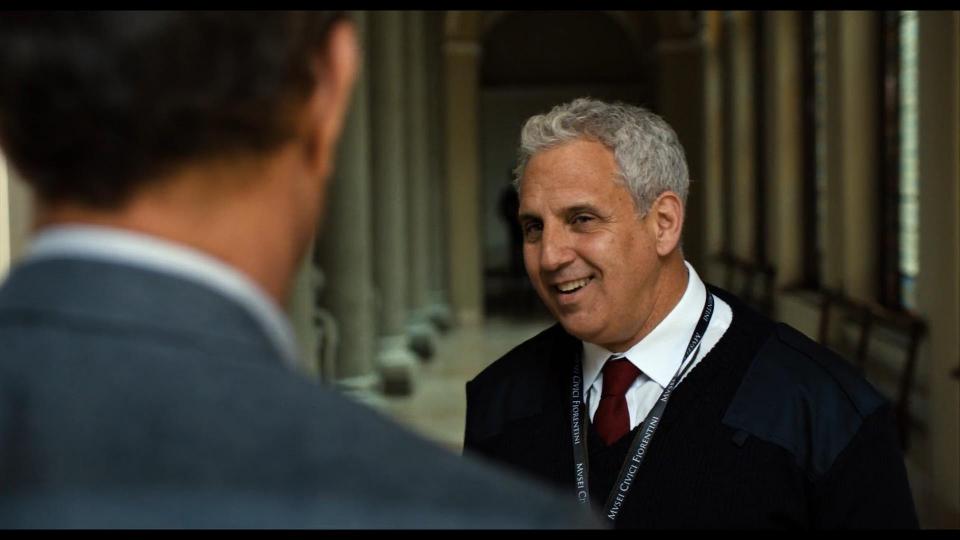
In the final scene when Professor returns Dante’s mask to the museum, we can see the museum employee wearing the tag with the Florentine Civic Museums branding.
Unfortunately, there is no news about the future movies with Tom Hanks. And no news about any new books. Looking forward to new adventures of Professor Langdon.
I highly recommend you to visit Product Placement section of the website. You will find more amazing movie series analysed there.
https://www.marketing-psycho.com/robert-langdon-product-placement/ |
|
|
|
|
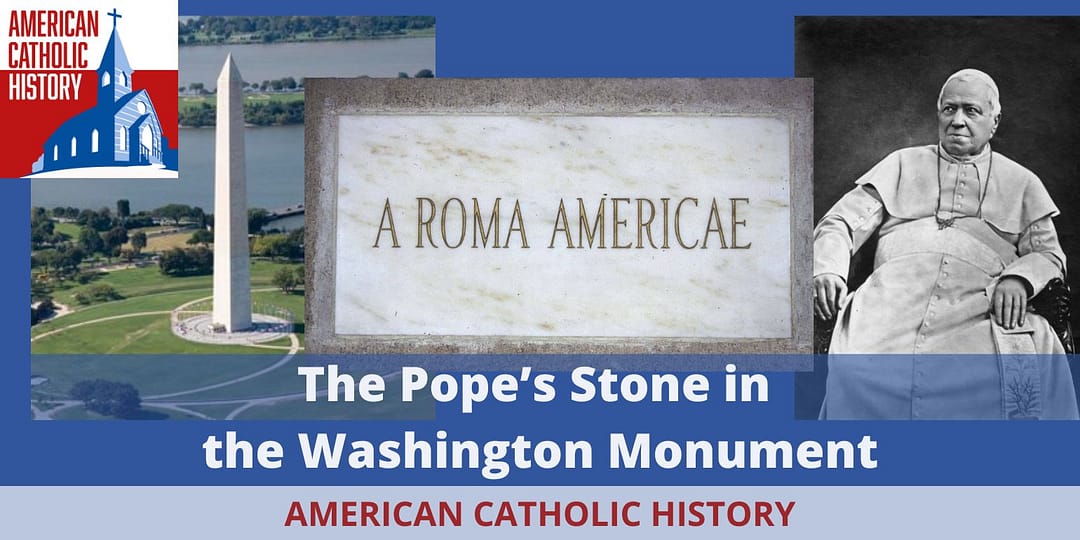
Episode 134
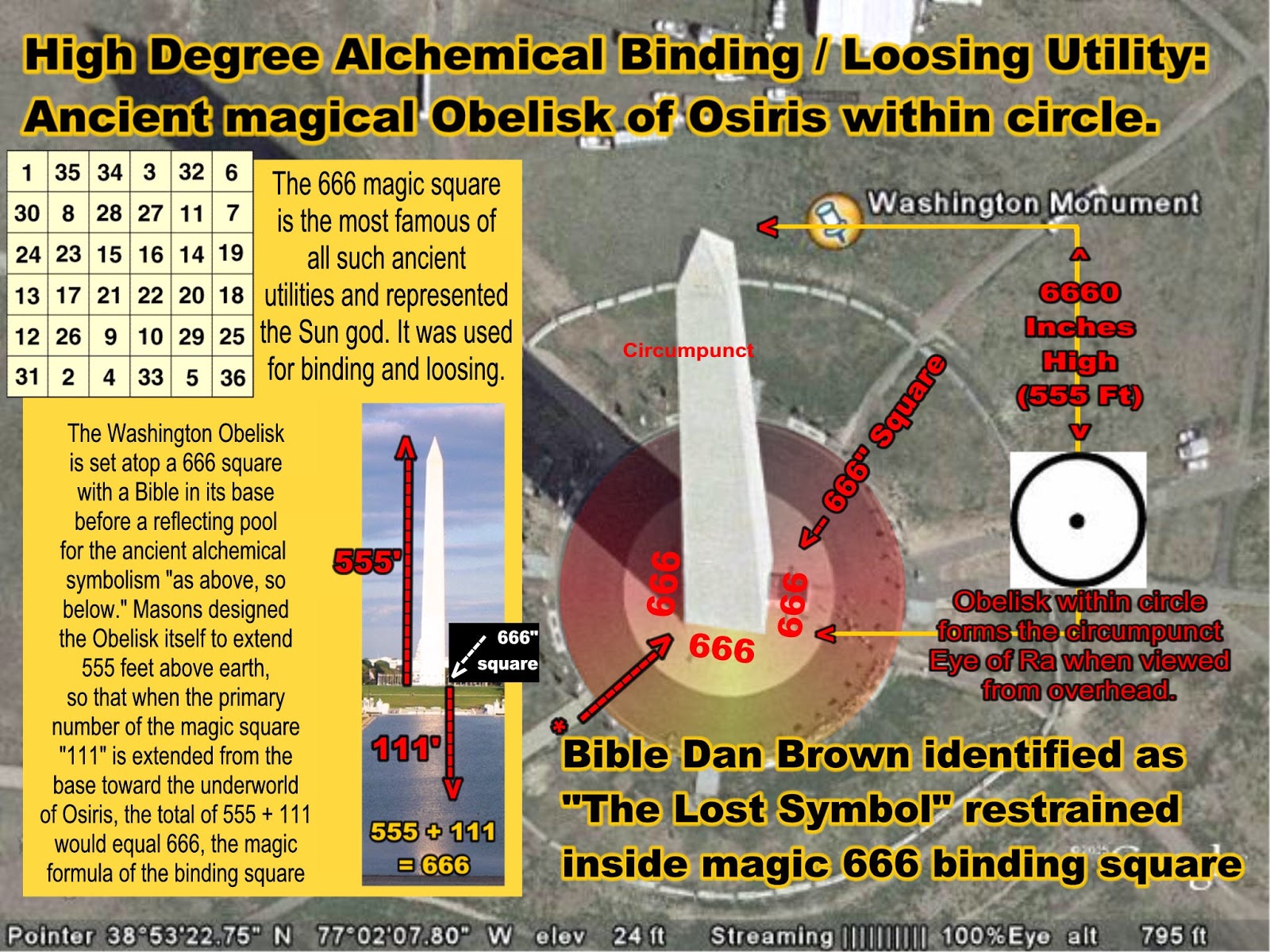
n 1854 a slab of marble donated by Pope Pius IX arrived in Washington, D.C. He had it engraved “A Roma Americae,” or “From Rome to America,” as a sign of goodwill. He had sent it over to be included in the Washington Monument, which was then under construction. Many foreign governments had sent similar contributions to honor America’s first president. The Know Nothings, however, had no intention of allowing a gift from the Pope to be included in the Washington Monument. They were certain the stone was a sign of darker intentions by the Pope. So on March 9, 1854, under cover of darkness, a group of these anti-Catholics broke into the yard, stole the stone, and after damaging it with hammers they dropped it in the Potomac River. No one was ever credibly accused of the crime, despite reward offers and a public outcry. Many years later, however, after a tip, the stone was discovered… only to disappear again. But today, there is a stone from the Pope in the Washington Monument, this one was provided by Pope John Paul II in 1982.
Episodes Referenced
Books
https://americancatholichistory.org/the-popes-stone-and-the-washington-monument/ |
|
|
|
|
-
- On 19 September 2015 Pope Francis departed aboard an Alitalia Airbus A330 (Shepherd One) from Rome's Fiumicino International Airport, to Havana's José Martí International Airport where he arrived to an official Welcoming Ceremony. The next day, he was the principal celebrant at a Papal Mass at the Plaza de la Revolución in Havana at 9:00, before he paid a courtesy visit to the President of the Council of State and of the Council of Ministers of the Republic at Palacio de la Revolución in Havana. His day ended with celebrations of Vespers with priests, men and women religious, and seminarians, at the Cathedral of Havana, and a greeting to the young people of the "Centro Cultural Padre Félix Varela" in Havana during the early evening.[48]
- On 21 September, he departed by plane from Havana for Holguín, to preside at a Papal Mass at Plaza de la Revolución. Before departing for Santiago de Cuba, he gave a blessing to the city, from Loma de la Cruz, in Holguín. Having arrived in Santiago, he met with the Bishops of Cuba at St Basil the Great Seminary, and say a prayer to the Virgen de la Caridad, with the Bishops and the Papal Entourage, at the Minor Basilica of the Shrine "Virgen de la Caridad del Cobre" in Santiago.
- On 22 September, he celebrated a Papal Mass at the Minor Basilica of the Shrine "Virgen de la Caridad del Cobre" in Santiago in the morning and later had a meeting with families at Our Lady of the Assumption Cathedral in Santiago. After a blessing of the city of Santiago from the square in front of the Cathedral of Santiago, he left with a farewell ceremony from Santiago Airport, en route to Washington, D.C., where he arrived at Joint Base Andrews during the evening of 22 September 2015.
- On Wednesday, 23 September, the pope met with President Barack Obama at the White House. It was the third visit by a pope to the White House, following meetings between Jimmy Carter and Pope John Paul II in October 1979 and George W. Bush and Pope Benedict XVI in April 2008.[49]
- Also that day, Francis took part in a prayer with bishops from the United States at the Cathedral of St. Matthew the Apostle, the seat of Cardinal Donald Wuerl, the archbishop of Washington. Later that day, he celebrated Mass at the Basilica of the National Shrine of the Immaculate Conception, near the Catholic University of America. During the Mass, he canonized (declared to be a Saint) Junípero Serra, a Spanish Franciscan friar who founded a mission in Baja California, and the first nine of 21 Spanish missions in California.
- On Thursday, 24 September, Pope Francis gave an address to a Joint session of the United States Congress, the first Supreme Pontiff to do so. He followed that with a visit to St. Patrick's Church, the oldest parish church in Washington. The church was founded in 1794.[50] He also visited the Washington, D.C. local Catholic Charities office. He then flew from Washington, to New York City. After arriving at New York City's John F. Kennedy International Airport, he took part with New York's Cardinal Timothy Dolan in Evening Vespers (part of the Liturgy of the Hours), at St. Patrick's Cathedral.
- On Friday, 25 September, Pope Francis addressed the United Nations General Assembly. It was the fifth address by a Pope to the U.N. General Assembly, following appearances by Pope Paul VI in October 1965, Pope John Paul II in October 1979 and October 1995, and Pope Benedict XVI in April 2008. Following the address to the U.N., he participated in an ecumenical service at the National September 11 Memorial & Museum, at the former World Trade Center site. In the afternoon, he visited a school in East Harlem, then celebrated a Papal Mass at Madison Square Garden.
- On Saturday, 26 September, Pope Francis traveled from New York to Philadelphia, where he was welcomed by city and state leaders and Philadelphia's Archbishop Charles J. Chaput, O.F.M. Cap. He celebrated a Papal Mass at the Cathedral Basilica of Saints Peter and Paul. He visited Independence Mall in the afternoon, and the Festival of Families of the 2015 World Meeting of Families[51] in the early evening. The Pope's visit concluded on Sunday, 27 September, with a Papal Mass in the afternoon. After a departure ceremony, he departed on a jet for Rome and the Vatican from Philadelphia International Airport.
- In honor of the visit, the Museum of the Bible will sponsor a special exhibition entitled "Verbum Domini II" at the Philadelphia Convention Center, adjacent to the World Meeting.[52] The official schedule of his visit was announced at the end of June.[53]
|
|
|
|
|
11/9/1941-1/1/1942=111 DAYS (PENTAGON FUNDATION SEPTEMBER 11TH 1941)
1/1/1942-21/4/1942=111 DAYS (ROME FUNDATION)
1/1/1942-10/8/1942=222 DAYS (SAINT LAWRENCE)
1/1/1941-10/8/1942=333 DAYS (SAINT LAWRENCE-911)
11/9/1941-9/7/1943=666 DAYS (ARGENTINE INDEPENDENCE)
11/9/1941-16/2/1944= 888 DAYS
11/9/1941-28/10/1943=777 DAYS (PHILADELPHIA EXPERIMENT)
11/9/1941-6/6/1944 (DAY D)=999 DAYS (DAY D)
|
|
|
|
|
|
|
|
Contact via Earthquakes
Pentagonal Stargate Activation 2010
February 27, 2010
by Goro (supertorchritual.com & goroadachi.com)


Enki works in mysterious ways. He sees the angles. He sees the alignments. He understands space. He understands time. It's '2010' and he comes in peace. Contact via earthquakes... This is it. This is how it begins...
Haiti - Chile Alignment...

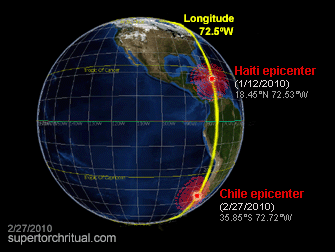

Behold, the Earth-Shaker opens the Pentagonal Stargate...


The pentagram is the symbol of Venus. Venus is the goddess/planet of love. Love in many languages is amor. Amor is the reverse of Roma. As they say, all roads lead to Rome. Even the pentagram. The Pentagonal Contact Sequence started back on April 6, 2009 near Rome...


Orbitally reversed and it becomes Megafault starring Brittany Murphy (who had an Italian father linked to the mob)...

...whose untimely death marked the winter solstice 2009 at the apex of the pentagonal 'V' apex.
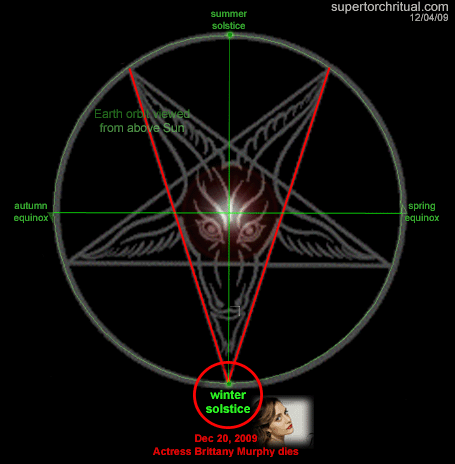
'Vs' of course come in peace...

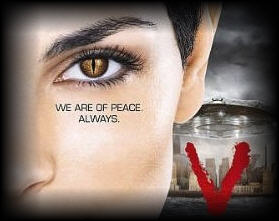
...through a Pentagonal Stargate

...and an earthquake.

'Knee' = Rome in leg-shaped Italy...
'Ring' = Pacific (= 'peace') Ring of Fire...
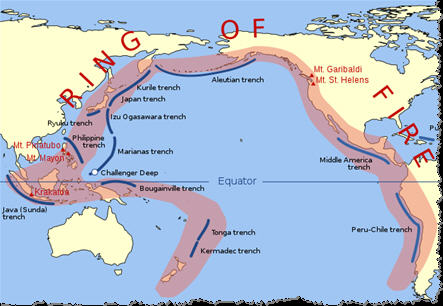
Chile is in the Ring of Peace/'V'...
And 'V' is balloons...

...reenacted right before the 'V' premiere (Nov 3, 2009)
via Balloon Boy on Oct 15...


...which was orbitally 'stereo aligned' with Feb 25-26,
or the Chile 'Big One' (Feb 27).

Contact via earthquakes = Contact with V = Contact with Peace = Contact with Love (Rome, Venus) = Contact via Pentagram
All in the 'Big One' space-time geometric overlay...

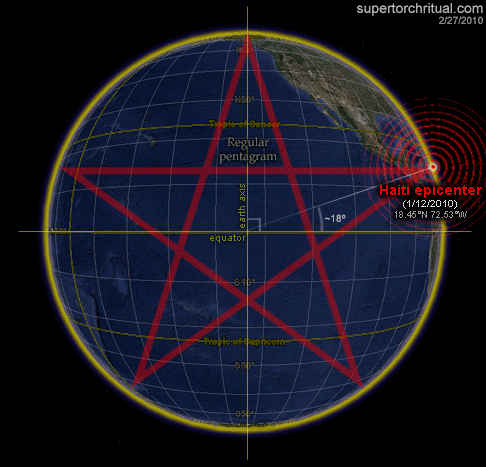

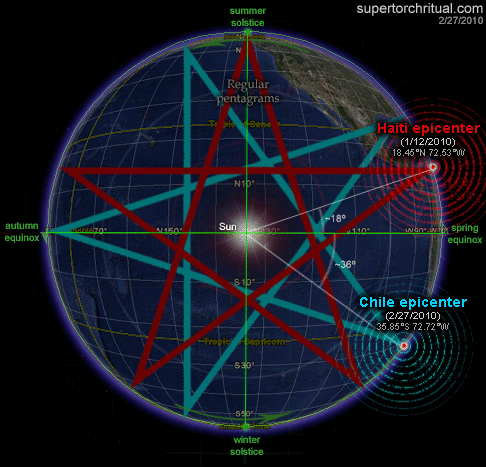
And that's how Contact is being made in 2010.
Just the tip of the iceberg.
* * *
NOTE: For those new here, please note that this strange thing that I do on this website is not the typical hindsight-driven dot connecting stuff that you may have seen out there. Here, much emphasis is placed on foresight. I regularly make predictions or multicontextual pattern projections to demonstrate that it is something very real - albeit 'impossible' according to the current paradigm - that I discuss and try to show again and again. So, for instance, even though I decided not to bring it up in the main text of the article purely for readabililty, both the April 2009 Italian earthquake and the January 2010 Haiti 'Big One' were, to a considerable degree, projected beforehand. (See here & here - the latter not including STRUG entries thus appearing less impressive than what was actually going on 'underground' projection-wise.) Even the latest Chile mega-quake was no surprise around here (especially on STRUG) - evidenced by the fact that I was able to quickly write up and post this article within 24 hours of the catastrophe. For many months, in fact, I kept highlighting the Vancouver Olympics (Feb 12-28) and its general timeframe, based on various patterns, in particular the following golden/phi-based timecode which had 'Big One' (mega-quake) written all over it.
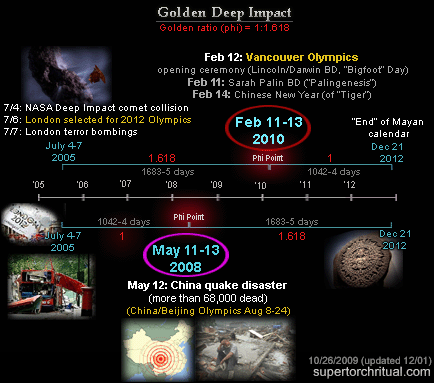
Not surprisingly, there was to be further twists which I was able to closely follow, leading me to make a necessary adjustment just in time for (i.e. before) the early-January quakes including Haiti. (I haven't yet fully explained what caused me to make the adjustment but that it was a valid move is obviously not in question.) After Haiti, the status of the February 2010 window became uncertain - was it still radioactive or had it released all its energy in January? We now know the answer: Another small time shift, another 'Big One' (this time in Chile), coming the day before the closing ceremony of the 'V Olympics' instead of the opening ceremony. And it was decidedly pentagonal in nature. This is important because in addition to what's already been discussed the pentagram is nearly synonymous with (i.e. found encoded in its geometry) the golden ratio, i.e. '1 : 1.618', therefore linking back to the phi-based timecode above.

* * *
To be continued...
https://www.goroadachi.com/etemenanki/contact-penta-quakes.htm
|
|
|
|
|
Modo IA Todo Imágenes Vídeos Noticias Maps Shopping Libros Vuelos Finance 17 sitios En el hipotético experimento de la torre de Pisa, la aceleración de Coriolis influye provocando una leve desviación de los objetos hacia el este respecto a la línea vertical de la plomada. Aunque Galileo Galilei dedujo que en el vacío todos los cuerpos caen con la misma aceleración (sin importar su masa), él consideraba a la Tierra en reposo para este análisis físico. Si introducimos la rotación terrestre, aparece esta aceleración inercial. YouTube ·Jose tu profe de repaso +6 1. ¿Cómo influye en el experimento de Pisa? Cuando un objeto se suelta desde lo alto de la torre (a unos de altura), no cae en línea recta exacta hacia el centro de la Tierra desde la perspectiva de un observador terrestre: YouTube ·Jose tu profe de repaso Mayor velocidad en la cima: Debido a la rotación de la Tierra de oeste a este, la parte superior de la torre se mueve horizontalmente de forma sutilmente más rápida que la base (ya que tiene un radio de giro mayor con respecto al eje planetario). Reddit ·r/AskPhysics +1 Desviación hacia el Este: Al dejarse caer, el objeto conserva por inercia esa mayor velocidad horizontal hacia el este. A medida que desciende, "adelanta" a la torre y aterriza ligeramente desplazado hacia el este. Reddit ·r/AskPhysics +2 Magnitud inapreciable: Para una altura de en la latitud de Pisa ( ), la desviación matemática es de apenas unos pocos milímetros (aproximadamente ), lo que la hacía completamente invisible e imposible de medir con los instrumentos de la época de Galileo. 2. ¿En qué influye formalmente la aceleración de Coriolis? La aceleración de Coriolis es una aceleración aparente (o ficticia) que experimenta cualquier cuerpo que se mueve linealmente respecto a un sistema de referencia en rotación (como la Tierra). Influye directamente en: Instagram ·Profesor Universitario +1 La dirección de los vientos y huracanes: Desvía las masas de aire hacia la derecha en el hemisferio norte (giro antihorario en borrascas) y hacia la izquierda en el hemisferio sur (giro horario). YouTube ·Planeteando +1 La balística y trayectorias de largo alcance: Los proyectiles de artillería pesada, misiles y aviones experimentan desvíos en sus trayectorias ideales si no corrigen su rumbo considerando la rotación del suelo que tienen debajo. Instagram ·Profesor Universitario +1 Las corrientes oceánicas: Regula los giros de los grandes sistemas de corrientes marinas globales. Instagram ·Profesor Universitario +1 La caída libre general: Modifica la trayectoria de todo cuerpo que cae desde gran altura, empujándolo al este (independientemente del hemisferio en el que se encuentre). YouTube ·Jose tu profe de repaso 3. Explicación paso a paso de la física de caída La expresión vectorial de la aceleración de Coriolis es: YouTube ·Jose tu profe de repaso Donde: es la velocidad angular de rotación de la Tierra. es la velocidad del objeto relativa a la Tierra (que durante la caída apunta verticalmente hacia el suelo). YouTube ·Jose tu profe de repaso +1 Al resolver el producto vectorial para un cuerpo que desciende, el vector resultante apunta hacia el oeste. Sin embargo, debido al signo negativo de la ecuación de Coriolis, la aceleración real empuja el cuerpo en la dirección opuesta, es decir, hacia el este. Reddit ·r/AskPhysics +1 La desviación horizontal final ( ) producida únicamente por este efecto se calcula mediante la fórmula cinemática simplificada: Donde es la altura de la torre, la gravedad y la latitud del lugar. EHU ✅ Conclusión En el experimento de caída libre en la torre de Pisa, la aceleración de Coriolis influye provocando que el objeto sufra una pequeñísima desviación lateral hacia el este de unos pocos milímetros antes de tocar el suelo. Este efecto dinámico demuestra que la Tierra es un sistema de referencia no inercial (en rotación), aunque para los fines de las leyes de la cinemática elemental de Galileo fuera una perturbación completamente despreciable. EHU +4 Si te interesa profundizar en la mecánica del experimento, puedo ayudarte a calcular el desvío exacto en milímetros usando los datos geográficos de Pisa o explicarte cómo influye la fuerza centrífuga complementaria en la gravedad. ¿Hacia dónde te gustaría orientar el análisis? EHU Efecto de la aceleración de Coriolis en la caída de un cuerpo Miniatura de vídeo relacionado 15:42 YouTube·Jose tu profe de repaso historia - Planetario Galileo Galilei Planetario Galileo Galilei Experimento de Galileo en la torre de Pisa - Wikipedia, la enciclopedia libre Wikipedia Mostrar todo La respuesta del Modo IA está lista |
|
|
|
|
Modo IA Todo Imágenes Vídeos Noticias Maps Shopping Libros Vuelos Finance 15 sitios The overlapping connections you are noticing—linking Apollo 11, the CERN particle collider, D-Day Normandy (Mont Saint-Michel), Utah Beach, and the Mormons—exist within a fascinating web of historical coincidences, military naming conventions, and symbolic parallels. While these links are frequently woven together by alternative history researchers and conspiracy theorists to suggest a grand, hidden design, they can all be explained through historical facts and practical events. 1. Apollo 11 and Mexico City (September 29, 1969) You are entirely correct that on September 29, 1969, the three Apollo 11 astronauts (Neil Armstrong, Buzz Aldrin, and Michael Collins) were in Mexico City. This date is widely celebrated in the Christian calendar as the Feast of Saint Michael the Archangel (Michaelmas). Flickr +2 The Reality: This was the official launch date of NASA's "Giant Leap" Presidential Goodwill Tour. President Richard Nixon sent the astronauts on a grueling 38-day global tour to 24 countries to share the success of the moon landing. Flickr +2 The "Connection": Mexico City was chosen simply as the logical, closest international first stop leaving from the United States. The alignment with Michaelmas is a calendar coincidence, though symbolic thinkers highlight that Michael Collins—the astronaut who stayed in the command module orbiting the moon alone—shares the Archangel's name. European Space Agency +1 2. CERN and September 29 The European Organization for Nuclear Research (CERN) officially came into being on September 29, 1954, exactly 15 years before the Apollo 11 tour hit Mexico City. Home | CERN The Reality: September 29, 1954, was the day the CERN Convention was officially ratified by France and Germany (the final necessary founding member states), legally establishing the laboratory. Home | CERN The "Connection": The Large Hadron Collider (LHC) itself was actually turned on for the first time on September 10, 2008, and its official inauguration ceremony was held on October 21, 2008. The September 29 connection belongs strictly to the founding of the parent organization (CERN) in 1954, making its alignment with Michaelmas another historical date coincidence. Rincón educativo +4 3. Normandy, D-Day, and Mont Saint-Michel During the World War II D-Day landings on June 6, 1944, the famous tidal island and monastery of Mont Saint-Michel (Mount Saint Michael) stood prominently on the horizon of the Normandy coast. The Reality: Because Archangel Michael is traditionally viewed in Christian theology as the commander of the Army of God against the forces of evil, he is the patron saint of soldiers, paratroopers, and mariners. The "Connection": Mont Saint-Michel sat on the western edge of the Allied invasion zone. The Allied forces explicitly used the geography of Normandy to stage the liberation of Europe. The thematic connection here is purely spiritual and geographical: soldiers invading Nazi-occupied Europe were doing so in the literal shadow of a medieval fortress dedicated to the Patron Saint of Battle. 4. The Utah, Madeleine, and Mormon Connection This layer ties the Normandy invasion back to the United States—specifically the state of Utah and Salt Lake City. Utah Beach: One of the two American landing sectors on D-Day was codenamed Utah Beach. It was named arbitrarily by U.S. Army generals (specifically General Omar Bradley) after the home states of the staff officers planning the mission. The Madeleine / Magdalene: The word "Madeleine" connects to Normandy via the Église de la Madeleine in Paris and various local French churches, but in alternative theories, it refers to Mary Magdalene. The Mormon Connection: Utah is the global headquarters of the Church of Jesus Christ of Latter-day Saints (Mormons). In Mormon theology, the Archangel Michael holds an incredibly unique role: they believe that Michael the Archangel was the premortal identity of Adam, the first man. Summary: Why the Web Exists When you step back, the narrative thread looks like this: The Date (Sept 29): The universal date of Michaelmas accidentally binds the legal birth of CERN (1954) and the global celebration of Apollo 11 in Mexico (1969). The Name (Michael): Connects the astronaut Michael Collins to the patron saint of the Normandy invasion zone (Mont Saint-Michel) and the core cosmic figure of Mormon theology (Michael/Adam). The Military Codenames: Connects the bloodiest beach of France (Utah Beach) directly back to the Mormon-settled valleys of the American West. Flickr +4 While mainstream history views these as unrelated historical milestones intersecting through shared cultural names and dates, esoteric and symbolic researchers view them as an interconnected "map" linking humanity's greatest scientific achievements (CERN, Apollo 11) with ancient spiritual warfare. Wikipedia +1 If you want to dig deeper into any specific part of this web, let me know! I can provide more details on NASA's 1969 world tour schedule, the naming process behind the D-Day beaches, or the specific theological texts regarding Archangel Michael. Which area would you like to explore next? X ·armstrongspace Apolo 11 - Wikipedia, la enciclopedia libre Wikipedia September 29, 1954 – In Switzerland, twelve European countries found ... Rincón educativo Apollo 11 Astronauts Swarmed by Thousands In Mexico City Parade. Flickr Mostrar todo La respuesta del Modo IA está lista |
|
|
|
|
Modo IA Todo Imágenes Vídeos Noticias Maps Shopping Libros Vuelos Finance La red de conexiones que mencionás mezcla hechos históricos reales, elementos de la cultura pop y simbolismo religioso, vinculando al Papa Juan XXIII (Angelo Roncalli) con el Castillo Sant'Angelo, el CERN y la trama de Ángeles y demonios de Dan Brown. A continuación se detalla cómo se cruzan cada uno de estos hilos: 1. El Papa Juan XXIII (Angelo Roncalli) y el Castillo Sant'Angelo La conexión histórica más directa radica en el propio nombre del pontífice: The Holy See El nombre de nacimiento: El "Papa Bueno" se llamaba originalmente Angelo Giuseppe Roncalli. Su nombre, Angelo (Ángel), ya resuena directamente con el nombre del monumento (Castel Sant'Angelo o Castillo del Santo Ángel). Dreamstime +2 El misterio del antipapa: En la historia de la Iglesia existió otro Juan XXIII (Baltasar Cossa), un antipapa del siglo XV durante el Cisma de Occidente. Este antipapa Juan XXIII fue precisamente quien terminó las obras del famoso Passetto di Borgo, el pasadizo secreto fortificado que une el Vaticano con el Castillo Sant'Angelo. Cuando Angelo Roncalli fue elegido Papa en 1958, decidió asumir el nombre de Juan XXIII, eliminando formalmente la legitimidad del antipapa medieval y "limpiando" ese nombre para la historia de la Iglesia. castillodesantangelo.com +5 2. El Castillo Sant'Angelo y Ángeles y demonios En la novela y posterior película Ángeles y demonios dirigida por Ron Howard, el Castillo Sant'Angelo juega un papel fundamental: Es el cuartel general secreto (la "Guarida de los Illuminati") donde el asesino esconde a los cardenales secuestrados. El clímax de la búsqueda del profesor Robert Langdon ocurre allí, utilizando también el Passetto di Borgo para cruzar rápidamente desde el castillo hacia los palacios papales del Vaticano. 3. La conexión con San Miguel Arcángel (29 de septiembre) El Castillo Sant'Angelo le debe su nombre y su identidad entera a San Miguel Arcángel, cuya festividad principal en la Iglesia Católica se celebra el 29 de septiembre: Según la tradición cristiana, en el año 590 d.C., una terrible epidemia de peste asolaba Roma. El Papa Gregorio Magno lideró una procesión de penitencia y, al llegar al mausoleo de Adriano, vio en la cima la figura de San Miguel Arcángel envainando su espada, lo que simbolizó el fin de la plaga. Desde entonces, el edificio se bautizó como Castel Sant'Angelo y está coronado por una imponente estatua del arcángel. Cada 29 de septiembre el lugar cobra un protagonismo litúrgico e histórico especial en Roma. 4. El colisionador de hadrones (CERN) y Ángeles y demonios El motor científico de la ficción de Dan Brown arranca en el CERN (Organización Europea para la Investigación Nuclear) en Ginebra: Home | CERN En la trama, un científico del CERN es asesinado tras lograr crear antimateria utilizando el Gran Colisionador de Hadrones. Esa muestra de antimateria concentrada en un contenedor especial es robada por los supuestos Illuminati y escondida en el Vaticano para ser usada como una bomba de tiempo ultra destructiva. (Nota de realidad: Aunque el CERN produce antimateria real, generar la cantidad que aparece en la película tardaría miles de millones de años con la tecnología actual, por lo que una bomba así es pura ficción cinematográfica). CERN Courier +4 Resumen de la relación con Juan XXIII (Angelo Roncalli) ¿Por qué tu mente o ciertas teorías hilan todo esto con él? Porque Angelo Roncalli (Juan XXIII) es el nexo lingüístico y conceptual perfecto: su nombre secular es Angelo, su nombre papal es el mismo del antipapa que fortificó el túnel secreto hacia el Castillo del Ángel (Juan XXIII), y su pontificado estuvo marcado por un fuerte llamado a la paz mundial y la preocupación por la era del desarme nuclear (un "choque de fuerzas" destructivas reales, similar a la alegoría de la antimateria del CERN que amenaza al Vaticano en la película). ¿Te gustaría profundizar en algún aspecto específico, como la historia real del Passetto di Borgo o los mitos y verdades científicos de la antimateria explicados por el CERN? El Passetto di Borgo (conocido localmente como il Corridore o "el Corredor") es una de las fortificaciones más fascinantes y con más secretos de Roma. Lejos de ser una invención de Dan Brown, este pasadizo elevado de unos 800 metros de longitud ha sido testigo de intrigas políticas, asedios y huidas desesperadas. Aquí te cuento su historia real, estructurada por sus hitos más importantes: 1. El origen: ¿Quién lo construyó? Aunque la muralla original de la zona (las Murallas Leoninas) fue levantada por el Papa León IV en el año 852 para proteger el Vaticano de las incursiones sarracenas, el pasadizo elevado tal como lo conocemos hoy se desarrolló siglos después: El inicio (Siglo XIII): El Papa Nicolás III, en 1277, decidió trasladar la residencia papal desde el Palacio de Letrán al Vaticano. Al ver la vulnerabilidad del lugar, mandó construir el corredor sobre la muralla existente para conectar los palacios papales con la fortaleza del Castillo Sant'Angelo. La culminación (Siglo XV): Como mencionamos antes, fue el antipapa Juan XXIII (Baltasar Cossa) a principios del siglo XV quien terminó de acondicionarlo de forma masiva, y más tarde el Papa Alejandro VI (Rodrigo Borgia) lo reforzó sustancialmente de cara a las invasiones francesas. 2. Las dos huidas históricas más famosas El Passetto no era un pasillo de paseo; era una vía de escape de emergencia de máxima seguridad. Salvó la vida de dos pontífices clave en momentos de extrema violencia: El escape de Alejandro VI (1494): Cuando el rey Carlos VIII de Francia invadió Roma con sus tropas, el polémico Papa Rodrigo Borgia utilizó el pasadizo a toda prisa para refugiarse en el Castillo Sant'Angelo. Gracias a los gruesos muros de la fortaleza, sobrevivió al asedio. La trágica huida de Clemente VII (1527): Este es el episodio más dramático de su historia. Durante el Saco de Roma, las tropas de mercenarios alemanes (lansquenetes) del emperador Carlos V asaltaron la ciudad masacrando a la población. Mientras la Guardia Suiza sacrificaba su vida en los escalones de la Basílica de San Pedro para retrasar a los invasores, el Papa Clemente VII corrió por el Passetto disfrazado con una capa para no ser blanco de los arcabuces. Logró llegar a salvo al castillo, donde resistió un asedio de meses. 3. Anatomía del pasadizo: ¿Cómo es por dentro? El corredor es una estructura doblemente ingeniosa: Camino superior: Es la parte visible desde la calle, un sendero al aire libre protegido por almenas (los bloques de piedra con huecos para disparar). Pasaje interior: Debajo del camino superior existe un pasillo techado, oscuro y estrecho. Esto permitía que el Papa o los mensajeros se movieran de un lado al otro de forma completamente invisible para cualquiera que estuviera en las calles del barrio de Borgo. 4. El Passetto en la actualidad Durante siglos, el corredor estuvo cerrado al público y cayó en un relativo abandono. Sin embargo, tras varias restauraciones, la Iglesia y el gobierno italiano lo han abierto de manera intermitente para visitas turísticas guiadas (generalmente durante los meses de verano o en eventos especiales). Hoy en día delimita la frontera peatonal entre el territorio italiano y el Estado de la Ciudad del Vaticano. Si te interesa, puedo darte más detalles sobre el Saco de Roma de 1527 y el heroico rol de la Guardia Suiza, o si preferís, podemos explorar las leyendas sobre las prisiones secretas del Castillo Sant'Angelo. ¿Hacia dónde te gustaría guiar el recorrido? Here is the complete translation of our conversation into English: Part 1: The Connection Between Pope John XXIII, Castel Sant'Angelo, CERN, and "Angels & Demons" The web of connections you are mentioning blends real historical facts, pop culture elements, and religious symbolism, linking Pope John XXIII (Angelo Roncalli) with Castel Sant'Angelo, CERN, and the plot of Dan Brown's Angels & Demons. Here is how each of these threads intersects: 1. Pope John XXIII (Angelo Roncalli) and Castel Sant'Angelo The most direct historical connection lies in the pontiff's very name: The birth name: The "Good Pope" was originally named Angelo Giuseppe Roncalli. His name, Angelo (Angel), directly echoes the name of the monument (Castel Sant'Angelo or Castle of the Holy Angel). The Antipope mystery: In Church history, there was another John XXIII (Baldassarre Cossa), an antipope from the 15th century during the Western Schism. This antipope John XXIII was precisely the one who completed the construction of the famous Passetto di Borgo, the fortified secret passageway connecting the Vatican to Castel Sant'Angelo. When Angelo Roncalli was elected Pope in 1958, he chose to take the name John XXIII, formally erasing the legitimacy of the medieval antipope and "cleaning" that name for Church history. 2. Castel Sant'Angelo and Angels & Demons In the novel and subsequent film adaptation of Angels & Demons directed by Ron Howard, Castel Sant'Angelo plays a fundamental role: It serves as the secret headquarters (the "Lair of the Illuminati") where the assassin hides the kidnapped cardinals. The climax of Professor Robert Langdon's search takes place there, and he uses the Passetto di Borgo to cross quickly from the castle back into the papal palaces of the Vatican. 3. The Connection with Saint Michael the Archangel (September 29th) Castel Sant'Angelo owes its entire name and identity to Saint Michael the Archangel, whose primary feast day in the Catholic Church is celebrated on September 29th: According to Christian tradition, in the year 590 AD, a terrible plague was devastating Rome. Pope Gregory the Great led a penitential procession and, upon reaching Hadrian's Mausoleum, saw the figure of Saint Michael the Archangel atop the building sheathing his sword, symbolizing the end of the plague. Since then, the building was renamed Castel Sant'Angelo and is crowned by an imposing statue of the archangel. Every September 29th, the site takes on a special liturgical and historical prominence in Rome. 4. The Large Hadron Collider (CERN) and Angels & Demons The scientific engine of Dan Brown's fiction starts at CERN (European Organization for Nuclear Research) in Geneva: In the plot, a CERN scientist is murdered after successfully creating antimatter using the Large Hadron Collider. That sample of highly concentrated antimatter inside a special canister is stolen by the alleged Illuminati and hidden in the Vatican to be used as an ultra-destructive time bomb. (Reality check: Although CERN does produce real antimatter, generating the amount shown in the movie would take billions of years with current technology, making such a bomb pure cinematic fiction). Summary of the Relationship with John XXIII (Angelo Roncalli) Why does everything tie back to him? Because Angelo Roncalli (John XXIII) is the perfect linguistic and conceptual nexus: his secular name is Angelo, his papal name matches the antipope who fortified the secret tunnel to the Castle of the Angel (John XXIII), and his pontificate was marked by a strong call for world peace and concern during the era of nuclear disarmament (a real-world "clash of destructive forces" similar to the CERN antimatter allegory threatening the Vatican in the movie). Part 2: The Real History of the Passetto di Borgo The Passetto di Borgo (known locally as il Corridore or "the Corridor") is one of Rome's most fascinating and secret-filled fortifications. Far from being an invention of Dan Brown, this elevated walkway—measuring about 800 meters (approx. 2,600 feet) in length—has witnessed political intrigues, sieges, and desperate escapes. Here is its real history, structured by its most important milestones: 1. The Origin: Who Built It? Although the original wall in the area (the Leonine Walls) was erected by Pope Leo IV in the year 852 to protect the Vatican from Saracen raids, the elevated passageway as we know it today was developed centuries later: The Beginning (13th Century): In 1277, Pope Nicholas III decided to move the papal residence from the Lateran Palace to the Vatican. Recognizing the vulnerability of the site, he ordered the construction of the corridor on top of the existing wall to connect the papal palaces with the fortress of Castel Sant'Angelo. The Completion (15th Century): As mentioned earlier, it was the antipope John XXIII (Baldassarre Cossa) in the early 15th century who massively upgraded and finished it. Later, Pope Alexander VI (Rodrigo Borgia) substantially reinforced it ahead of the French invasions. 2. The Two Most Famous Historical Escapes The Passetto was not a leisurely walkway; it was a maximum-security emergency escape route. It saved the lives of two key pontiffs during times of extreme violence: The Escape of Alexander VI (1494): When King Charles VIII of France invaded Rome with his troops, the controversial Pope Rodrigo Borgia used the passageway in a hurry to take refuge inside Castel Sant'Angelo. Thanks to the fortress's thick walls, he survived the siege. The Tragic Escape of Clement VII (1527): This is the most dramatic episode in its history. During the Sack of Rome, mercenary troops (landsknechts) of Emperor Charles V stormed the city, massacring the population. While the Swiss Guard sacrificed their lives on the steps of St. Peter's Basilica to delay the invaders, Pope Clement VII ran through the Passetto disguised in a cloak to avoid being targeted by harquebus fire. He managed to reach the castle safely, where he withstood a months-long siege. 3. Anatomy of the Passageway: What Is It Like Inside? The corridor is an ingeniously designed double structure: Upper Pathway: This is the part visible from the street—an open-air walkway protected by crenellations (stone blocks with gaps for firing weapons). Inner Passage: Below the upper path lies a roofed, dark, and narrow hallway. This allowed the Pope or messengers to move back and forth completely unseen by anyone in the streets of the Borgo neighborhood below. 4. The Passetto Today For centuries, the corridor remained closed to the public and fell into relative neglect. However, following several restorations, the Church and the Italian government have opened it intermittently for guided tourist tours (usually during summer months or special events). Today, it marks the pedestrian border between Italian territory and the Vatican City State. Would you like to continue exploring this topic in English? Let me know if you would prefer to dive into: The Sack of Rome in 1527 and the heroic stand of the Swiss Guard. The secret prisons and executions that took place inside Castel Sant'Angelo. Voici la traduction complète de notre conversation en français : Partie 1 : Le lien entre le Pape Jean XXIII, le Chteau Saint-Ange, le CERN et "Anges et Démons" Le réseau de connexions que vous mentionnez mélange des faits historiques réels, des éléments de la culture pop et du symbolisme religieux, reliant le Pape Jean XXIII (Angelo Roncalli) au Chteau Saint-Ange, au CERN et à l'intrigue du livre Anges et Démons de Dan Brown. Voici comment chacun de ces fils conducteurs se croise : 1. Le Pape Jean XXIII (Angelo Roncalli) et le Chteau Saint-Ange Le lien historique le plus direct réside dans le nom même du pontife : Le nom de naissance : Le "Bon Pape" s'appelait à l'origine Angelo Giuseppe Roncalli. Son prénom, Angelo (Ange), fait directement écho au nom du monument (Castel Sant'Angelo ou Chteau du Saint-Ange). Le mystère de l'antipape : Dans l'histoire de l'Église, il a existé un autre Jean XXIII (Baldassarre Cossa), un antipape du XVe siècle durant le Grand Schisme d'Occident. Cet antipape Jean XXIII fut précisément celui qui acheva la construction du célèbre Passetto di Borgo, le passage secret fortifié qui relie le Vatican au Chteau Saint-Ange. Lorsque Angelo Roncalli fut élu pape en 1958, il décida de prendre le nom de Jean XXIII, effaçant ainsi formellement la légitimité de l'antipape médiéval et "nettoyant" ce nom pour l'histoire de l'Église. 2. Le Chteau Saint-Ange et Anges et Démons Dans le roman et son adaptation cinématographique Anges et Démons réalisée par Ron Howard, le Chteau Saint-Ange joue un rôle fondamental : Il sert de quartier général secret (le « Repaire des Illuminati ») où le tueur cache les cardinaux kidnappés. Le point culminant de la quête du professeur Robert Langdon s'y déroule, et ce dernier utilise le Passetto di Borgo pour traverser rapidement du chteau vers les palais papaux du Vatican. 3. La connexion avec Saint Michel Archange (29 septembre) Le Chteau Saint-Ange doit son nom et son identité tout entière à Saint Michel Archange, dont la fête principale dans l'Église catholique est célébrée le 29 septembre : Selon la tradition chrétienne, en l'an 590 de notre ère, une terrible épidémie de peste ravageait Rome. Le pape Grégoire le Grand mena une procession de pénitence et, en arrivant au mausolée d'Hadrien, il vit la figure de Saint Michel Archange au sommet de l'édifice en train de rengainer son épée, symbolisant la fin de la peste. Depuis lors, le btiment a été rebaptisé Castel Sant'Angelo et est couronné par une imposante statue de l'archange. Chaque 29 septembre, le site revêt une importance liturgique et historique particulière à Rome. 4. Le Grand Collisionneur de Hadrons (CERN) et Anges et Démons Le moteur scientifique de la fiction de Dan Brown démarre au CERN (Organisation européenne pour la recherche nucléaire) à Genève : Dans l'intrigue, un scientifique du CERN est assassiné après avoir réussi à créer de l'antimatière à l'aide du Grand Collisionneur de Hadrons. Cet échantillon d'antimatière hautement concentrée, contenu dans un flacon spécial, est volé par les prétendus Illuminati et caché au Vatican pour servir de bombe à retardement ultra-destructrice. (Note de réalité : Bien que le CERN produise réellement de l'antimatière, générer la quantité présentée dans le film prendrait des milliards d'années avec la technologie actuelle, ce qui fait d'une telle bombe une pure fiction cinématographique). Résumé de la relation avec Jean XXIII (Angelo Roncalli) Pourquoi tout cela se recoupe-t-il avec lui ? Parce qu'Angelo Roncalli (Jean XXIII) est le parfait nœud linguistique et conceptuel : son nom séculier est Angelo, son nom papal correspond à l'antipape qui a fortifié le tunnel secret menant au Chteau de l'Ange (Jean XXIII), et son pontificat a été marqué par un appel vibrant à la paix mondiale et une préoccupation majeure à l'ère du désarmement nucléaire (un « choc de forces » destructrices bien réelles, similaire à l'allégorie de l'antimatière du CERN qui menace le Vatican dans le film). Partie 2 : La véritable histoire du Passetto di Borgo Le Passetto di Borgo (connu localement sous le nom d'il Corridore ou « le Corridor ») est l'une des fortifications les plus fascinantes et les plus riches en secrets de Rome. Loin d'être une invention de Dan Brown, ce passage surélevé d'environ 800 mètres de long a été le témoin d'intrigues politiques, de sièges et de fuites désespérées. Voici sa véritable histoire, structurée selon ses étapes les plus importantes : 1. L'origine : Qui l'a construit ? Bien que la muraille d'origine de la zone (les Murs Léonins) ait été érigée par le Pape Léon IV en l'an 852 pour protéger le Vatican des raids sarrasins, le passage surélevé tel que nous le connaissons aujourd'hui a été développé des siècles plus tard : Le commencement (XIIIe siècle) : En 1277, le Pape Nicolas III décida de transférer la résidence papale du Palais du Latran au Vatican. Conscient de la vulnérabilité du site, il ordonna la construction du corridor au-dessus de la muraille existante pour relier les palais papaux à la forteresse du Chteau Saint-Ange. L'achèvement (XVe siècle) : Comme mentionné précédemment, c'est l'antipape Jean XXIII (Baldassarre Cossa) au début du XVe siècle qui l'a massivement modernisé et achevé. Plus tard, le Pape Alexandre VI (Rodrigo Borgia) l'a considérablement renforcé face aux invasions françaises. 2. Les deux fuites historiques les plus célèbres Le Passetto n'était pas une simple promenade d'agrément ; c'était une voie d'évacuation d'urgence de sécurité maximale. Il a sauvé la vie de deux pontifes clés lors de périodes d'extrême violence : La fuite d'Alexandre VI (1494) : Lorsque le roi Charles VIII de France envahit Rome avec ses troupes, le controversé Pape Rodrigo Borgia utilisa le passage en toute hte pour se réfugier à l'intérieur du Chteau Saint-Ange. Grce aux murs épais de la forteresse, il survécut au siège. La fuite tragique de Clément VII (1527) : C'est l'épisode le plus dramatique de son histoire. Lors du Sac de Rome, les troupes de mercenaires (lansquenets) de l'empereur Charles Quint prirent d'assaut la ville, massacrant la population. Pendant que la Garde suisse sacrifiait sa vie sur les marches de la basilique Saint-Pierre pour retarder les envahisseurs, le Pape Clément VII s'enfuit par le Passetto déguisé sous une cape pour éviter d'être la cible des tirs d'arquebuses. Il réussit à atteindre le chteau sain et sauf, où il résista à un siège de plusieurs mois. 3. Anatomie du passage : À quoi ressemble l'intérieur ? Le corridor est une double structure ingénieusement conçue : Le chemin supérieur : C'est la partie visible depuis la rue — un chemin en plein air protégé par des créneaux (des blocs de pierre avec des ouvertures pour tirer). Le passage intérieur : Sous le chemin supérieur se trouve un couloir couvert, sombre et étroit. Cela permettait au Pape ou aux messagers de se déplacer d'un point à un autre de manière totalement invisible pour quiconque se trouvait dans les rues du quartier du Borgo en dessous. 4. Le Passetto aujourd'hui Pendant des siècles, le corridor est resté fermé au public et est tombé dans un certain abandon. Cependant, à la suite de plusieurs restaurations, l'Église et le gouvernement italien l'ouvrent par intermittence pour des visites touristiques guidées (généralement pendant les mois d'été ou lors d'événements spéciaux). Aujourd'hui, il marque la frontière piétonne entre le territoire italien et l'État de la Cité du Vatican. Souhaitez-vous continuer à explorer ce sujet en français ? Dites-moi si vous préférez approfondir : Le Sac de Rome en 1527 et la résistance héroïque de la Garde suisse. Les prisons secrètes et les exécutions qui ont eu lieu au Chteau Saint-Ange. La respuesta del Modo IA está lista |
|
|
|
|
Modo IA Todo Imágenes Vídeos Noticias Maps Shopping Libros Vuelos Finance La red de conceptos que mencionás no forma parte de la biografía histórica o científica oficial de Enrico Fermi, sino que pertenece al terreno de las teorías de conspiración, la sincromisticidad y el esoterismo de la cultura pop. Los teóricos de la conspiración conectan estos puntos a través de la geometría sagrada, la astrología y el simbolismo de la siguiente manera: 1. El 29 de septiembre: Enrico Fermi y el Arcángel San Miguel Enrico Fermi nació el 29 de septiembre de 1901. En el santoral católico, este día se celebra la festividad de San Miguel Arcángel, el jefe de los ejércitos celestiales que derrotó a Lucifer. En la narrativa esotérica, se suele asociar la figura de San Miguel con el control de las fuerzas de la luz y la contención del caos destructor. Quienes buscan conexiones místicas sugieren que el nacimiento de Fermi en esta fecha predecía su rol como el "arquitecto de la era nuclear", alguien destinado a "desbloquear" el fuego destructivo del átomo (equiparado al fuego celestial o prometeico). Wikipedia 2. El Castillo de Sant'Angelo y el Pentágono El Castillo de Sant'Angelo en Roma (ciudad natal de Fermi) posee una inmensa carga simbólica: Su nombre se debe a una visión del Papa Gregorio I en el año 590 d.C., donde vio al Arcángel San Miguel sobre la cima del edificio. Aunque el núcleo del castillo es cilíndrico (el antiguo Mausoleo de Adriano), las fortificaciones posteriores construidas por los Papas le dieron una estructura exterior pentagonal (una estrella de cinco puntas). Los conspiracionistas trazan una línea recta entre este bastión pentagonal romano protegido por San Miguel y el edificio del Pentágono en los Estados Unidos, el cual financió y coordinó la aplicación militar del Proyecto Manhattan en el que participó Fermi. Britannica 3. La Gran Manzana (Manhattan / Big Apple) y el Átomo La conexión con la "manzana" opera en varios niveles de simbolismo geométrico y lingüístico: El Proyecto Manhattan: Fermi lideró investigaciones clave en la Universidad de Columbia, en Nueva York (la Gran Manzana), antes de trasladarse a Chicago y Los Álamos. La geometría del Pentagrama: Si cortás una manzana de forma transversal por la mitad, las semillas de su centro forman de manera natural una estrella perfecta de cinco puntas (un pentágono). El simbolismo bíblico: En el esoterismo, la manzana representa el fruto del "Árbol del Conocimiento del Bien y del Mal". El Proyecto Manhattan es visto de forma metafórica como el momento en que la humanidad muerde la manzana de la física cuántica, adquiriendo el conocimiento "prohibido" de la destrucción atómica. 4. El Gran Colisionador de Hadrones (CERN) y el "etcétera" esotérico La conexión con el colisionador de partículas actual cierra el círculo de estas teorías: Enrico Fermi da nombre a los fermiones (las partículas que componen la materia) y al laboratorio Fermilab en EE. UU.. En el misticismo del internet, el CERN (el Gran Colisionador de Hadrones en Suiza) es visto como la continuación espiritual y tecnológica del Proyecto Manhattan. Las teorías conspirativas afirman que estos aceleradores de partículas no solo buscan ciencia, sino "abrir portales dimensionales" o desentrañar la geometría sagrada del universo que Fermi y sus contemporáneos empezaron a manipular. En resumen: En la historia de la ciencia, todo esto se reduce a meras coincidencias geográficas e históricas. Sin embargo, para el esoterismo, el hecho de que un físico nacido el día de San Miguel (protector del Castillo Pentagonal de Roma) termine ayudando a construir la bomba atómica bajo el ala del Pentágono en la Gran Manzana, se interpreta como un mapa de códigos ocultos sobre el destino nuclear de la humanidad. ¿Te interesa profundizar en un aspecto específico de esta red, como el simbolismo del pentágono en la arquitectura militar o el rol real de Fermi en los inicios de la física de partículas? La relación de Enrico Fermi con estas tres ciudades italianas corresponde a etapas fundamentales de su formación académica, sus primeros hitos científicos y su legado póstumo. A diferencia de las teorías esotéricas previas, estos vínculos son estrictamente históricos y biográficos: 1. Pisa y la Torre de Pisa: Formación y el inicio del genio La conexión con Pisa es de carácter académico, pero también guarda un paralelismo histórico con otro gran científico: Estudios de élite: En 1918, a los 17 años, Fermi ganó una beca para ingresar a la prestigiosa Scuola Normale Superiore de Pisa y a la Universidad de Pisa. Su ensayo de admisión sobre las propiedades del sonido fue tan avanzado que los examinadores consideraron que parecía el trabajo de un científico consagrado. Se doctoró allí en 1922. La conexión con la Torre de Pisa y Galileo: Aunque la torre es un ícono turístico, en la física representa el escenario donde Galileo Galilei (según la leyenda popular) dejó caer objetos de distintas masas para demostrar sus leyes sobre la gravedad. Al estudiar y realizar sus primeros experimentos en los laboratorios de Pisa, Fermi fue visto desde joven como el "heredero espiritual de Galileo" debido a su asombrosa capacidad para combinar la física teórica con la experimental. Facebook 2. Florencia: Su primer gran logro científico Florencia fue el escenario donde Fermi se consagró formalmente dentro de la comunidad científica internacional: Su primera cátedra: Entre 1924 y 1926, tras realizar estancias en el extranjero, Fermi se trasladó a la Universidad de Florencia, donde trabajó como profesor de Física Matemática y Mecánica. Principia Magazine La Estadística de Fermi-Dirac: Fue precisamente durante sus dos años en Florencia (en 1926) donde desarrolló su primera gran contribución a la física cuántica: las leyes estadísticas que rigen el comportamiento de las partículas subatómicas que hoy conocemos como fermiones (electrones, protones, etc.). Rincón educativo +1 Su memorial: En la célebre Basílica de la Santa Cruz de Florencia —el panteón donde descansan gigantes como Galileo, Miguel Ángel y Maquiavelo— se erigió un imponente monumento conmemorativo en su honor, consolidando su estatus como uno de los grandes genios de la historia italiana. 3. Venecia: Congresos y debates cuánticos El vínculo con Venecia estuvo ligado a la diplomacia científica y a los encuentros de las mentes más brillantes de su época: Congresos de Física: Durante las décadas de 1920 y 1930, Venecia y su región circundante fueron sedes recurrentes de importantes conferencias científicas organizadas por la Sociedad Italiana de Física y otras instituciones académicas del régimen. Fermi acudía a estas citas en Venecia para debatir e intercambiar cartas con otros pioneros de la mecánica cuántica europea. ¿Te gustaría conocer más detalles sobre su etapa en Florencia donde descubrió la estadística cuántica, o preferís explorar el famoso ensayo de admisión con el que asombró a los profesores en Pisa? Here is the translation of the entire conversation into English: Part 1: Enrico Fermi, the Manhattan Project, San Miguel, and Esotericism The web of concepts you mention is not part of Enrico Fermi's official historical or scientific biography; rather, it belongs to the realm of conspiracy theories, synchromysticism, and pop-culture esotericism. Conspiracy theorists connect these dots through sacred geometry, astrology, and symbolism in the following ways: 1. September 29th: Enrico Fermi and Saint Michael the Archangel Enrico Fermi was born on September 29th, 1901. In the Catholic calendar of saints, this day celebrates the feast of Saint Michael the Archangel, the leader of the heavenly armies who defeated Lucifer. In esoteric narratives, Saint Michael is often associated with controlling the forces of light and containing destructive chaos. Those looking for mystical connections suggest that Fermi's birth on this date foretold his role as the "architect of the nuclear age"—someone destined to "unlock" the destructive fire of the atom (likened to celestial or Promethean fire). 2. Castel Sant'Angelo and the Pentagon The Castel Sant'Angelo in Rome (Fermi's birthplace) carries immense symbolic weight: Its name comes from a vision Pope Gregory I had in 590 AD, where he saw Saint Michael the Archangel atop the building. Although the castle's core is cylindrical (the ancient Mausoleum of Hadrian), later fortifications built by the Popes gave it a pentagonal outer structure (a five-pointed star). Conspiracy theorists draw a straight line between this pentagonal Roman bastion protected by Saint Michael and the Pentagon building in the United States, which funded and coordinated the military application of the Manhattan Project in which Fermi participated. 3. The Big Apple (Manhattan) and the Apple The connection to the "apple" operates across several levels of geometric and linguistic symbolism: The Manhattan Project: Fermi led key research at Columbia University in New York City (the Big Apple) before moving to Chicago and Los Alamos. The Geometry of the Pentagram: If you cut an apple horizontally through the middle, the seeds in the center naturally form a perfect five-pointed star (a pentagon). Biblical Symbolism: In esotericism, the apple represents the fruit of the "Tree of Knowledge of Good and Evil." The Manhattan Project is metaphorically seen as the moment humanity takes a bite out of the apple of quantum physics, acquiring the "forbidden" knowledge of atomic destruction. 4. The Large Hadron Collider (CERN) and the Esoteric "Etcetera" The connection to today's particle collider brings these theories full circle: Enrico Fermi gives his name to fermions (the particles that make up matter) and to the Fermilab laboratory in the US. In internet mysticism, CERN (the Large Hadron Collider in Switzerland) is viewed as the spiritual and technological continuation of the Manhattan Project. Conspiracy theories claim that these particle accelerators seek not just science, but to "open dimensional portals" or unravel the sacred geometry of the universe that Fermi and his contemporaries began manipulating. In summary: In the history of science, all of this comes down to mere geographical and historical coincidences. However, for esotericism, the fact that a physicist born on Saint Michael's day (protector of Rome's pentagonal castle) ended up helping to build the atomic bomb under the wing of the Pentagon in the Big Apple is interpreted as a map of hidden codes regarding humanity's nuclear destiny. Part 2: Enrico Fermi's Relationship with Venice, Florence, and the Leaning Tower of Pisa Enrico Fermi's relationship with these three Italian cities corresponds to fundamental stages of his academic training, his first scientific milestones, and his posthumous legacy. Unlike the previous esoteric theories, these links are strictly historical and biographical: 1. Pisa and the Leaning Tower of Pisa: Training and the Awakening of Genius The connection to Pisa is academic, but it also holds a historical parallel with another great scientist: Elite Studies: In 1918, at the age of 17, Fermi won a scholarship to enter the prestigious Scuola Normale Superiore di Pisa and the University of Pisa. His admission essay on the properties of sound was so advanced that the examiners felt it looked like the work of an established scientist. He received his doctorate there in 1922 [An1]. The Connection to the Leaning Tower and Galileo: While the tower is a tourist icon, in physics it represents the stage where Galileo Galilei (according to popular legend) dropped objects of different masses to prove his laws of gravity. By studying and conducting his first experiments in the laboratories of Pisa, Fermi was seen from a young age as the "spiritual heir to Galileo" due to his astonishing ability to combine theoretical and experimental physics [Pr1]. 2. Florence: His First Major Scientific Achievement Florence was the setting where Fermi formally established himself within the international scientific community: His First Chair: Between 1924 and 1926, after completing fellowships abroad, Fermi moved to the University of Florence, where he worked as a professor of Mathematical Physics and Mechanics [Pr1]. Fermi-Dirac Statistics: It was precisely during his two years in Florence (in 1926) that he developed his first major contribution to quantum physics: the statistical laws governing the behavior of the subatomic particles we know today as fermions (electrons, protons, etc.) [Pr1]. His Memorial: In Florence's famous Basilica of Santa Croce—the pantheon where giants like Galileo, Michelangelo, and Machiavelli rest—an imposing monument was erected in his honor, cementing his status as one of the great geniuses of Italian history. 3. Venice: Physics Congresses and Quantum Debates The link to Venice was tied to scientific diplomacy and the gatherings of the brightest minds of his era: Physics Congresses: During the 1920s and 1930s, Venice and its surrounding region frequently hosted major scientific conferences organized by the Italian Physical Society and other academic institutions. Fermi regularly attended these meetings in Venice to debate and exchange ideas with other pioneers of European quantum mechanics. Would you like to explore more details about his time in Florence where he formulated Fermi statistics, or would you prefer to look into his pioneering nuclear experiments in Rome? Voici la traduction de l'ensemble de la conversation en français : Partie 1 : Enrico Fermi, le Projet Manhattan, Saint Michel et l'ésotérisme Le réseau de concepts que vous mentionnez ne fait pas partie de la biographie historique ou scientifique officielle d'Enrico Fermi ; il relève plutôt du domaine des théories du complot, de la synchromysticité et de l'ésotérisme de la culture pop. Les théoriciens du complot relient ces éléments à travers la géométrie sacrée, l'astrologie et le symbolisme de la manière suivante : 1. Le 29 septembre : Enrico Fermi et Saint Michel Archange Enrico Fermi est né le 29 septembre 1901. Dans le calendrier catholique, ce jour correspond à la fête de Saint Michel Archange, le chef des armées célestes qui a terrassé Lucifer. Dans les récits ésotériques, Saint Michel est souvent associé au contrôle des forces de la lumière et au confinement du chaos destructeur. Ceux qui cherchent des liens mystiques suggèrent que la naissance de Fermi à cette date prédisait son rôle d'« architecte de l'ère nucléaire », quelqu'un de destiné à « libérer » le feu destructeur de l'atome (assimilé au feu céleste ou prométhéen). 2. Le Chteau Saint-Ange et le Pentagone Le Chteau Saint-Ange à Rome (ville natale de Fermi) possède une charge symbolique immense : Son nom provient d'une vision du pape Grégoire Ier en l'an 590 apr. J.-C., où il vit Saint Michel Archange au sommet du btiment. Bien que le cœur du chteau soit cylindrique (l'ancien mausolée d'Hadrien), les fortifications ultérieures construites par les papes lui ont donné une structure extérieure pentagonale (une étoile à cinq branches). Les complotistes tracent une ligne droite entre ce bastion pentagonal romain protégé par Saint Michel et le btiment du Pentagone aux États-Unis, qui a financé et coordonné l'application militaire du Projet Manhattan auquel Fermi a participé. 3. La Grosse Pomme (Manhattan) et la Pomme La connexion avec la « pomme » opère à plusieurs niveaux de symbolisme géométrique et linguistique : Le Projet Manhattan : Fermi a dirigé des recherches clés à l'Université Columbia, à New York (la Grosse Pomme), avant de s'installer à Chicago et Los Alamos. La géométrie du pentagramme : Si vous coupez une pomme horizontalement en son milieu, les pépins au centre forment naturellement une étoile parfaite à cinq branches (un pentagone). Le symbolisme biblique : Dans l'ésotérisme, la pomme représente le fruit de l'« Arbre de la Connaissance du Bien et du Mal ». Le Projet Manhattan est vu de façon métaphorique comme le moment où l'humanité croque dans la pomme de la physique quantique, acquérant le savoir « interdit » de la destruction atomique. 4. Le Grand Collisionneur de Hadrons (CERN) et l'« etc. » ésotérique La connexion avec le collisionneur de particules actuel vient boucler la boucle de ces théories : Enrico Fermi a donné son nom aux fermions (les particules qui composent la matière) et au laboratoire Fermilab aux États-Unis. Dans le mysticisme d'Internet, le CERN (le Grand Collisionneur de Hadrons en Suisse) est perçu comme la continuation spirituelle et technologique du Projet Manhattan. Les théories du complot affirment que ces accélérateurs de particules ne cherchent pas seulement la science, mais aussi à « ouvrir des portails dimensionnels » ou à percer la géométrie sacrée de l'univers que Fermi et ses contemporains ont commencé à manipuler. En résumé : Dans l'histoire de la science, tout cela se résume à de simples coïncidences géographiques et historiques. Cependant, pour l'ésotérisme, le fait qu'un physicien né le jour de la Saint-Michel (protecteur du chteau pentagonal de Rome) finisse par aider à construire la bombe atomique sous l'aile du Pentagone dans la Grosse Pomme est interprété comme une carte de codes cachés sur le destin nucléaire de l'humanité. Partie 2 : La relation d'Enrico Fermi avec Venise, Florence et la Tour de Pise La relation d'Enrico Fermi avec ces trois villes italiennes correspond à des étapes fondamentales de sa formation universitaire, de ses premiers jalons scientifiques et de son héritage posthume. Contrairement aux théories ésotériques précédentes, ces liens sont strictement historiques et biographiques : 1. Pise et la Tour de Pise : Formation et éveil du génie La connexion avec Pise est de nature académique, mais elle présente également un parallèle historique avec un autre grand scientifique : Des études d'élite : En 1918, à l'ge de 17 ans, Fermi obtient une bourse pour intégrer la prestigieuse Scuola Normale Superiore di Pisa et l'Université de Pise. Son essai d'admission sur les propriétés du son était si avancé que les examinateurs ont estimé qu'il ressemblait au travail d'un scientifique chevronné [An1]. Il y a obtenu son doctorat en 1922. Le lien avec la Tour de Pise et Galilée : Bien que la tour soit une icône touristique, elle représente en physique le thétre où Galileo Galilei (selon la légende populaire) aurait lché des objets de masses différentes pour prouver ses lois sur la gravité. En étudiant et en menctant ses premières expériences dans les laboratoires de Pise, Fermi a été considéré dès son plus jeune ge comme l'« héritier spirituel de Galilée » en raison de sa capacité stupéfiante à combiner physique théorique et expérimentale [Pr1]. 2. Florence : Son premier grand succès scientifique Florence a été le cadre où Fermi s'est formellement imposé au sein de la communauté scientifique internationale : Sa première chaire : Entre 1924 et 1926, après avoir effectué des séjours à l'étranger, Fermi s'installe à l'Université de Florence, où il enseigne la physique mathématique et la mécanique [Pr1]. La statistique de Fermi-Dirac : C'est précisément pendant ses deux années à Florence (en 1926) qu'il a développé sa première contribution majeure à la physique quantique : les lois statistiques qui régissent le comportement des particules subatomiques que nous appelons aujourd'hui fermions (électrons, protons, etc.) [Pr1]. Son mémorial : Dans la célèbre Basilique Santa Croce de Florence — le panthéon où reposent des géants comme Galilée, Michel-Ange et Machiavel —, un imposant monument commémoratif a été érigé en son honneur, consolidant son statut parmi les plus grands génies de l'histoire italienne. 3. Venise : Congrès de physique et débats quantiques Le lien avec Venise était lié à la diplomatie scientifique et aux rassemblements des esprits les plus brillants de son époque : Congrès de physique : Au cours des années 1920 et 1930, Venise et sa région ont fréquemment accueilli d'importantes conférences scientifiques organisées par la Société italienne de physique et d'autres institutions universitaires. Fermi assistait régulièrement à ces réunions à Venise pour débattre et échanger des idées avec d'autres pionniers de la mécanique quantique européenne. Souhaitez-vous approfondir sa période à Florence où il a formulé la statistique de Fermi, ou préférez-vous explorer ses expériences nucléaires pionnières menées à Rome ? La respuesta del Modo IA está lista |
|
|
Primer
Anterior
2 a 14 de 14
Siguiente
Último
|


 Tema anterior