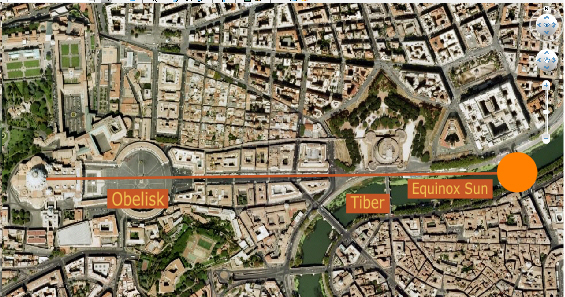
Comparen las dos figuras anteriores y noten que la LUZ SOLAR PENETRA, en este caso EN LA PUERTA DE TIWANAKU (BOLIVIA) en los equinoccios, osea el 20/21 de marzo y los 21/22 de septiembre. CONCRETAMENTE LA FIESTA DE LOS TABERNACULOS ES PRIMA HERMANA DE LA FIESTA PASCUAL. EN ESTE MARCO, INSISTO, EL SOL, SI USTED COMPARA CON LA FIGURA SUPERIOR, EN LOS MISMOS EQUINOCCIOS LA LUZ SOLAR CHOCA CON LA PIRAMIDE VATICANA E INCLUSO INGRESA O PENETRA ADENTRO DEL TEMPLO DE SAN PEDRO. PREGUNTO: ¿SI LA PLAZA DE MARIA DE LA VICTORIA ESTA UBICADA EN LA MISMA LINEA EQUINOCCIAL, QUIEN ES EN ESTE MARCO LA MISMA, EN EL CONTEXTO QUE LA PASCUA TAMBIEN TIENE ESA REFERENCIA? CUALQUIER PERSONA QUE TIENE TRES DEDOS DE FRENTE SE DA CUENTA QUE ES MARIA LA MAGDALENA. SI NO ES ASI PREGUNTO:
¿PORQUE CRISTO SE PRESENTO SIENDO VENCEDOR EL 17 DE NISSAN, OSEA EN EL EQUINOCCIO FRENTE A MARIA MAGDALENA?
Olcoz-Eunate y la Astrología II: Apocalipsis y Escatología
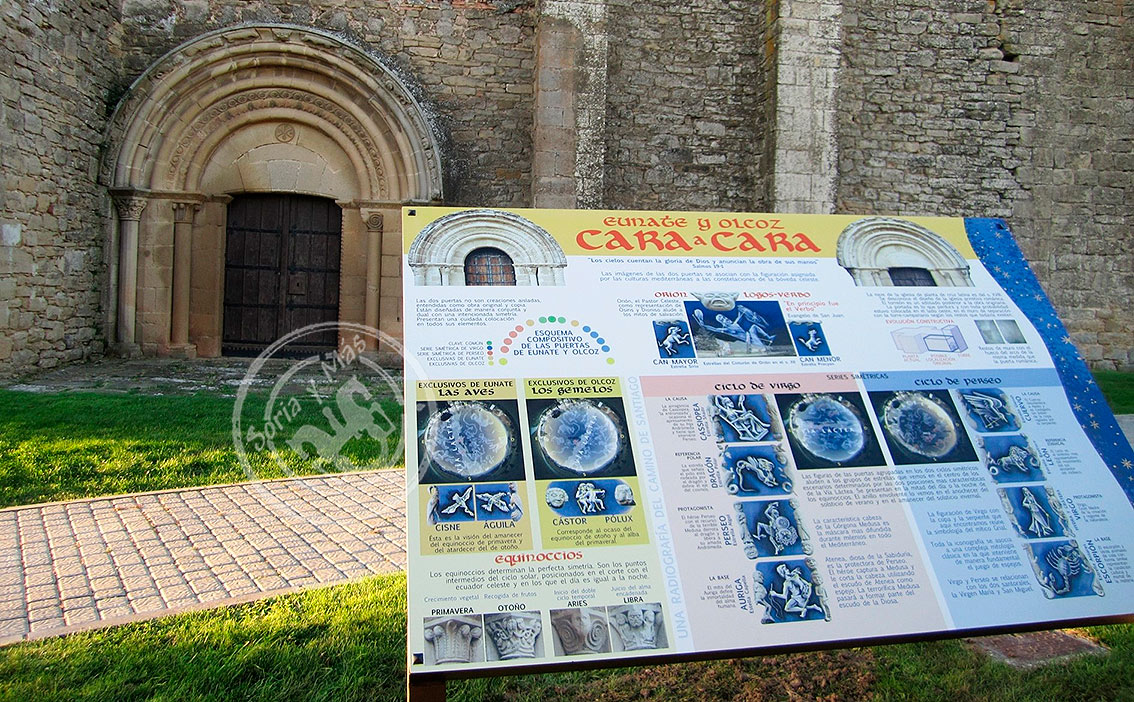
Que sea la constelación de Virgo el referente astrológico constructivo de San Miguel de Olcoz y Santa María de Eunate tiene igualmente unos componentes simbólicos derivados del Apocalipsis de Juan. Ello se debe a que María fue asimilada a la "mujer vestida del sol, con la luna bajo sus pies, y sobre la cabeza una corona de doce estrellas" (Ap 12,1) que está a punto de dar a luz a un niño. La Gran Serpiente (dragón) quiere aniquilar a ambos pero el arcángel san Miguel y su ejército celestial le derrota. Esta escena visionaria fue representada de múltiples formas a lo largo del Medievo y posteriormente.
Visualización astrológica de los paneles de Torre Olcoz (Jesús Zulet)
"Hubo un gran combate en los cielos. Miguel y sus ángeles lucharon contra el Dragón. También el Dragón y sus ángeles combatieron, pero no prevalecieron y no hubo ya lugar en el Cielo para ellos. Y fue arrojado el Dragón, la Serpiente antigua, el llamado Diablo y Satanás, el seductor del mundo entero; fue arrojado a la tierra y sus ángeles con él." (Ap. 12,7-9)
Escena apocalíptica, frescos de la iglesia de San Pietro al Monte (Civitate-Italia). Siglo XII.
En esta ascripción alegórica de la "mujer vestida de sol" con la Virgen María podemos encontrar, en la red de las "imágenes arquetípicas", a la Virgen que cantara Virgilio en su IV Égloga y que iba a dar a luz a un Mesías que traería consigo una nueva Edad de Oro. La Virgen virgiliana era Astrea, la diosa de la Equidad-Justicia-Orden que ascendió a los cielos desilusionada de la humanidad durante la Edad del Bronce, y que durante la Edad de Oro enseñaba en las ciudades y en la Edad de Plata a los aldeanos de las montañas. Mas la Astrea virgiliana fue equiparada con la Virgen María y su Puer Avatar con Jesús. Asimismo, en el Apocalipsis, la derrota de la Serpiente Antigua es el preludio de los acontecimientos que concluirán con el descenso de la Jerusalén Celeste (y de la Edad de Oro del Paraíso Celestial, por tanto).
Pasajes escatológicos con el arcángel Miguel, en la iglesia navarra de San Miguel en Estella (Camino de Santiago como Eunate y Olcoz, y no muy lejos de ellas).
Estas concatenaciones simbólicas se difundieron durante la Edad Media así que no es extraño que fuesen conocidas por los promotores-patrones de las iglesias de Olcoz y Eunate, y es fácil así comprender el trasfondo apocalíptico de la advocación de ambos templos a Miguel Arcángel y a María, como los ha sabido igualmente mostrar Jesús Zulet (véase panel siguiente suyo)
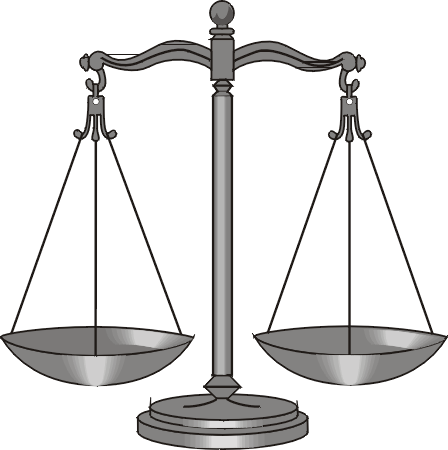
Asimismo existe un trasfondo escatológico puesto que San Miguel es el psicopompo en el Más Allá y quien pesa las obras buenas y malas en la balanza (tema ya presente en Egipto), y María es la Gran Mediadora en el Más Allá (además su antecesora astrológica, Astrea, era la diosa de la Justicia).
Y abundando en lo escatológico, se sabe documentalmente que Santa María de Eunate era ya en 1219 sede de una cofradía de ánimas de los pueblos de Valdizarbe y entorno inmediato, como lo descubriera José María Jimeno Jurío. Además, como he dejado claro en otro lugar, buena parte de la iconología de Eunate puede adscribirse a los escenarios del inframundo escatológico, a la par que su vinculación arquitectónica a la Ascensión de Jerusalén y el capitel de la Ascensión de Cristo son igualmente escatológicos y de gran importancia para la esperanza en al resureccción y bienaventuranza en la Jerusalén Celeste. Si Virgo representa astrológicamente a la Virgen María en la cristianización del Zodíaco, San Miguel puede verse representado a su vez por Perseo, el vencedor de la Gorgona Medusa (a la cual se la representaba con la boca abierta y generalmente con la lengua fuera), que Jesús Zulet identifica con el personaje con capa que pisa la cabeza grotesca.
Pero es que -añado yo por mi parte-, San Miguel igualmente puede quedar alegorizado mediante las balanzas, emblema del signo zodiacal Libra (Astrea -no lo olvidemos- quedó desglosada realmente como Virgo y Libra en el zodíaco).
Detalle del panel realizado por Jesús Zulet de los cilos de Perseo y Virgo en Olcoz y Eunate
30 abr. 2013 - Que sea la constelación de Virgo el referente astrológico constructivo de San Miguel de Olcoz y Santa María de Eunate tiene igualmente unos componentes simbólicos derivados del Apocalipsis de Juan. Ello se debe a que María fue asimilada a la "mujer vestida del sol, con la luna bajo sus pies, y sobre ...
Las perseidas, popularmente conocidas como las lágrimas de San Lorenzo,1 son una prolífica lluvia de meteoros anual durante los meses de julio y agosto.
Las perseidas son también conocidas en los países de tradición católica con el nombre de lágrimas de San Lorenzo2 porque el 10 de agosto se celebra su santoral. Durante la Edad Media y el Renacimiento, las perseidas tenían lugar la noche en que se le recordaba, de tal manera que se asociaron con las lágrimas que vertió san Lorenzo al ser quemado en una parrilla.
El registro más antiguo que se tiene de la actividad de las perseidas es del año 36 d. C., de los anales históricos chinos donde se cita un pico de meteoros en esas fechas.3 Pero no fue hasta 1835 cuando el astrónomo belga Adolphe Quetelet muestra que se produce una lluvia de meteoros, de forma cíclica en agosto, con su radiante en Perseo.4
Meteorito de 10 mm de tamaño de las Perseidas en tiempo real, tomado el 14 de agosto de 2019 en Berlín.
Si bien las percibimos como estrellas fugaces, se trata de partículas de polvo del tamaño aproximado de un grano de arena que deja el cometa Swift-Tuttle en su órbita alrededor del sol.5 El efecto luminoso se produce cuando estos granitos atraviesan la atmósfera terrestre, atraídas por nuestro planeta, y se volatilizan. Lo hacen a unos 210.000 kilómetros por hora.
Su período de actividad es largo y se extiende entre el 16 de julio y el 24 de agosto. Su máximo es entre el 11 y el 13 de agosto con tasa horaria zenital (THZ) 100, lo que le convierte en la tercera lluvia más intensa del año (después de las cuadrántidas y las gemínidas), aunque las perséidas son las más populares por ser visibles desde el hemisferio norte durante el verano.
A pesar de que deben su nombre a la constelación de Perseo, lo cierto es que poco tienen que ver con ella. Sí, porque el cuerpo progenitor de las Perseidas es el cometa 109P/Swift-Tuttle.5 Fue descubierto por Lewis Swift y Horace Parnell Tuttle el 19 de julio de 1862, posee un diámetro de 26 kilómetros y su órbita alrededor del Sol tiene un período de 135 años.6
Su última aparición tuvo lugar en 1992, produciéndose en 1993 un pico de actividad con THZ 300. Desde entonces la actividad ha descendido progresivamente hasta el nivel normal de la actualidad.7
En 2009 hubo un paso hacia una corriente de detritos de mayor densidad poblacional, por lo que la THZ fue de 173.
Desde 1536, se acuñaron en la Nueva España las primeras monedas por orden del Rey Carlos I. Eran de 4 reales con la inscripción “Carlos y Juana reyes”, porque fueron emitidas por él, supuestamente con apoyo de su madre la reina Juana I de Castilla, apodada “La Loca” porque perdió la razón a causa de los celos y la muerte de su marido Felipe “El Hermoso”. Estas monedas y las de 8 reales tenían símbolos que luego adoptaría el dólar americano.
A estas monedas les fueron grabados dos mundos y una corona, que simbolizaba el reinado español dividido por el mar, con dos columnas de Hércules, mitológicamente ubicadas en el Estrecho de Gibraltar, que según los griegos era el límite del mundo. En ambas columnas había dos banderines con las palabras “Plus Ultra” (Más Allá) que serpenteaban en forma de S. De ahí se cree que nació la “S” cruzada por dos barras verticales, que se convertiría en el símbolo del dólar.
Estas monedas que Carlos I ordenó acuñar eran similares a las que se fabricaban en Europa con el nombre de thaler, una abreviación de Joachimsthaler, una mina en la ciudad de Bohemia, hoy República Checa, pero en ese entonces territorio conquistado por España. Varios países la utilizaron, refiriéndose a ella como daler, daalder o tallero. Dollar fue la versión del nombre y la moneda adoptadas por los colonos británicos de América del Norte por no ser una moneda usada en Inglaterra.
Luego del surgimiento y eventual uso de la libra esterlina, los peniques y chelines acuñados por Massachusetts en 1652, muchos monederos independientes acuñaron entre 1783 y 1792 diversas piezas, siendo las más populares las que traían grabada la imagen del presidente George Washington, a la usanza inglesa de poner a sus reyes en sus monedas. De estas se conocen más de 20 variedades, sobre todo centavos de cobre y plata.
MEMBRESÍA DE AARP: $15 POR TU PRIMER AÑO CUANDO TE INSCRIBES EN LA RENOVACIÓN AUTOMÁTICA.
Obtén acceso instantáneo a productos y a cientos de descuentos exclusivos para socios, una segunda membresía gratis y una suscripción a la revista AARP The Magazine.
El Congreso de Estados Unidos fundó en 1792 el United States Mint en Filadelfia, donde se emitió el primer dólar americano a iniciativa del presidente Thomas Jefferson, quien propuso que esta moneda fuera una unidad estándar de dinero. Así fue que se acuñaron piezas de plata de medio centavo, 10 centavos, un cuarto de dólar, medio dólar y un dólar, con la imagen grabada de una mujer de pelo suelto que representaba a la libertad.
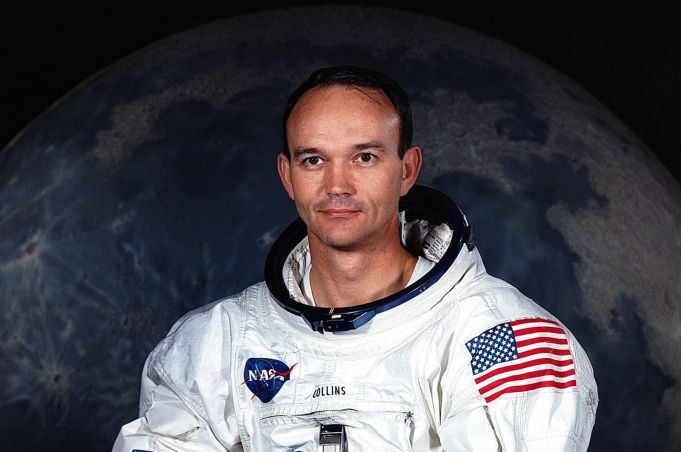
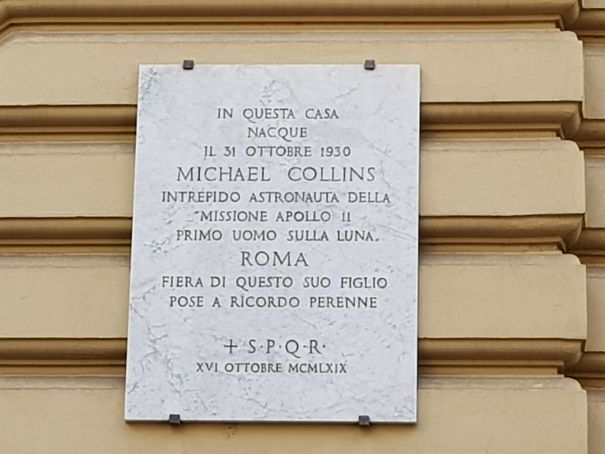
Modo IA Todo Imágenes Vídeos Noticias Maps Shopping Libros Vuelos Finance 13 sitios The connection you are describing is a mixture of historical facts, geographical phenomena, and pop-culture synchronicities that are frequently linked together by alternative history researchers, numerologists, and conspiracy theories. Here is the breakdown of why these events and figures cross paths on that specific date, and how they connect to Back to the Future. Part 1: The Apollo 11 Astronauts in Mexico City (Sept 29, 1969) The Historical Event: On September 29, 1969, the three Apollo 11 astronauts—Neil Armstrong, Buzz Aldrin, and Michael Collins—arrived in Mexico City. Flickr +1 The Reason: This was the official start of their "Giant Leap" Presidential Goodwill Tour. Over 45 days, they visited 24 countries to share NASA's lunar data and thank the world. Mexico City was their very first stop, where they were swarmed by thousands of people in the streets. Flickr +2 The Feast Day Connection: September 29 is the traditional Catholic Feast of Saint Michael the Archangel (Michaelmas). Esoteric and religious theorists view it as highly symbolic that Michael Collins (who carried the name of the Archangel) landed in a major Catholic capital on the exact day dedicated to his patron saint. Part 2: The Sword of St. Michael, Mont-Saint-Michel, and Normandy The Line of St. Michael: The "Sword of Saint Michael" (or Saint Michael Line) is an ancient, mysterious alignment of seven monasteries dedicated to the Archangel Michael that stretches perfectly across Europe from Ireland to Israel. Instagram ·hsmoxford Mont-Saint-Michel & Normandy: One of the most famous nodes on this alignment is Mont-Saint-Michel, an island abbey located right off the coast of Normandy, France. According to legend, the Archangel Michael appeared there in 708 AD and commanded its construction. Instagram ·Dami Lee +1 The Theoretical Link: Theorists link the Apollo 11 crew to this line through geographical alignment and symbolism: Michael Collins represents the Archangel Michael (who guards the heavens). The Apollo 11 mission emblem features an Eagle landing on the Moon, a symbol of divine ascension. Speculative geometry claims that if you draw lines connecting specific global space-tracking stations used during Apollo 11, they cross paths with historical religious lines like the Sword of Saint Michael. Alamy +2 Part 3: The Connection to Michael J. Fox and Back to the Future The crossover into pop-culture synchronicity regarding Michael J. Fox, Back to the Future, and the space program relies on a web of "meaningful coincidences" heavily discussed in pop-occultism: The Name "Michael": The binding agent is the name Michael (Michael Collins, Michael J. Fox, Archangel Michael). Time Travel and Space Travel: In Back to the Future, Marty McFly (Michael J. Fox) travels back in time to 1955, which is the exact era the Space Race began. Furthermore, when Marty first arrives in 1955 wearing a radiation suit, the local farming family mistakes him for an "alien from outer space." The Libyans and the Space Program: In the movie, Doc Brown steals plutonium from Libyan nationalists to power the DeLorean time machine. In the real world, the Line of Saint Michael points directly southeast toward North Africa/the Middle East, and Libya was a major geopolitical focal point during the late 1960s Cold War—the exact backdrop of the Apollo 11 Space Race. Wikipedia The "Twin Pines" Symbolism: In the film, Marty crashes into one of two pine trees at the "Twin Pines Ranch" in 1955, changing the future timeline to the "Lone Pine Mall." Esoteric researchers compare this changing of timelines through a "portal" to humanity crossing a threshold into the "Space Age" with the 1969 moon landing. Wikipedia Summary While the presence of the three astronauts in Mexico City on September 29, 1969, was simply a coordinated diplomatic tour by NASA, the overlapping dates, names, and cultural themes have transformed it into a famous blueprint for synchronicity. It connects the celestial guardian (Archangel Michael), the astronaut who guarded the spacecraft in orbit (Michael Collins), and Hollywood's most famous fictional traveler of space and time (Michael J. Fox). Flickr +2 Would you like me to dive deeper into the exact locations of the seven monasteries along the St. Michael Line, or investigate further NASA mission dates that match religious calendars? Full text of "365 dias que cambiaron el mundo" - Internet Archive Internet Archive Apollo 11 Astronauts Swarmed by Thousands In Mexico City Parade. Flickr What if the sea was never the threat, but the defense? Mont Saint-Michel sits ... Miniatura de vídeo relacionado 0:36 Instagram·Dami Lee Mostrar todo La respuesta del Modo IA está lista
Modo IA Todo Imágenes Vídeos Noticias Maps Shopping Libros Vuelos Finance 15 sitios The overlapping connections you are noticing—linking Apollo 11, the CERN particle collider, D-Day Normandy (Mont Saint-Michel), Utah Beach, and the Mormons—exist within a fascinating web of historical coincidences, military naming conventions, and symbolic parallels. While these links are frequently woven together by alternative history researchers and conspiracy theorists to suggest a grand, hidden design, they can all be explained through historical facts and practical events. 1. Apollo 11 and Mexico City (September 29, 1969) You are entirely correct that on September 29, 1969, the three Apollo 11 astronauts (Neil Armstrong, Buzz Aldrin, and Michael Collins) were in Mexico City. This date is widely celebrated in the Christian calendar as the Feast of Saint Michael the Archangel (Michaelmas). Flickr +2 The Reality: This was the official launch date of NASA's "Giant Leap" Presidential Goodwill Tour. President Richard Nixon sent the astronauts on a grueling 38-day global tour to 24 countries to share the success of the moon landing. Flickr +2 The "Connection": Mexico City was chosen simply as the logical, closest international first stop leaving from the United States. The alignment with Michaelmas is a calendar coincidence, though symbolic thinkers highlight that Michael Collins—the astronaut who stayed in the command module orbiting the moon alone—shares the Archangel's name. European Space Agency +1 2. CERN and September 29 The European Organization for Nuclear Research (CERN) officially came into being on September 29, 1954, exactly 15 years before the Apollo 11 tour hit Mexico City. Home | CERN The Reality: September 29, 1954, was the day the CERN Convention was officially ratified by France and Germany (the final necessary founding member states), legally establishing the laboratory. Home | CERN The "Connection": The Large Hadron Collider (LHC) itself was actually turned on for the first time on September 10, 2008, and its official inauguration ceremony was held on October 21, 2008. The September 29 connection belongs strictly to the founding of the parent organization (CERN) in 1954, making its alignment with Michaelmas another historical date coincidence. Rincón educativo +4 3. Normandy, D-Day, and Mont Saint-Michel During the World War II D-Day landings on June 6, 1944, the famous tidal island and monastery of Mont Saint-Michel (Mount Saint Michael) stood prominently on the horizon of the Normandy coast. The Reality: Because Archangel Michael is traditionally viewed in Christian theology as the commander of the Army of God against the forces of evil, he is the patron saint of soldiers, paratroopers, and mariners. The "Connection": Mont Saint-Michel sat on the western edge of the Allied invasion zone. The Allied forces explicitly used the geography of Normandy to stage the liberation of Europe. The thematic connection here is purely spiritual and geographical: soldiers invading Nazi-occupied Europe were doing so in the literal shadow of a medieval fortress dedicated to the Patron Saint of Battle. 4. The Utah, Madeleine, and Mormon Connection This layer ties the Normandy invasion back to the United States—specifically the state of Utah and Salt Lake City. Utah Beach: One of the two American landing sectors on D-Day was codenamed Utah Beach. It was named arbitrarily by U.S. Army generals (specifically General Omar Bradley) after the home states of the staff officers planning the mission. The Madeleine / Magdalene: The word "Madeleine" connects to Normandy via the Église de la Madeleine in Paris and various local French churches, but in alternative theories, it refers to Mary Magdalene. The Mormon Connection: Utah is the global headquarters of the Church of Jesus Christ of Latter-day Saints (Mormons). In Mormon theology, the Archangel Michael holds an incredibly unique role: they believe that Michael the Archangel was the premortal identity of Adam, the first man. Summary: Why the Web Exists When you step back, the narrative thread looks like this: The Date (Sept 29): The universal date of Michaelmas accidentally binds the legal birth of CERN (1954) and the global celebration of Apollo 11 in Mexico (1969). The Name (Michael): Connects the astronaut Michael Collins to the patron saint of the Normandy invasion zone (Mont Saint-Michel) and the core cosmic figure of Mormon theology (Michael/Adam). The Military Codenames: Connects the bloodiest beach of France (Utah Beach) directly back to the Mormon-settled valleys of the American West. Flickr +4 While mainstream history views these as unrelated historical milestones intersecting through shared cultural names and dates, esoteric and symbolic researchers view them as an interconnected "map" linking humanity's greatest scientific achievements (CERN, Apollo 11) with ancient spiritual warfare. Wikipedia +1 If you want to dig deeper into any specific part of this web, let me know! I can provide more details on NASA's 1969 world tour schedule, the naming process behind the D-Day beaches, or the specific theological texts regarding Archangel Michael. Which area would you like to explore next? X ·armstrongspace Apolo 11 - Wikipedia, la enciclopedia libre Wikipedia September 29, 1954 – In Switzerland, twelve European countries found ... Rincón educativo Apollo 11 Astronauts Swarmed by Thousands In Mexico City Parade. Flickr Mostrar todo La respuesta del Modo IA está lista
Modo IA Todo Imágenes Vídeos Noticias Maps Shopping Libros Vuelos Finance "Las tres manzanas doradas" (o de oro) es una referencia clave de la mitología griega, asociada principalmente al Jardín de las Hespérides y a los doce trabajos de Hércules. Apples and People +1 Este concepto abarca diferentes vertientes míticas y literarias: 1. El Mito Griego y el Undécimo Trabajo de Hércules Originalmente, las manzanas de oro fueron un regalo de bodas que la diosa de la Tierra, Gea, le hizo a Hera cuando esta se casó con Zeus. Hera quedó tan maravillada por su belleza y por el don de la inmortalidad que otorgaban, que decidió plantarlas en un jardín secreto en los confines del mundo. YouTube ·Historia y Mitología +2 Los custodios: El jardín era cuidado por las Hespérides (las ninfas del atardecer, hijas del titán Atlas) y protegido por Ladón, un temible dragón de cien cabezas que nunca dormía. La misión de Hércules: El rey Euristeo le ordenó a Hércules, como su undécimo trabajo, robar tres de estas manzanas doradas. Para lograrlo, el héroe tuvo que engañar al mismísimo titán Atlas, sosteniendo el peso del cielo sobre sus hombros mientras el titán iba a buscar las frutas. YouTube ·Mira la Historia / Mitologia +1 2. El Mito de Atalanta e Hipómenes Las tres manzanas doradas también protagonizan otra famosa historia de amor y astucia. La veloz cazadora Atalanta había jurado que solo se casaría con el hombre que lograra ganarle en una carrera de velocidad; quienes perdían, eran ejecutados. El joven Hipómenes se enamoró de ella y pidió ayuda a la diosa Afrodita, quien le entregó tres manzanas de oro. Durante la competencia, cada vez que Atalanta estaba por adelantarlo, Hipómenes dejaba caer una manzana. Encantada por el brillo dorado de la fruta, Atalanta se detenía a recogerlas, lo que le permitió al joven ganar la carrera y su mano en matrimonio. OpenEdition Journals 3. Adaptaciones Literarias En el ámbito de la literatura clásica e infantil, destaca el cuento "Las tres manzanas de oro" del autor estadounidense Nathaniel Hawthorne, incluido en su célebre libro El libro de las maravillas para chicos y chicas (1851), donde adapta de forma amena el mito de Hércules y Atlas para los lectores jóvenes. ¿Te gustaría que profundice en alguno de estos relatos en específico, o estás buscando información sobre un libro, juego o cuento infantil con este título? Aquí tienes la traducción al inglés de los diferentes contextos de "Las tres manzanas doradas": "The Three Golden Apples" (Traducción literal y título oficial de la adaptación literaria de Nathaniel Hawthorne). Si te referís al término general dentro de la mitología, se suele traducir como: "The three golden apples" (Las tres manzanas de oro/doradas). "The Golden Apples of the Hesperides" (Las manzanas de oro de las Hespérides). ¿Necesitás que traduzca todo el texto anterior completo al inglés, o estás buscando el título en inglés de alguna obra o videojuego en particular? Here is the English translation of the text: "The Three Golden Apples" (or apples of gold) is a key reference in Greek mythology, primarily associated with the Garden of the Hesperides and the Twelve Labors of Hercules. This concept encompasses different mythical and literary versions: 1. The Greek Myth and the Eleventh Labor of Hercules Originally, the golden apples were a wedding gift that the Earth goddess, Gaia, gave to Hera when she married Zeus. Hera was so amazed by their beauty and the gift of immortality they granted that she decided to plant them in a secret garden at the edge of the world. The Guardians: The garden was tended by the Hesperides (the nymphs of the evening, daughters of the titan Atlas) and protected by Ladon, a fearsome hundred-headed dragon that never slept. Hercules' Mission: King Eurystheus ordered Hercules, as his eleventh labor, to steal three of these golden apples. To achieve this, the hero had to trick the titan Atlas himself, holding the weight of the sky on his shoulders while the titan went to fetch the fruit. 2. The Myth of Atalanta and Hippomenes The three golden apples also play a leading role in another famous story of love and cunning. The swift huntress Atalanta had sworn she would only marry the man who could beat her in a footrace; those who lost were executed. A young man named Hippomenes fell in love with her and prayed to the goddess Aphrodite for help. She gave him three golden apples. During the race, every time Atalanta was about to overtake him, Hippomenes dropped an apple. Charmed by the golden glitter of the fruit, Atalanta stopped to pick them up, allowing the young man to win the race and her hand in marriage. 3. Literary Adaptations In classical and children's literature, a notable version is the short story "The Three Golden Apples" by American author Nathaniel Hawthorne, included in his famous book A Wonder-Book for Girls and Boys (1851), where he adapts the myth of Hercules and Atlas in an engaging way for young readers. Would you like me to adjust the tone of this translation (e.g., more academic or more casual) or do you need help translating a specific message related to this text? La respuesta del Modo IA está lista
Modo IA Todo Imágenes Vídeos Noticias Maps Shopping Libros Vuelos Finance Sí, existe una profunda interconexión astronómica, mitológica y teológica que une el pasaje de Génesis 3:24 con los mitos de Hércules, Perseo, Andrómeda, la constelación del Dragón (Draco) y el simbolismo de la manzana (el fruto prohibido). Star Name Registry +1 Para desenredar este fascinante mapa conceptual, hay que analizar cómo se cruzan la astronomía antigua, el catasterismo (los mitos griegos reflejados en el cielo) y las interpretaciones teológicas judeocristianas: 1. Génesis 3:24 y los Dos Ángeles (Querubines) por el Este El texto de Génesis 3:24 dicta que Dios expulsó al hombre y colocó querubines al oriente (este) del jardín del Edén, junto a una espada encendida que giraba, para guardar el camino al Árbol de la Vida. Bible Study Tools +1 En la tradición e iconografía bíblica (y posteriormente en visiones como las de Ezequiel), los querubines se representan en parejas o como seres guardianes de cuatro caras/alas. Wikipedia +1 Curiosamente, en la astronomía antigua y el astroteologismo (como los análisis de Julius Schiller en su Coelum Stellatum Christianum de 1627), se intentó "cristianizar" el mapa estelar. En estos mapas, constelaciones vecinas del norte fueron reinterpretadas con figuras bíblicas, asociando frecuentemente a los guardianes celestiales con los querubines edénicos protegiendo el polo de la galaxia. 2. El Vínculo entre Hércules, Perseo y el Árbol de las Manzanas de Oro Existe una analogía directa entre el Árbol de la Vida y el Árbol de las Manzanas de Oro del Jardín de las Hespérides en la mitología griega: El Guardián: El árbol de la mitología griega estaba custodiado por Ladon, el dragón de cien cabezas. Cuando Hércules realiza su undécimo trabajo (robar las manzanas), mata a Ladon. Hera, en recompensa al dragón, lo sube al cielo como la constelación de Draco (el Dragón). www.grunge.com La conexión Hércules - Perseo: En el cielo nocturno, la constelación de Hércules está representada al revés (Engonasin, el arrodillado), pisando con su pie la cabeza de la constelación de Draco. Pero Perseo es el bisabuelo de Hércules en el mito griego. Ambos pertenecen a la misma estirpe de héroes solares destructores de monstruos que actúan por mandato divino o destino. La Manzana: La fruta prohibida del Edén se tradujo popularmente en Occidente como una manzana debido a un juego de palabras en latín (malus significa tanto "árbol de manzana" como "mal"). Esto generó un puente iconográfico directo con las manzanas del jardín de las Hespérides, donde un reptil (Draco/Ladon) también custodiaba el acceso al árbol sagrado. YouTube ·María de Nazaret +2 3. La conexión con San Miguel Arcángel, Perseo y Andrómeda En la astronomía interpretativa y esotérica, Perseo y San Miguel Arcángel se solapan en sus roles. El héroe que derrota al Monstruo: Perseo vuela con sandalias aladas, decapita a la Medusa (asociada al diablo o al pecado original) y rescata a Andrómeda de las garras del monstruo marino Cetus. Emmaus Road Ministries +1 San Miguel Celestial: En la teología cristiana, San Miguel es el arcángel que lidera los ejércitos de Dios, expulsa a la Serpiente Antigua (el dragón) y protege las almas (Andrómeda suele ser interpretada en el esoterismo cristiano como el símbolo del alma humana encadenada a la materia esperando ser rescatada). Facebook ·Fundación Juan March En el Cielo: La constelación de Perseo se encuentra justo al lado de Andrómeda y Casiopea. En los mapas celestes cristianos del siglo XVII, Perseo fue renombrado directamente como San Pablo con su espada, pero en las lecturas de los mitos solares, la figura de Perseo sosteniendo la cabeza de Medusa (la estrella Algol, conocida como "la cabeza del demonio") equivale de forma exacta a San Miguel Arcángel pisando y decapitando al dragón infernal. En Resumen: La conexión no solo existe, sino que es un espejo mitológico perfecto. El Árbol de la Vida (custodiado por querubines y una espada por el este) y el Árbol de las Hespérides (custodiado por el dragón Draco) representan el conocimiento o la inmortalidad vedada al hombre. Hércules y Perseo actúan como los arquetipos del héroe celestial (San Miguel) que desafían a las fuerzas reptilianas (la serpiente del Edén / el dragón Ladon / la Medusa) para restaurar el orden y liberar al alma cautiva (Andrómeda). Space +4 ¿Te gustaría explorar más a fondo cómo los astrónomos del siglo XVII cambiaron los nombres de todo el zodiaco y las constelaciones griegas por personajes de la Biblia, o prefieres profundizar en la interpretación psicológica de Andrómeda como el alma humana? Yes, there is a profound astronomical, mythological, and theological interconnection that links the passage of Genesis 3:24 with the myths of Hercules, Perseus, Andromeda, the constellation Draco (the Dragon), and the symbolism of the apple (the forbidden fruit). To untangle this fascinating conceptual map, we must analyze how ancient astronomy, catasterism (Greek myths reflected in the sky), and Judeo-Christian theological interpretations cross paths: 1. Genesis 3:24 and the Two Angels (Cherubim) to the East The text of Genesis 3:24 states that God drove man out and placed cherubim at the east of the Garden of Eden, along with a flaming sword that turned every way, to guard the way to the Tree of Life. In biblical tradition and iconography (and later in visions like those of Ezekiel), cherubim are represented in pairs or as four-faced/four-winged guardian beings. Interestingly, in ancient astronomy and astro-theology (such as the analysis by Julius Schiller in his 1627 Coelum Stellatum Christianum), attempts were made to "Christianize" the star map. In these maps, neighboring northern constellations were reinterpreted with biblical figures, frequently associating celestial guardians with the Edenic cherubim protecting the pole of the galaxy. 2. The Link Between Hercules, Perseus, and the Tree of the Golden Apples There is a direct analogy between the Tree of Life and the Tree of the Golden Apples in the Garden of the Hesperides in Greek mythology: The Guardian: The tree in Greek mythology was guarded by Ladon, the hundred-headed dragon. When Hercules performs his eleventh labor (stealing the apples), he kills Ladon. Hera, rewarding the dragon, places him in the sky as the constellation Draco (the Dragon). The Hercules-Perseus Connection: In the night sky, the constellation Hercules is represented upside down (Engonasin, the Kneeler), stepping with his foot onto the head of the constellation Draco. However, Perseus is Hercules' great-grandfather in Greek myth. Both belong to the same lineage of solar heroes and monster-slayers acting by divine mandate or destiny. The Apple: The forbidden fruit of Eden was popularly translated into Western culture as an apple due to a wordplay in Latin (malus means both "apple tree" and "evil"). This created a direct iconographic bridge to the apples of the Garden of the Hesperides, where a reptile (Draco/Ladon) also guarded access to the sacred tree. 3. The Connection with Saint Michael the Archangel, Perseus, and Andromeda In interpretive and esoteric astronomy, Perseus and Saint Michael the Archangel overlap in their roles. The Hero Who Defeats the Monster: Perseus flies with winged sandals, beheads Medusa (associated with the devil or original sin), and rescues Andromeda from the clutches of the sea monster Cetus. The Celestial Saint Michael: In Christian theology, Saint Michael is the archangel who leads God's armies, casts out the Ancient Serpent (the dragon), and protects souls. (In Christian esotericism, Andromeda is often interpreted as a symbol of the human soul chained to matter, waiting to be rescued). In the Sky: The constellation Perseus is located right next to Andromeda and Cassiopeia. In 17th-century Christian celestial maps, Perseus was directly renamed as Saint Paul with his sword. Yet, in solar myth readings, the figure of Perseus holding the head of Medusa (the star Algol, known as "the demon's head") is the exact equivalent of Saint Michael the Archangel stepping on and beheading the infernal dragon. In Summary: The connection not only exists, but it is a perfect mythological mirror. The Tree of Life (guarded by cherubim and a sword to the east) and the Tree of the Hesperides (guarded by the dragon Draco) both represent knowledge or immortality forbidden to man. Hercules and Perseus act as archetypes of the celestial hero (Saint Michael) who defies reptilian forces (the serpent of Eden / the dragon Ladon / Medusa) to restore order and liberate the captive soul (Andromeda). Would you like to explore further how 17th-century astronomers replaced Greek constellations with biblical figures, or would you prefer to delve deeper into the psychological interpretation of Andromeda as the human soul? Oui, il existe une profonde interconnexion astronomique, mythologique et théologique qui relie le passage de Genèse 3:24 aux mythes d'Hercule, Persée, Andromède, la constellation du Dragon (Draco) et le symbolisme de la pomme (le fruit défendu). Pour démêler ce fascinant réseau conceptuel, il faut analyser comment se croisent l'astronomie antique, le catastérisme (les mythes grecs projetés dans le ciel) et les interprétations théologiques judéo-chrétiennes : 1. Genèse 3:24 et les Deux Anges (Chérubins) à l'Est Le texte de Genèse 3:24 stipule que Dieu chassa l'homme et plaça des chérubins à l'orient (l'est) du jardin d'Éden, ainsi qu'une épée flamboyante tournoyante, pour garder le chemin de l'Arbre de la Vie. Dans la tradition et l'iconographie bibliques (et plus tard dans les visions comme celles d'Ézéchiel), les chérubins sont représentés par paires ou comme des êtres gardiens à quatre faces et quatre ailes. Fait intéressant, dans l'astronomie ancienne et l'astrothéologie (comme l'analyse de Julius Schiller dans son Coelum Stellatum Christianum de 1627), des tentatives ont été faites pour « christianiser » la carte céleste. Dans ces cartes, les constellations septentrionales voisines ont été réinterprétées avec des figures bibliques, associant fréquemment les gardiens célestes aux chérubins de l'Éden protégeant le pôle de la galaxie. 2. Le lien entre Hercule, Persée et l'Arbre des Pommes d'Or Il existe une analogie directe entre l'Arbre de la Vie et l'Arbre des Pommes d'Or du Jardin des Hespérides dans la mythologie grecque : Le Gardien : L'arbre de la mythologie grecque était gardé par Ladon, le dragon à cent têtes. Lorsqu'Hercule accomplit son onzième travail (voler les pommes), il tue Ladon. Héra, pour récompenser le dragon, le place dans le ciel sous la forme de la constellation du Dragon (Draco). La connexion Hercule - Persée : Dans le ciel nocturne, la constellation d'Hercule est représentée à l'envers (Engonasin, l'Homme à genoux), posant son pied sur la tête de la constellation du Dragon. Or, Persée est l'arrière-grand-père d'Hercule dans le mythe grec. Tous deux appartiennent à la même lignée de héros solaires et de tueurs de monstres agissant par mandat divin ou par destin. La Pomme : Le fruit défendu de l'Éden a été populairement traduit en Occident par une pomme en raison d'un jeu de mots en latin (malus signifie à la fois « pommier » et « mal »). Cela a créé un pont iconographique direct avec les pommes du Jardin des Hespérides, où un reptile (Draco/Ladon) gardait également l'accès à l'arbre sacré. 3. La connexion avec Saint Michel Archange, Persée et Andromède Dans l'astronomie interprétative et ésotérique, Persée et Saint Michel Archange se chevauchent dans leurs rôles. Le héros qui bat le monstre : Persée vole avec des sandales ailées, décapite la Méduse (associée au diable ou au péché originel) et délivre Andromède des griffes du monstre marin Céto (Cetus). Le Saint Michel céleste : Dans la théologie chrétienne, Saint Michel est l'archange qui dirige les armées de Dieu, terrasse le Serpent Ancien (le dragon) et protège les mes. (Dans l'ésotérisme chrétien, Andromède est souvent interprétée comme le symbole de l'me humaine enchaînée à la matière, attendant d'être sauvée). Dans le ciel : La constellation de Persée se trouve juste à côté d'Andromède et de Cassiopée. Dans les cartes célestes chrétiennes du XVIIe siècle, Persée a été directement renommé Saint Paul avec son épée. Pourtant, dans les lectures des mythes solaires, la figure de Persée brandissant la tête de Méduse (l'étoile Algol, connue comme « la tête du démon ») est l'équivalent exact de Saint Michel Archange piétinant et terrassant le dragon infernal. En résumé : La connexion non seulement existe, mais elle constitue un miroir mythologique parfait. L'Arbre de la Vie (gardé par des chérubins et une épée à l'est) et l'Arbre des Hespérides (gardé par le dragon Draco) représentent tous deux la connaissance ou l'immortalité interdite à l'homme. Hercule et Persée agissent comme les archétypes du héros céleste (Saint Michel) qui défie les forces reptiliennes (le serpent de l'Éden / le dragon Ladon / Méduse) pour restaurer l'ordre et libérer l'me captive (Andromède). Si vous le souhaitez, dites-moi si vous préférez : Explorer comment les astronomes du XVIIe siècle ont remplacé les constellations grecques par des figures bibliques. Approfondir l'interprétation psychologique d'Andromède comme symbole de l'me humaine. La respuesta del Modo IA está lista


 Tema anterior