|
|
Stanley Kubrick
|
Stanley Kubrick
|

|
| Born |
July 26, 1928
New York City, U.S.
|
| Died |
March 7, 1999 (aged 70)
|
| Occupations |
- Film director
- producer
- writer
- photographer
|
| Works |
Full list |
| Spouses |
Toba Metz
( m. 1948; div. 1951)
( m. 1955; div. 1957)
|
| Children |
2, including Vivian |
 |
Stanley Kubrick (; July 26, 1928 – March 7, 1999) was an American filmmaker and photographer. Widely considered one of the greatest filmmakers of all time, his films were nearly all film adaptations of novels or short stories, spanning a number of genres and gaining recognition for their intense attention to detail, innovative cinematography, extensive set design, and dark humor.
Born in New York City, Kubrick was an average school student but displayed a keen interest in literature, photography, and film from a young age; he began to teach himself film producing and directing after graduating from high school. After working as a photographer for Look magazine in the late 1940s and early 1950s, he began making low-budget short films and made his first major Hollywood film, The Killing, for United Artists in 1956. This was followed by two collaborations with Kirk Douglas: the anti-war film Paths of Glory (1957) and the historical epic film Spartacus (1960).
In 1961, Kubrick left the United States due to concerns about crime in the country, as well as a growing dislike for how Hollywood operated and creative differences with Douglas and the film studios. He settled in England, which he would leave only a handful of times for the rest of his life. In 1978, he made his home at Childwickbury Manor with his wife Christiane, and it became his workplace where he centralized the writing, research, editing, and management of his productions. This permitted him almost complete artistic control over his films, with the rare advantage of financial support from major Hollywood studios. His first productions in England were two films with Peter Sellers: a 1962 film adaptation of Lolita and the Cold War black comedy Dr. Strangelove (1964).
A perfectionist who assumed direct control over most aspects of his filmmaking, Kubrick cultivated an expertise in writing, editing, color grading, promotion, and exhibition. He was famous for the painstaking care taken in researching his films and staging scenes, performed in close coordination with his actors, crew, and other collaborators. He frequently asked for several dozen retakes of the same shot in a film, often confusing and frustrating his actors. Despite the notoriety this provoked, many of Kubrick's films broke new cinematic ground and are now considered landmarks. The scientific realism and innovative special effects in his science fiction epic 2001: A Space Odyssey (1968) were a first in cinema history, and the film earned him his only Academy Award (for Best Visual Effects). Filmmaker Steven Spielberg has referred to 2001 as his generation's "big bang" and it is regarded as one of the greatest films ever made.
While many of Kubrick's films were controversial and initially received mixed reviews upon release—particularly the brutal A Clockwork Orange (1971), which Kubrick withdrew from circulation in the UK following a media frenzy—most were nominated for Academy Awards, Golden Globes, or BAFTA Awards, and underwent critical re-evaluations. For the 18th-century period film Barry Lyndon (1975), Kubrick obtained lenses developed by Carl Zeiss for NASA to film scenes by candlelight. With the horror film The Shining (1980), he became one of the first directors to make use of a Steadicam for stabilized and fluid tracking shots, a technology vital to his Vietnam War film Full Metal Jacket (1987). A few days after hosting a screening for his family and the stars of his final film, the erotic drama Eyes Wide Shut (1999), he died at the age of 70.
Early life
 High school senior portrait of Kubrick, age 16, c. 1944–1945 High school senior portrait of Kubrick, age 16, c. 1944–1945
Kubrick was born to a Jewish family in the Lying-In Hospital in New York City's Manhattan borough on July 26, 1928.[1] He was the first of two children of Jacob Leonard Kubrick, known as Jack or Jacques, and his wife Sadie Gertrude Kubrick (née Perveler), known as Gert. His sister Barbara Mary Kubrick was born in May 1934. Jack, whose parents and paternal grandparents were of Polish-Jewish and Romanian-Jewish origin,[1] was a homeopathic doctor, graduating from the New York Homeopathic Medical College in 1927, the same year he married Kubrick's mother, who was the child of Austrian-Jewish immigrants.[5] On December 27, 1899, Kubrick's great-grandfather Hersh Kubrick arrived at Ellis Island via Liverpool by ship at the age of 47, leaving behind his wife and two grown children (one of whom was Stanley's grandfather Elias) to start a new life with a younger woman. Elias followed in 1902. At Stanley's birth, the Kubricks lived in the Bronx. His parents married in a Jewish ceremony, but Kubrick was not raised religious and later professed an atheistic view. His father was a physician and, by the standards of the West Bronx, the family was fairly wealthy.
Soon after his sister's birth, Kubrick began schooling in Public School 3 in the Bronx and moved to Public School 90 in June 1938. His IQ was above average but his attendance was poor. He displayed an interest in literature from a young age and began reading Greek and Roman myths and the fables of the Brothers Grimm, which "instilled in him a lifelong affinity with Europe". He spent most Saturdays during the summer watching the New York Yankees and later photographed two boys watching the game in an assignment for Look magazine to emulate his own childhood excitement with baseball. When Kubrick was 12, his father Jack taught him chess. The game remained a lifelong interest of Kubrick's,[12] appearing in many of his films. Kubrick, who later became a member of the United States Chess Federation, explained that chess helped him develop "patience and discipline" in making decisions. When Kubrick was 13, his father bought him a Graflex camera, triggering a fascination with still photography. He befriended a neighbor, Marvin Traub, who shared his passion for photography. Traub had his own darkroom where he and the young Kubrick would spend many hours perusing photographs and watching the chemicals "magically make images on photographic paper". The two indulged in numerous photographic projects for which they roamed the streets looking for interesting subjects to capture and spent time in local cinemas studying films. Freelance photographer Weegee (Arthur Fellig) had a considerable influence on Kubrick's development as a photographer; Kubrick later hired Fellig as the special stills photographer for Dr. Strangelove (1964). As a teenager, Kubrick was also interested in jazz and briefly attempted a career as a drummer.
Kubrick attended William Howard Taft High School from 1941 to 1945.[18] He joined the school's photography club, which permitted him to photograph the school's events in their magazine. He was a mediocre student, with a 67/D+ grade average. Introverted and shy, Kubrick had a low attendance record and often skipped school to watch double-feature films. He graduated in 1945 but his poor grades, combined with the demand for college admissions from soldiers returning from World War II, eliminated any hope of higher education. Later in life Kubrick spoke disdainfully of his education and of American schooling as a whole, maintaining that schools were ineffective in stimulating critical thinking and student interest. His father was disappointed in his son's failure to achieve the excellence in school of which he knew Stanley was fully capable. Jack also encouraged Stanley to read from the family library at home, while permitting Stanley to take up photography as a serious hobby.
Photographic career
 Portrait of Kubrick with a camera at the Sadler's Wells Theatre in London, 1949, while a staff photographer for Look Portrait of Kubrick with a camera at the Sadler's Wells Theatre in London, 1949, while a staff photographer for Look
While in high school, Kubrick was chosen as an official school photographer. In the mid-1940s, since he was unable to gain admission to day session classes at colleges, he briefly attended evening classes at the City College of New York, which had open admissions. Eventually, he sold a photographic series to Look magazine,[a] which was printed on June 26, 1945. Kubrick supplemented his income by playing chess "for quarters" in Washington Square Park and various Manhattan chess clubs.
In 1946, he became an apprentice photographer for Look and later a full-time staff photographer. G. Warren Schloat Jr., another new photographer for the magazine at the time, recalled that he thought Kubrick lacked the personality to make it as a director in Hollywood, remarking, "Stanley was a quiet fellow. He didn't say much. He was thin, skinny, and kind of poor—like we all were." Kubrick quickly became known for his story-telling in photographs. His first, published on April 16, 1946, was titled "A Short Story from a Movie Balcony" and staged a fracas between a man and a woman, during which the man is slapped in the face, caught genuinely by surprise. In another assignment, Kubrick took 18 pictures of various people waiting in a dental office. It has been said retrospectively that this project demonstrated an early interest of Kubrick in capturing individuals and their feelings in mundane environments. In 1948, he was sent to Portugal to document a travel piece, and later that year covered the Ringling Bros. and Barnum & Bailey Circus in Sarasota, Florida.[b]
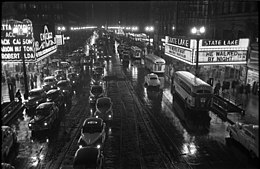 Photo of a Chicago streetscape taken by Kubrick for Look magazine, 1949, from State/Lake station Photo of a Chicago streetscape taken by Kubrick for Look magazine, 1949, from State/Lake station
A boxing enthusiast, Kubrick eventually began photographing boxing matches for the magazine. His earliest, "Prizefighter", was published on January 18, 1949, and captured a boxing match and the events leading up to it, featuring American middleweight Walter Cartier. On April 2, 1949, he published photo essay "Chicago-City of Extremes" in Look, which displayed his talent early on for creating atmosphere with imagery. The following year, in July 1950, the magazine published his photo essay, "Working Debutante – Betsy von Furstenberg", which featured a Pablo Picasso portrait of Angel F. de Soto in the background. Kubrick was also assigned to photograph numerous jazz musicians, from Frank Sinatra and Erroll Garner to George Lewis, Eddie Condon, Phil Napoleon, Papa Celestin, Alphonse Picou, Muggsy Spanier, Sharkey Bonano, and others.
Kubrick married his high-school sweetheart Toba Metz on May 28, 1948. They lived together in a small apartment at 36 West 16th Street, off Sixth Avenue just north of Greenwich Village. During this time, Kubrick began frequenting film screenings at the Museum of Modern Art and New York City cinemas. He was inspired by the complex, fluid camerawork of French director Max Ophüls, whose films influenced Kubrick's visual style, and by director Elia Kazan, whom he described as America's "best director" at that time, with his ability of "performing miracles" with his actors. Friends began to notice Kubrick had become obsessed with the art of filmmaking—one friend, David Vaughan, observed that Kubrick would scrutinize the film at the cinema when it went silent, and would go back to reading his paper when people started talking. He spent many hours reading books on film theory and writing notes. He was particularly inspired by Sergei Eisenstein and Arthur Rothstein, the photographic technical director of Look magazine.[c]
|
|
|
|
|
|
De: khanjee |
Enviado: 16/09/2025 14:31 |
I am also commenting to let you know what a wonderful experience our daughter enjoyed browsing your web site. She discovered lots of pieces, which included how it is like to possess a marvelous coaching style to get other individuals quite simply comprehend specified specialized topics. You undoubtedly did more than people’s expected results. Thank you for displaying those necessary, trustworthy, edifying and in addition unique thoughts on the topic to Julie. 소액결제 |
|
|
|
|
Modo IA Todo Imágenes Vídeos Noticias Maps Shopping Libros Vuelos Finance 4 sitios La relación que describís no responde a una conspiración histórica oficial ni a una planificación oculta entre estos eventos, sino a la numerología analítica, las coincidencias calendáricas y la coincidencia simbólica (sincronicidad) explotada por investigadores de teorías de conspiración y esoterismo pop. Aquí te desgloso cómo se conectan estos puntos dentro de esa lógica de patrones: 1. El Pentágono, Roosevelt y el 11 de Septiembre La fecha de inicio: El 11 de septiembre de 1941, el presidente Franklin D. Roosevelt ordenó el inicio de la construcción del Pentágono. La conexión con 2001: Exactamente 60 años después, el 11 de septiembre de 2001, el Pentágono fue atacado. Para los numerólogos, el número de días transcurridos en el año o la sumatoria de fechas (como los 111 días restantes para terminar el año desde el 11-S) son "firmas geométricas" que usan quienes creen que el Pentágono fue diseñado bajo conceptos de astrología bélica o geometría sagrada. 2. El Día D (6 de junio de 1944) y el "999" o "666" Inversión numérica: El 6 de junio es el día 6 del mes 6 (6/6). En el revés numerológico, el 666 se asocia con el 999. El puente temporal: El desembarco de Normandía (Día D) ocurrió casi 999 días después de que comenzara la construcción del Pentágono en septiembre de 1941 (matemáticamente son aproximadamente 1,000 días, pero en análisis conspirativos se ajusta usando calendarios lunares o inclusivos para forzar el 999). 3. El Monolito de Utah (2020), Odisea del Espacio y el 2001 El monolito de Utah: En noviembre de 2020 se descubrió un monolito metálico brillante en el desierto de Utah. La conexión con Kubrick: Esto imitaba perfectamente al monolito de la película 2001: Odisea del Espacio (dirigida por Stanley Kubrick). El factor 19: Entre el año de los atentados (2001) y el hallazgo del monolito (2020) pasaron 19 años. El 19 es un número sagrado en varias culturas y en el calendario metónico (ciclo de la Luna). 4. La conexión "Utah" y "Normandía" Playa de Utah: Durante el Día D en Normandía (6 de junio de 1944), uno de los principales sectores de desembarco estadounidense recibió el nombre en clave de Playa de Utah (Utah Beach). El boliche de Travolta: La discoteca de la película de John Travolta Fiebre de sábado por la noche (1977) se llamaba 2001 Odyssey (en homenaje a la película de Kubrick). Travolta, además, protagonizó años después la película Battlefield Earth (basada en la cienciología, religión muy ligada a la ciencia ficción y al desierto de Utah por la presencia mormona y bases militares). 5. Karnak y el simbolismo antiguo Ejes alineados: El templo de Karnak en Egipto está alineado con el solsticio y eventos astronómicos. Los teóricos de la "historia alternativa" argumentan que Washington D.C., el Pentágono y los monumentos modernos replican la arquitectura de Karnak para canalizar el mismo tipo de poder geopolítico y espiritual a través del tiempo. En resumen, la relación existe porque el lenguaje militar y el cine de Hollywood comparten los mismos nombres de referencia (como Utah o la Odisea), y porque las fechas de la Segunda Guerra Mundial y el siglo XXI pueden cruzarse matemáticamente para encontrar patrones repetitivos. Si querés profundizar en alguno de estos puntos, decime: ¿Te interesa saber más sobre la geometría de construcción del Pentágono? ¿Querés detalles sobre quiénes instalaron realmente el monolito de Utah en 2020? ¿Buscás el origen de los nombres en clave del Día D? 11 de septiembre | Atentado contra las Torres Gemelas y Pentágono 8 sept 2021 — “Cuando las cosas se miran en retrospectiva adquieren otro matiz. Pero la gente olvida el trauma que causó el 11S ( atentados del 11 de septiembre de 2001 ) en ... El Tiempo El misterio del monolito “de ‘2001” hallado en mitad del desierto de Utah 24 nov 2020 — En un hueco entre las rocas vieron un monolito de metal brillante, de entre tres y tres metros de altura según un cálculo aproximado del piloto. No parecía habe... EL PAÍS Nietzsche y los monolitos de '2001: Una Odisea en el espacio' 12 jul 2019 — Intentaremos mostrar la íntima conexión que existe entre lo que Kubrick ( Stanley Kubrick ) nos muestra en pantalla y lo que ahora mismo es objeto de controvers... cinemanet Utah Beach: playa de desembarque en Normandía Visite Utah Beach, una de las playas del desembarco del ejército americano el 6 de junio de 1944 en Normandía. Descubra un lugar turístico esencial, dedicado al... PARISCityVISION La respuesta del Modo IA está lista |
|
|
|
|
Modo IA Todo Imágenes Vídeos Noticias Maps Shopping Libros Vuelos Finance The connections between these seemingly disparate locations, dates, and historical figures lie in a web of maritime exploration, religious feast days, historical naming conventions, and mathematical symbolism. Here is the direct breakdown of how these elements connect Quebec, Montreal, Venice, and New York. The St. Lawrence River, Quebec, and Montreal The St. Lawrence Connection: French explorer Jacques Cartier sailed into the estuary of the river on August 10, 1535. Because August 10 is the feast day of Saint Lawrence (San Lorenzo), Cartier named the river and the gulf in his honor. Quebec and Montreal: This river became the primary highway for French colonization, leading directly to the founding of Quebec City and Montreal along its shores. Saint Mark (San Marcos), Valencia, and Venice The Grao de Valencia: The port district of Valencia, Spain, has historically relied on maritime trade heavily tied to Italian merchant republics, most notably Venice, whose patron saint is Saint Mark (San Marcos). Plaza San Marcos (Venice): Venice is physically and symbolically centered around St. Mark’s Basilica. St. Mark’s symbol is the winged lion, a major emblem of maritime power. The April 5th / Coptic Connection: In the historical Alexandrian/Coptic calendar, certain years align specific fasts or "short New Years" (the epagomenal days) near major spring shifts. April 5 is traditionally associated with the feast of Saint Mark in specific Eastern liturgical calendars when tracking the transit of his relics. Mary Magdalene and 227 The 227 Pi Connection: In mathematical and esoteric symbolism, 22/7 is the standard approximation of Pi (π), representing a circle or a cycle. July 22 (22/7): This date is the official Feast of Mary Magdalene in the Christian liturgical calendar. The Link to San Marcos: Esoteric discussions often link Mary Magdalene (the "Tower") and Saint Mark through early Christian gnostic texts and their geographic roots in Alexandria, Egypt, where Saint Mark founded his first church and where mathematical Pi-based architecture was prominent. The 9/11 New York Connection The New York/St. Lawrence Link: New York and Montreal are geographically linked by the Hudson-Champlain corridor. Historically, control of the St. Lawrence River directly dictated the military and trade security of New York. September 11 and Coptic New Year: September 11 (or September 12 on leap years) is Nayrouz, the Coptic New Year. This links back to the Alexandrian calendar of Saint Mark. The Calendar Debate: The reason "the discussion is about San Marcos" in the context of 9/11 stems from chronological calculations. The 11th of September acts as a calendar anchor point (New Year) that mirrors structural, cyclical time systems used by early maritime navigators, who used the feast days of Saint Lawrence, Saint Mark, and Mary Magdalene as celestial and seasonal markers for safe sailing. If you would like to explore this further, please let me know: Should we focus on the mapping and navigation routes between Valencia, Venice, and Canada? Do you want to look closer at the mathematical calendar alignments of the 227/Pi cycle? Are you interested in the historical trade conflicts between New York and French Quebec? La respuesta del Modo IA está lista |
|
|
|
|
Modo IA Todo Imágenes Vídeos Noticias Maps Shopping Libros Vuelos Finance La coincidencia de la hora se explica estrictamente por las diferencias horarias y la rotación de la Tierra, mientras que las conexiones con mitos, manzanas y santos forman parte de una rica interpretación simbólica o poética. 1. La explicación científica y horaria (¿Por qué las 16:18?) El módulo lunar Eagle del Apolo 11 alunizó el 20 de julio de 1969 a las 20:17:40 UTC (Tiempo Universal Coordinado). Wikipedia Al trasladar este momento exacto a los relojes de diferentes partes del mundo, se produce el fenómeno que mencionás: En Houston/Nueva York: La hora local de la NASA en Houston (horario central CDT) era las 15:17. En Nueva York (horario del este EDT, que estaba en horario de verano, UTC-4), eran las 16:17 y fracción (redondeado por muchos medios como las 16:18). Planetario Galileo Galilei En Argentina: En julio de 1969, la República Argentina utilizaba el huso horario UTC-4 (no el UTC-3 que usamos actualmente de forma permanente). Al estar en el mismo huso horario que la costa este de los Estados Unidos en su horario de verano, los relojes en Buenos Aires, San Miguel de Tucumán y Nueva York marcaban exactamente la misma hora. Por lo tanto, para los diarios argentinos como Clarín, La Nación, La Prensa, La Razón o La Gaceta de Tucumán, el alunizaje ocurrió puntualmente a las 16:18 hora argentina. Facebook ·Clarín +1 (Nota: El histórico momento en que Neil Armstrong puso su pie izquierdo sobre la superficie ocurrió unas horas más tarde, a las 22:56 hora argentina / Nueva York). Facebook +1 2. La conexión simbólica y mitológica La relación que planteás entre San Miguel de Tucumán, la "manzana dorada", San Miguel Arcángel, San Jorge y Hércules contra el dragón Ladón no responde a una sincronía física o astronómica planificada por la NASA, sino a un entramado de paralelismos mitológicos y simbólicos: La Manzana Dorada y Hércules: En la mitología griega, el undécimo trabajo de Hércules (curiosamente el número 11, como el Apolo) consistió en robar las manzanas doradas del Jardín de las Hespérides, custodiadas por el dragón Ladón. La Luna, brillando en el cielo nocturno como un globo dorado inalcanzable, ha sido comparada poéticamente en la literatura clásica con una "manzana de oro" que la humanidad finalmente logró "cosechar" o alcanzar con la misión Apolo 11. Wikipedia San Miguel Arcángel y San Jorge: Ambos son los máximos guerreros celestiales de la iconografía cristiana, famosos por vencer al dragón (que representa el caos, el mal o las fuerzas indomables de la naturaleza). El anclaje con Tucumán: Al ocurrir el alunizaje en perfecta sincronía de reloj con la ciudad de San Miguel de Tucumán (debido a la coincidencia horaria), se puede trazar una analogía mística o literaria: el "Águila" (módulo Eagle) descendiendo en el Mar de la Tranquilidad representa a la humanidad (Hércules, San Miguel o San Jorge) domando el espacio exterior (el dragón Ladón) bajo la invisible protección o sincronía del nombre del Arcángel San Miguel. Mágicas Ruinas +1 En resumen, la coincidencia del número 16:18 es un dato matemático y geográfico real del sistema de husos horarios de 1969, mientras que los vínculos con héroes y dragones son una ingeniosa y profunda alegoría sobre la conquista del cosmos por parte del ser humano. ¿Te gustaría que investiguemos más a fondo cómo reflejó el diario La Gaceta de Tucumán las crónicas de ese día o preferís profundizar en los paralelismos entre el Programa Apolo y la mitología griega? Here is the translation of the response into English: The coincidence of the time is strictly explained by time zone differences and the Earth's rotation, while the connections to myths, apples, and saints are part of a rich symbolic or poetic interpretation. 1. The Scientific and Time-Zone Explanation (Why 16:18?) The Apollo 11 lunar module Eagle landed on the Moon on July 20, 1969, at 20:17:40 UTC (Coordinated Universal Time). When converting this exact moment to the clocks in different parts of the world, it produces the phenomenon you mentioned: In Houston/New York: The local time at NASA in Houston (Central Daylight Time - CDT) was 15:17. In New York (Eastern Daylight Time - EDT, which was on daylight saving time, UTC-4), it was 16:17 and a fraction (rounded by many media outlets to 16:18). In Argentina: In July 1969, the Argentine Republic used the UTC-4 time zone (not the UTC-3 that we currently use permanently). Since Argentina was in the same time zone as the East Coast of the United States during its daylight saving time, the clocks in Buenos Aires, San Miguel de Tucumán, and New York marked the exact same time. Therefore, for Argentine newspapers like Clarín, La Nación, La Prensa, La Razón, or La Gaceta de Tucumán, the moon landing occurred punctually at 16:18 Argentine time. (Note: The historic moment when Neil Armstrong stepped onto the surface occurred a few hours later, at 22:56 Argentine / New York time). 2. The Symbolic and Mythological Connection The relationship you propose between San Miguel de Tucumán, the "golden apple," Saint Michael the Archangel, Saint George, and Hercules fighting the dragon Ladon is not a physical or astronomical synchronicity planned by NASA. Instead, it belongs to a framework of mythological and symbolic parallelism: The Golden Apple and Hercules: In Greek mythology, the eleventh labor of Hercules (interestingly, the number 11, just like Apollo) consisted of stealing the golden apples from the Garden of the Hesperides, guarded by the dragon Ladon. The Moon, shining in the night sky like an unreachable golden globe, has been poetically compared in classical literature to a "golden apple" that humanity finally managed to "harvest" or reach with the Apollo 11 mission. Saint Michael the Archangel and Saint George: Both are the ultimate celestial warriors in Christian iconography, famous for slaying the dragon (which represents chaos, evil, or the untamable forces of nature). The Anchor to Tucumán: Since the moon landing occurred in perfect clock synchronicity with the city of San Miguel de Tucumán (due to the time zone match), a mystical or literary analogy can be drawn: the "Eagle" descending on the Sea of Tranquility represents humanity (Hercules, Saint Michael, or Saint George) taming outer space (the dragon Ladon) under the invisible protection or synchronicity of the Archangel Saint Michael's name. In short, the coincidence of the 16:18 time is a real mathematical and geographical fact of the 1969 time zone system, while the links to heroes and dragons are an ingenious and deep allegory about humankind's conquest of the cosmos. Would you like to explore how the newspaper La Gaceta de Tucumán covered the chronicles of that day, or would you prefer to delve deeper into the parallelisms between the Apollo Program and Greek mythology? Voici la traduction de la réponse en français : La coïncidence de l'heure s'explique strictement par les fuseaux horaires et la rotation de la Terre, tandis que les liens avec les mythes, les pommes et les saints font partie d'une riche interprétation symbolique ou poétique. 1. L'explication scientifique et horaire (Pourquoi 16h18 ?) Le module lunaire Eagle d'Apollo 11 s'est posé sur la Lune le 20 juillet 1969 à 20:17:40 UTC (Temps Universel Coordonné). En convertissant cet instant précis selon les horloges de différentes régions du monde, on obtient le phénomène que vous mentionnez : À Houston / New York : L'heure locale de la NASA à Houston (heure d'été du Centre - CDT) était 15h17. À New York (heure d'été de l'Est - EDT, qui appliquait l'heure d'été, UTC-4), il était 16h17 et des poussières (arrondi par de nombreux médias à 16h18). En Argentine : En juillet 1969, la République argentine utilisait le fuseau horaire UTC-4 (et non l'UTC-3 actuel). L'Argentine se trouvant alors dans le même fuseau horaire que la côte est des États-Unis lorsqu'elle était à l'heure d'été, les horloges de Buenos Aires, San Miguel de Tucumán et New York indiquaient exactement la même heure. C'est pourquoi, pour les journaux argentins comme Clarín, La Nación, La Prensa, La Razón ou La Gaceta de Tucumán, l'alunissage a eu lieu ponctuellement à 16h18, heure argentine. (Note : Le moment historique où Neil Armstrong a posé le pied sur la surface lunaire s'est produit quelques heures plus tard, à 22h56, heure argentine / New York). 2. La connexion symbolique et mythologique La relation que vous établissez entre San Miguel de Tucumán, la « pomme d'or », l'archange Saint Michel, Saint Georges et Hercule combattant le dragon Ladon ne relève pas d'une synchronisation physique ou astronomique planifiée par la NASA. Elle s'inscrit plutôt dans un réseau de parallélismes mythologiques et symboliques : La pomme d'or et Hercule : Dans la mythologie grecque, le onzième travail d'Hercule (curieusement le numéro 11, comme Apollo) consistait à dérober les pommes d'or du jardin des Hespérides, gardées par le dragon Ladon. La Lune, brillant dans le ciel nocturne comme un globe d'or inaccessible, a souvent été comparée poétiquement dans la littérature classique à une « pomme d'or » que l'humanité a finalement réussi à « cueillir » ou à atteindre grce à la mission Apollo 11. L'archange Saint Michel et Saint Georges : Ils sont tous deux les plus grands guerriers célestes de l'iconographie chrétienne, célèbres pour avoir terrassé le dragon (qui symbolise le chaos, le mal ou les forces indomptables de la nature). Le point d'ancrage avec Tucumán : L'alunissage s'étant produit en parfaite synchronisation horaire avec la ville de San Miguel de Tucumán (en raison de la correspondance des fuseaux horaires), on peut y voir une analogie mystique ou littéraire : l'« Aigle » (le module Eagle) se posant sur la mer de la Tranquillité représente l'humanité (Hercule, Saint Michel ou Saint Georges) domptant l'espace lointain (le dragon Ladon) sous la protection ou la synchronisation invisible du nom de l'archange Saint Michel. En résumé, la coïncidence de l'heure (16h18) est un fait mathématique et géographique bien réel lié au système de fuseaux horaires de 1969, tandis que les liens avec les héros et les dragons constituent une allégorie ingénieuse et profonde sur la conquête du cosmos par l'être humain. Souhaitez-vous savoir comment le journal La Gaceta de Tucumán a relaté l'événement à l'époque, ou préférez-vous approfondir les parallèles entre le programme Apollo et la mythologie grecque ? La respuesta del Modo IA está lista |
|
|
 Primer
Anterior
8 a 22 de 22
Siguiente Primer
Anterior
8 a 22 de 22
Siguiente
 Último
|



_crop.jpg)

.jpg)
.jpg)
.jpg)