Página principal  |  Contacto  

Correo electrónico:

Contraseña:

Registrarse ahora!

¿Has olvidado tu contraseña?

DESENMASCARANDO LAS FALSAS DOCTRINAS
 
Novedades
  Únete ahora
  Panel de mensajes 
  Galería de imágenes 
 Archivos y documentos 
 Encuestas y Test 
  Lista de Participantes
 YHWH (DIOS PADRE) EL UNICO DIOS 
 JESUCRISTO NUESTRO MESIAS JUDIO 
 LOS DIEZ MANDAMIENTOS DE LA BIBLIA 
 MEJORE SU CARACTER Y SU VIDA 
 YOU TUBE-MAOR BA OLAM-LINKS 
 YOU TUBE-MAOR BA OLAM-LINKS II 
 BIBLIAS/CONCORDANCIA/LIBROS 
 MAYOR ENEMIGO DEL HOMBRE ES UNO MISMO 
 ¿LA TORA ES MACHISTA? -MENSAJE ESOTERICO Y EXOTERICO 
 ¿ES INMORTAL EL ALMA?- FALACIA DE LA ENCARNACION Y REENCARNACION 
 EL ISLAM TIENE ORIGEN UNITARIO ADOPCIONISTA 
 ANTIGUO TESTAMENTO-ESTUDIO POR VERSICULOS 
 NUEVO TESTAMENTO-ESTUDIOS POR VERSICULOS 
 NUEVO TESTAMENTO II-ESTUDIOS POR VERSICULOS 
 NUEVO TESTAMENTO III-ESTUDIOS POR VERSICULOS 
 CRISTO NO TUVO PREEXISTENCIA 
 ¿QUE ES EL ESPIRITU SANTO? 
 
 
  Herramientas
 
General: DOCTOR BROWN 1.21 GIGAWATTS GREAT SCOTT SCOTLAND/JAMES WATT/TRANSFIGURATION
Elegir otro panel de mensajes
Tema anterior  Tema siguiente
Respuesta  Mensaje 1 de 143 en el tema 
De: BARILOCHENSE6999  (Mensaje original) Enviado: 16/12/2024 16:34
Electricity Flows like Water - Learn Arduino
 
Work Formula Triangle Physics Relationship Between Work Done Force And  Distance With Equations Isolated On White Stock Illustration - Download  Image Now - iStock
 
Work Done- Physics | Mind Map
Work! | Melissa Middlebrooks
energia cinetica y potencial - Buscar con Google | Energía cinética, Energia  electrica, Tipos de energia
PORQUE EL NARCISISMO ES EL MAYOR ENEMIGO DE CRISTO, MAGDALENA Y JUAN  MARCOS? - DESENMASCARANDO LAS FALSAS DOCTRINAS - Gabitos
Work Done By a Constant Torque - Power & Moment of Inertia - Rotational  Motion Physics Problems
Rotational Power, Work, Energy, Torque & Moment of Inertia - Physics  Problems
Angular Velocity Physics Problems, Linear Speed, Frequency & Period
Omega symbol physics: uppercase and lowercase omega symbol meaning
 
 
Respuesta  Mensaje 36 de 36 en el tema 
De: BARILOCHENSE6999 Enviado: 16/12/2024 13:01
James watt. - ppt download
Amazon.com: James Watt and the Steam-Engine eBook : Rupert Sargent Holland:  Kindle Store
James Watt: Father of the Industrial Revolution - Engineer's Planet
80's Classic Back To The Future Doc Brown "Great Scott!" Custom Tee Any  Size | Back to the future, Doc brown, Great scott
great scott! on Tumblr
Great Scott GIFs - Get the best GIF on GIPHY
great_scott-s400x341-252428 - Un geek en Colombia
Great Scott! 1.21 JINGLE WATTS! (Back to the Future) Luxury Lined Notebook  - Journal Diary Writing Paper Note Pad Book Movie Prop Replica 1.21  Gigawatts BTTF Flux Capacitor Christmas: Wheeler, Jay: 9798583643912:  Amazon.com: Books
DeLorean of 'Back to the Future' fame is back with a new electric car -  YouTube
Pegatinas: Doc Brown | Redbubble
Fumo blu - Fumo blu added a new photo.
 
DeLorean Hire - Hire from Sandstone Productions
Docbrown Backtothefuture GIF - Docbrown Backtothefuture Gigawatt - Discover  & Share GIFs
80s Quotes - BACK TO THE FUTURE Doc Brown: 1.21 gigawatts!...
A very detailed map of Scotland I made to celebrate the beauty of Scottish  Landscapes and its fascinating physical geography ! ????????????????????????????????️ :  r/MapPorn
Scotland | History, Capital, Map, Flag, Population, & Facts | Britannica
Scotland - Geography, Culture and Economy - YouTube


Primer  Anterior  54 a 68 de 143  Siguiente   Último 
Respuesta  Mensaje 54 de 143 en el tema 
De: BARILOCHENSE6999 Enviado: 14/04/2025 03:00
80's Classic Back To The Future Doc Brown "Great Scott!" Custom Tee Any  Size | Back to the future, Doc brown, Great scott
great scott! on Tumblr
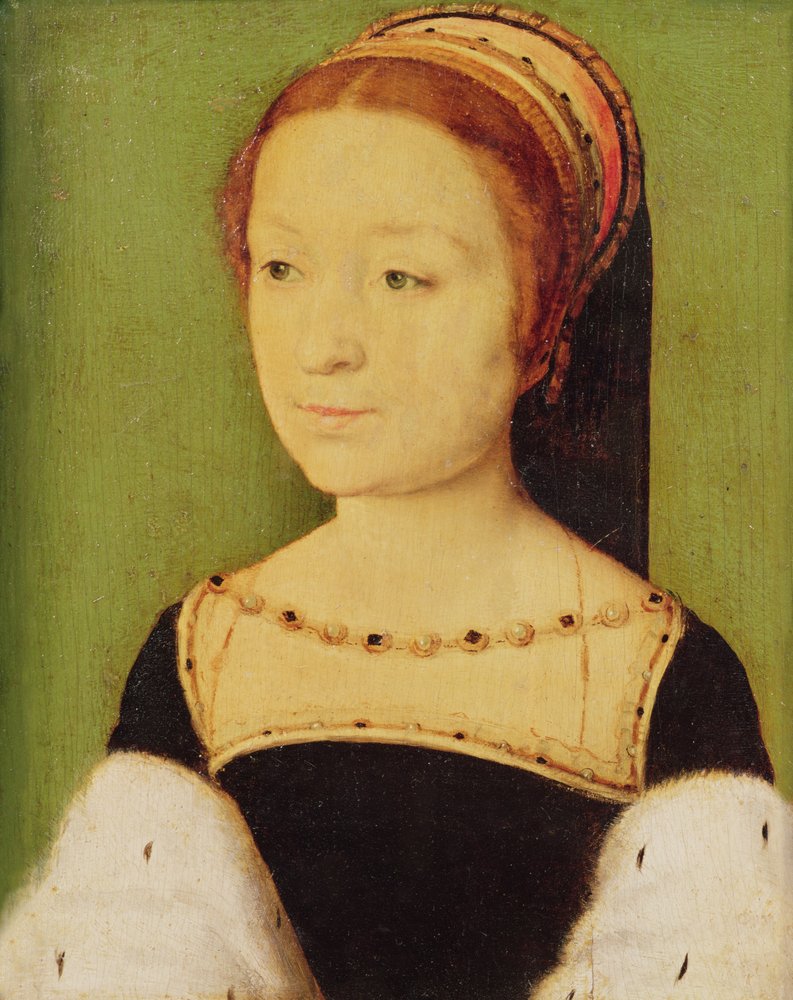
Madeleine de France, Queen of Scotland, 1536 by Corneille de Lyon
   

Madeleine de France, Queen of Scotland, 1536

(Madeleine de France (1520-37) Queen of Scotland, 1536 )

https://www.meisterdrucke.us/fine-art-prints/Corneille-de-Lyon/80721/Madeleine-de-France,-Queen-of-Scotland,-1536.html

SCOTTISH RITE BLOG

The House of the Temple: A History

House of Temple Header Image

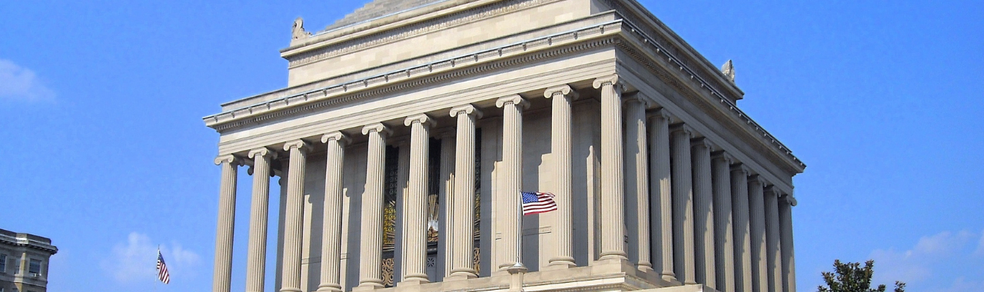
The House of the Temple is a Masonic temple in Washington, D.C. that serves as the headquarters of the Scottish Rite of Freemasonry, Southern Jurisdiction.

“The Temple should be built right, so that it could, and would be pointed to, by our brethren here and elsewhere, as the pride of the Mother Council of the Rite and all Scottish Rite Masons in the world. We are building a Temple, a permanent home, in the Great Capital of the Greatest nation of the Earth. I would prefer to be criticized for building a Temple, considered by some, too fine and costly, rather than for a cheap or mediocre building, surrounded as it will be, by the beautiful structures of our Capital. Better not build at all, than only half way build, while we are engaged in the laudable enterprise. (1911 Transactions, p. 125). — Grand Commander James D. Richardson (1911)

From the Masonic Temple in Detroit to Freemasons Hall in Copenhagen, Masonic structures around the world proudly represent our ancient fraternity. For over a century, the House of the Temple in Washington, D.C. has been one of the most awe-inspiring monuments to Freemasonry in the United States. Today, this majestic building serves as the headquarters of the Scottish Rite, Southern Jurisdiction. It also houses an extensive library and archives responsible for preserving records that are valuable pieces of Scottish Rite history.

The outside of the House of the Temple in Washington, D.C.The Scottish Rite of Freemasonry's House of the Temple in Dupont Circle, Washington, D.C.


Breaking Ground

In October 1909, the Supreme Council of the Scottish Rite, Southern Jurisdiction passed a resolution to enlarge or extend the existing House of the Temple in Washington, D.C., or to erect a new one. With a grand vision for the Scottish Rite headquarters, Grand Commander James D. Richardson sought to erect a magnificent new building that would inspire Scottish Rite Freemasons everywhere.

The search for designs began immediately and the winning submission was awarded to American architect John Russell Pope. Pope’s firm is now famous for designing several prominent public buildings in Washington, D.C., including the National Archives and Records Administration building, the Jefferson Memorial, and the West Building of the National Gallery of Art. At the time, however, Pope was an ambitious young architect attempting to make a name for himself. Pope's design for the new Temple was based on one of the Seven Wonders of the Ancient World: The Tomb of Mausolus at Halicarnassus, Turkey.

A photo of the House of the Temple under constructionThe House of the Temple during construction.

On April 16, 1910, the Scottish Rite officially hired Pope to make "the new Temple as magnificent as art and money can make it." The groundbreaking for the new House of the Temple was scheduled to occur in the following spring on May 31, 1911 (the 110th anniversary of the Supreme Council’s founding). The ceremony for laying the cornerstone was held later that year on October 18th and used the same Bible, candlesticks, trowel, and gavel used by Freemason and President George Washington when he laid the cornerstone of the U.S. Capitol in 1793.

There is little debate that Pope successfully achieved the Grand Commander’s vison of building a spectacular Masonic temple. Sadly, Grand Commander Richardson passed away on July 24, 1914, before he could see the new House of the Temple completed. Construction on the building finished over a year after his death, in October 1915. Richardson’s successor, Grand Commander, George F. Moore, led the dedication ceremony opening the Supreme Council’s new headquarters.

A Structure of Great Renown

When visiting the House of the Temple, it is easy to be overwhelmed by the beauty of such an artistic and architectural accomplishment. Pope’s peers seemed to agree; in January 1916, the London Architectural Review wrote "this monumental composition may surely be said to have reached the high-water mark of achievement in that newer interpretation of the Classic style with which modern American architecture is closely identified."

Indeed, it was years before praise for the structure simmered down. In 1917, the design received the gold medal from the Architectural League of New York. During the 1920s, the House of the Temple was ranked as one of the three best public buildings in the United States.

Art historian Royal Cortissoz wrote of the building in The Architecture of John Russell Pope, Vol. 2: "I cannot write temperately of the Temple of the Scottish Rite in Washington. I never see it without an uplifting of the heart; it is so vitalized an expression of imaginative power."

Architectural Significance

The House of the Temple is an essential part of Masonic history and not only because it houses one of the two governing bodies of Scottish Rite Freemasonry in the United States. Despite not being a Mason himself, John Russell Pope incorporated Masonic signs, symbols, and ideals into the building’s design, ensuring it would stand as a genuine monument to Scottish Rite Freemasons.

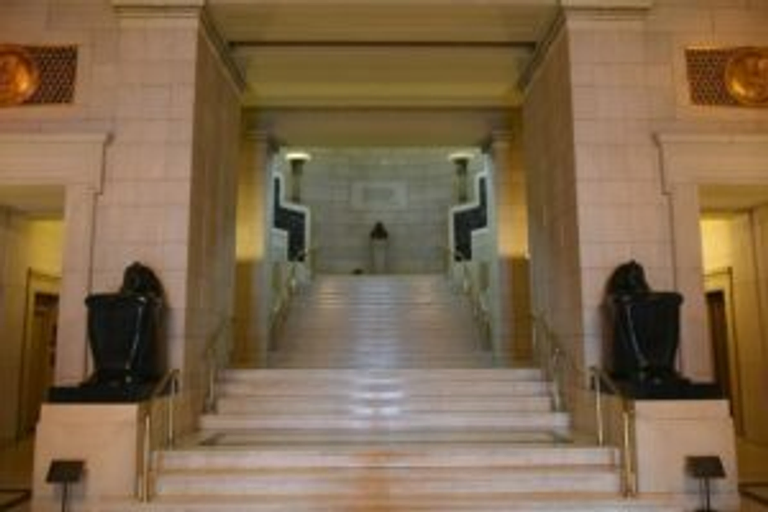
A photo of the House of the Temple’s interior stairsThe House of the Temple’s interior granite stairs.

Inside the building, the granite stairs rising from the building’s main entrance are arranged in groups of three, five, seven, and nine, reflecting the sacred numbers of Pythagoras. Additionally, two sphinxes – Wisdom and Power – sit on either side of the main entrance. On the way up to the Temple Room, two black Egyptian marble statues are inscribed with hieroglyphics that precede the name of a god or a sacred place flank the ceremonial staircase.

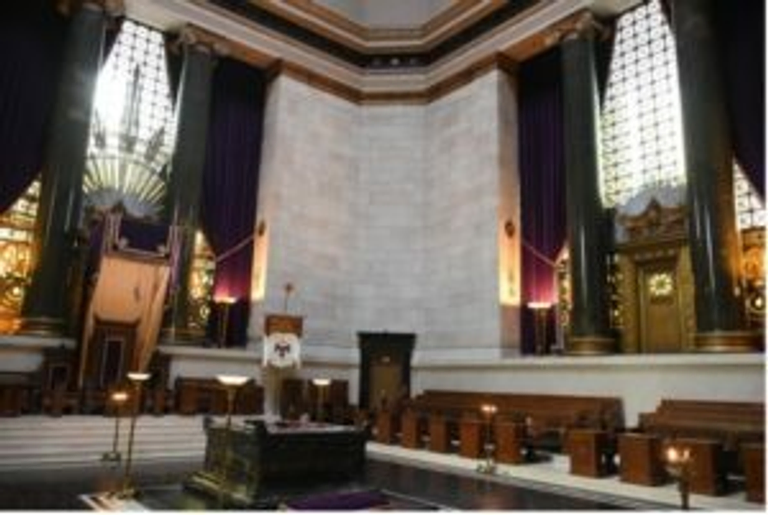
A photo of the House of the Temple’s windowsThe House of the Temple’s interior windows.

Inside the Temple room are large windows representing a Freemason’s progressive search for more light. In the center of these windows sits the double-headed eagle, the symbol of the Scottish Rite. Outside, there are 33 columns lining the Temple's facades, each standing 33 feet tall to the Scottish Rite’s famous 33rd degree.

Additionally, the remains of former Sovereign Grand Commander Albert Pike were moved from Oak Hill Cemetery in Georgetown to the House of the Temple in 1944. He is best known as the author of Morals and Dogma of the Ancient and Accepted Scottish Rite of Freemasonry, a book that describes in detail the 33 degrees of Scottish Rite Freemasonry, the stories and teachings associated with each rank, the rituals connected to each rank, and other lodge proceedings. Past Grand Commander John Henry Cowles was also entombed in the temple in 1952, after his 31-year reign as Grand Commander.


Library and Archives

Many of the Scottish Rite, Southern Jurisdiction’s earliest records were lost not long after it was founded through a combination of disasters. Albert Pike famously emphasized the importance of cataloguing and preserving Masonic artifacts and documents, instilling a tradition of archiving still practiced in the modern Scottish Rite.

Book lined shelves in the House of the Temple libraryThe library within the House of the Temple.

Today, the headquarters of the Scottish Rite of Freemasonry for the Southern Jurisdiction, the House of the Temple includes office and functional spaces and archives, a library, and museum space. The library, which is the oldest library in Washington, D.C., is open to the public, as is the museum, which displays a variety of Masonic artifacts. It is also home to one of the largest collections of materials related to Scottish poet and Freemason Robert Burns.

The archives, which is broken into two areas, include some of the Scottish Rite's most precious books and artifacts, including original documents dealing with the fraternity’s founding, rituals, and current domestic and international affairs. The first storage area is the General Archives, which maintains the records of Active Members and Deputies, and is responsible for housing approximately two million items in archival cases and fireproof file drawers.

The other storage area is the Archives Vault, which preserves the most valuable manuscripts and books, including the Scottish Rite ritual collection, as well as those of foreign jurisdictions, and manuscript copies of books, both published and unpublished. The items in the archives are part of a valuable, delicate collection of records, with some dating back to the 1800s. Because of their condition and, in certain cases, confidential nature, visitors are not eligible to view them. Specific requests for archival information from legitimate Masonic and historic scholars and researchers are managed on an individual basis.

The House of the Temple was one of the first buildings in the city to earn an individual listing in the D.C. Inventory of Historic Sites. As part of the 16th Street Historic District, the Temple was listed in the D.C. Inventory of Historic Sites on November 8, 1964, and in the National Register of Historic Places on August 25, 1978.

In the most recent edition of the “Guide to the Architecture of Washington DC,” the description, in part, reads, "an awe-inspiring temple in the midst of a quiet enclave." Most recently, in his book, “John Russell Pope: Architect of Empire”, Steven Bedford calls it "one of America's greatest architectural achievements."

Since it first opened in 1915, the House of the Temple has been open to the public for guided tours. Visitors interested in experiencing this monument to Masonic history and American architecture can receive a free, guided tour during weekdays. You can learn more about visiting The House of the Temple here: Planning Your Visit.

https://scottishritenmj.org/blog/house-of-temple-history

Respuesta  Mensaje 55 de 143 en el tema 
De: BARILOCHENSE6999 Enviado: 26/04/2025 14:44

Vézelay, Saint Maximin and the relics of Mary Magdalene

Vézelay, Saint Maximin and the relics of Mary Magdalene
 

Vezelay and Saint Maximin, an incredible “war” for the relics of Mary Magdalene

Mary Magdalene did not immediately have a great aura in the history of the Church. It was not until the 7th and 8th centuries that she began to be favored in monastic circles, where the accent was placed on repentance and forgiveness by welcoming sinners there. The life of the saint – a sinner who became an ascetic – then merges with the traditions concerning the life of Mary the Egyptian. She was a prostitute of the six century who would have done penance in the desert, on the other side of the Mediterranean.
In the 11th century, the monasteries, under the influence of the order of Cluny, took on social and economic importance. There is also a tremendous cult around all kinds of relics brought back from the Holy Land or purchased in Constantinople. Having relics of great saints is important at this time. It is because there are relics that pilgrimages are organized and pilgrimages pay off. In Vézelay at the beginning of the 11th century the monastery was in full decline. Wishing to promote his abbey, Abbot Geoffroy (1037-1052), friend of the pope, ambitious and close to princes “discovered” (“invented” is the term of use) and exhibited the relics of Mary Magdalene. Pilgrims flock.

Relic of Mary Magdalene, Vezelay basilica

In 1050 Mary Magdalene officially became the patron saint of Vezelay abbey.

Over the 11th and 12th centuries, the abbey, many times enlarged and rebuilt, was transformed into a magnificent sanctuary, with splendid Romanesque portals. It was an important stopover on the way to Compostela. The city took advantage of the influx of pilgrims. In the 12th century, its population amounted to 10,000 inhabitants, a considerable number for the time. Vézelay then became a center of great importance for the West.
Under the protection of the powerful dukes of Burgundy, in 1146, Saint Benedict preached the second crusade there. King Louis VII, Queen Eleanor and a crowd of nobles, prelates and people gathered on the hill.
In 1190, Richard Coeur-de-Lion and Philippe-Auguste met there at the start of the third crusade.
In 1217, François d’Assise chose the hill of Vézelay to found the first Franciscan establishment on French soil.


Saint Bernard preaching the 2nd Crusade, in Vézelay, in 1146, Émile Signol – Public domain

How the relics of Mary Magdalene arrived in Vézelay ?

Natural curiosity, but unsatisfactory answers.
We accepted the idea that it was Gérard de Roussillon who would have organized the transfer of the relics during the foundation of the abbey, relics that we would have gone to look for in Saint-Maximin where we knew that the saint had her burial. .
The bishop of Autun launched a prohibition against the pilgrimage. We then asked for the arbitration of the Pope. Pascal II, who by a bull given in 1103, broke the prohibition of the bishop and invited all the French to make the pilgrimage of Vézelay. The pilgrimage then took off, these were the great hours of Vézelay.
However, doubt persisted, not about the burial of Mary Magdalene in Provence, but about the transfer of her relics to Vézelay and their authenticity. We didn’t have much to show as relics in Vézelay, where we talked about them a lot without ever really presenting them in public.

“Presentable” and “indisputable” relics were needed. It was then that in 1265, relics were exhumed in Vézelay, kept in a box which would have been deposited in the crypt in 920 more than three centuries earlier. A certificate of authenticity in the box proves this!. “…under the high altar, a metal chest, long square, which contained some relics wrapped in two veils of silk, with a certain quantity woman’s hair”. There was also a letter from a King Charles certifying that “in this coffer is contained the body of the blessed Mary Magdalene”. (Act drawn up by Gui de Mello, bishop of Auxerre and Pierre, bishop of Panéade.)
Saint Louis officially recognized the relics and went to Vézelay for their elevation in 1267.

Vezelay basilicaSt Maximin basilica


Nevertheless, the doubt still persisted.
Twelve years later, in 1279, Charles II, Prince of Salerno, nephew of Saint Louis, who had come to Saint-Maximin on pilgrimage and had carried out a solid investigation, was convinced that the tomb of Mary Magdalene was in the crypt. where Saint Maximin had once buried her.
He organized excavations which led to the discovery of several sarcophagi. In the so-called “Sidoine’s sarcophagus” was discovered the body of Mary Magdalene with an inscription on a wooden tablet on which appeared simply: “Here lies the body of Saint Mary Magdalene.” 

And finally, for the Abbey of Vézelay, the miracle will not take place.

Indeed, Pope Boniface VIII definitively put an end to this “battle” between the 2 cities when he recognized the authenticity of the relics discovered by Charles II at Saint Maximin.
Vézelay will have to submit to the spiritual authority of the Pope. At the end of the 13th century, it is the beginning of the decline of the pilgrimage of Vézelay.The reliquary in the crypt of Vezelay contains a piece of her rib bone, given by the Dominican monks of St Maximin.

https://www.magdalenesacredjourneys.com/vezelay-saint-maximin-and-the-relics-of-mary-magdalene/

Respuesta  Mensaje 56 de 143 en el tema 
De: BARILOCHENSE6999 Enviado: 29/04/2025 22:06

Respuesta  Mensaje 57 de 143 en el tema 
De: BARILOCHENSE6999 Enviado: 23/06/2025 13:20


Respuesta  Mensaje 58 de 143 en el tema 
De: BARILOCHENSE6999 Enviado: 08/07/2025 10:07


Respuesta  Mensaje 59 de 143 en el tema 
De: BARILOCHENSE6999 Enviado: 08/07/2025 10:55


Respuesta  Mensaje 60 de 143 en el tema 
De: BARILOCHENSE6999 Enviado: 08/07/2025 11:28


Respuesta  Mensaje 61 de 143 en el tema 
De: BARILOCHENSE6999 Enviado: 08/07/2025 11:37


Respuesta  Mensaje 62 de 143 en el tema 
De: BARILOCHENSE6999 Enviado: 08/07/2025 11:55


Respuesta  Mensaje 63 de 143 en el tema 
De: BARILOCHENSE6999 Enviado: 08/07/2025 12:04


Respuesta  Mensaje 64 de 143 en el tema 
De: BARILOCHENSE6999 Enviado: 11/07/2025 18:39


Respuesta  Mensaje 65 de 143 en el tema 
De: BARILOCHENSE6999 Enviado: 11/07/2025 22:07


Respuesta  Mensaje 66 de 143 en el tema 
De: BARILOCHENSE6999 Enviado: 11/07/2025 22:44


Respuesta  Mensaje 67 de 143 en el tema 
De: BARILOCHENSE6999 Enviado: 13/07/2025 22:16


Respuesta  Mensaje 68 de 143 en el tema 
De: Samir34 Enviado: 17/07/2025 01:51
Many don’t realize how helpful it is to find doctors in London who are multilingual—it really eases communication for international residents and tourists alike. Find doctors in London


Primer  Anterior  54 a 68 de 143  Siguiente   Último 
Tema anterior  Tema siguiente
 
©2026 - Gabitos - Todos los derechos reservados