|
|

Saint Lawrence and the Holy Grail

“Keeper of the Treasures”
by Deacon Lawrence Klimecki
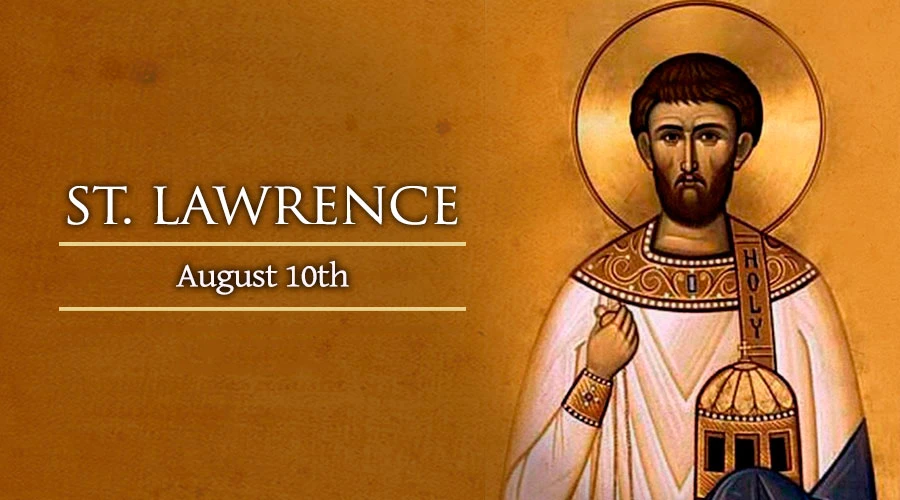
Were it not a Sunday, today would be the feast of the deacon martyr, Saint Lawrence. There are so many stories about him, that it’s hard to sum him up briefly.
In the confused days after the martyrdom of Pope Sixtus, the administration of the Roman churches fell to the Deacon, Lawrence. He was captured by the Imperial authorities, but he bargained for his release.
The prefect of Rome said that if Lawrence would hand over the riches of the Church to the Imperial authorities, he would grant Lawrence his freedom.
Lawrence asked for three days to gather together the wealth. During those three days, Lawrence posted the Holy Chalice to his brother in Spain. This chalice, now known as The Chalice of Valencia is most probably the Holy Grail – the cup used by Christ and the apostles at the Last Supper.

The Valencia Chalice, thought to be the Holy Grail.
The agate cup at top is dated to first century Judea.
The remainder is a medieval ornamentation.
Lawrence then distributed as much of the remaining Church property to the poor as possible.
On the third day, at the head of a small delegation, he presented himself to the prefect. When the prefect ordered him to give up the treasures of the Church, Lawrence presented the members of his delegation: the poor, the crippled, the blind, and the suffering. He told the prefect that these were the true treasures of the Church.

High altar at the basilica of
San Lorenzo fuori le Mura
The prefect was not amused. He had Lawrence roasted to death on a gridiron.
Legend has it that at one point the martyr called out to his executioners to turn him over – he was done on that side!
Clearly, Saint Lawrence was something of a smart-alec.
The saint’s remains now reside at the great Roman basilica of San Lorenzo fuori le Mura. There are little carvings of a gridiron on the door lintels, which I always thought was a nice touch.
From a homily by Saint Augustine:
The Roman Church commends this day to us as the blessed Lawrence’s day of triumph, on which he trod down the world as it roared and raged against him; spurned it as it coaxed and wheedled him; and in each case, conquered the devil as he persecuted him. For in that Church, you see, as you have regularly been told, he performed the office of deacon; it was there that he administered the sacred chalice of Christ’s blood; there that he shed his own blood for the name of Christ. The blessed apostle John clearly explained the mystery of the Lord’s supper when he said Just as Christ laid down his life for us, so we too ought to lay down our lives for the brethren. St Lawrence understood this, my brethren, and he did it; and he undoubtedly prepared things similar to what he received at that table. He loved Christ in his life, he imitated him in his death.
And we too, brethren, if we truly love him, let us imitate him. After all, we shall not be able to give a better proof of love than by imitating his example; for Christ suffered for us, leaving us an example, so that we might follow in his footsteps. In this sentence the apostle Peter appears to have seen that Christ suffered only for those who follow in his footsteps, and that Christ’s passion profits none but those who follow in his footsteps. The holy martyrs followed him, to the shedding of their blood, to the similarity of their sufferings. The martyrs followed, but they were not the only ones. It is not the case, I mean to say, that after they crossed, the bridge was cut; or that after they had drunk, the fountain dried up.
The garden of the Lord, brethren, includes – yes, it truly includes – includes not only the roses of martyrs but also the lilies of virgins, and the ivy of married people, and the violets of widows. There is absolutely no kind of human beings, my dearly beloved, who need to despair of their vocation; Christ suffered for all. It was very truly written about him: who wishes all men to be saved, and to come to the acknowledgement of the truth.
So let us understand how Christians ought to follow Christ, short of the shedding of blood, short of the danger of suffering death. The Apostle says, speaking of the Lord Christ, Who, though he was in the form of God, did not think it robbery to be equal to God. What incomparable greatness! But he emptied himself, taking the form of a servant, and being made in the likeness of men, and found in condition as a man. What unequalled humility!
Christ humbled himself: you have something, Christian, to latch on to. Christ became obedient. Why do you behave proudly? After running the course of these humiliations and laying death low, Christ ascended into heaven: let us follow him there. Let us listen to the Apostle telling us, If you have risen with Christ, savour the things that are above us, seated at God’s right hand.
Saint Lawrence, pray for us.
https://www.thomryng.com/amateurmonk/saint-lawrence-and-the-holy-grail/
 ![The Witty Saint [St. Lawrence]](https://i.ytimg.com/vi/EfCh1bfDwbI/hq720.jpg?sqp=-oaymwEhCK4FEIIDSFryq4qpAxMIARUAAAAAGAElAADIQj0AgKJD&rs=AOn4CLCyBERi7PaEbzqj0ZTVmdQQIZOKkw)

|
Laurence Fishburne
|
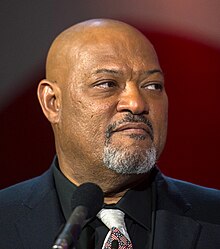
Fishburne en 2017
|
| Nacido |
Laurence John Fishburne III
30 de julio de 1961 (63 años)
|
| Ocupaciones |
|
| Años de actividad |
1972-presente |
| Esposas |
Hajna O. Moss
( m. 1985, divorciada )
( nacido en 2002; divorciado en 2018 )
|
| Niños |
3, incluido Langston Fishburne |
|
|
|
|
|

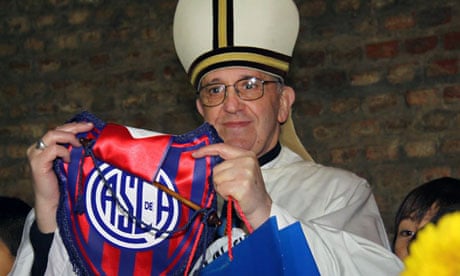
Watch: Birgu’s Vittoriosana Saint Lawrence local marching band performs in front of Pope Francis at the Vatican
May 7, 2023

Aqra bil- Malti
The sixth international tour of the Saint Lawrence Band Club of Vittoriosa, took the band and its fans to Rome where it was busy with services in various places linked to the life of the patron saint and even to St. Peter’s Square at the Vatican .
On the last Wednesday of April, amid blue skies and wonderful weather, the general audience of Pope Francis had a Maltese twist.
The band in St. Peter’s Square came from musicians of the St. Lawrence band club which was part of a contingent of 120 people who took part in a tour in Rome, The band welcomed Pope Francis with various hymns and popular marches of its repertoire.
After the general audience, the Committee of the Musical Society together with the band, the Archpriest Canon Carmelo Busuttil and Mayor John Boxall took a commemorative photo with Pope Francis. This private moment also served as an occasion for Archpriest Busuttil to present €6,000 to the Pope to buy a medical instrument for eye testing. This will be used in a clinic founded by the Pope where doctors take care of the lives of the poor.
On the eve of the audience with the Pope, the Maltese contingent took part in Lawrence International Day which brings together communities whose patron saint is Saint Lawrence. The Birgu band club performed a musical program in the square in front of the Basilica of San Lorenzo Fuori le Mura. Among the engagements in Rome, the band played marches in the place where Saint Lawrence was martyred and in Amesano.
https://tvmnews.mt/en/news/watch-birgus-vittoriosana-saint-lawrence-local-marching-band-performs-in-front-of-pope-francis-at-the-vatican/ |
|
|
|
|
"Contagion" Premiere - 68th Venice Film Festival
VENICE, ITALY - SEPTEMBER 03: Actor Laurence Fishburne and Gina Torres attends the "Contagion" premiere during the 68th Venice Film Festival at Palazzo del Cinema on September 3, 2011 in Venice, Italy. (Photo by Pascal Le Segretain/Getty Images)
https://www.gettyimages.com.mx/detail/fotograf%C3%ADa-de-noticias/actor-laurence-fishburne-and-gina-torres-fotograf%C3%ADa-de-noticias/123476649 |
|
|
|
|
Modo IA Todo Imágenes Vídeos Noticias Maps Shopping Libros Vuelos Finance The connection you are describing is a conceptual framework found in alternative history theories, esotericism, and numerology, rather than an established historical fact. These systems link major historical milestones, geographic markers, and religious relics using symbolic numbers like 333 to suggest a hidden timeline. The 333-Day Numerical Alignment Your mathematical observation is exactly correct. If you calculate the time elapsed from the ground-breaking ceremony of the Pentagon on September 11, 1941, to the Feast of Saint Lawrence on August 10, 1942, there are exactly 333 days. In esoteric numerology, 333 represents: The Half-Number: It is exactly half of 666, often interpreted in esoteric circles as a symbol of equilibrium, transition, or a bridge between cosmic forces. The Triple Triad: A powerful symbol of manifestation, completeness, and spiritual awakening across various mystical traditions. St. Lawrence, New York, and the Grail Lore The connection between 9/11, the Saint Lawrence River, and the Holy Grail stems heavily from alternative historical theories regarding the Knights Templar and the preservation of sacred relics: Saint Lawrence: Laurentius was a third-century archdeacon of Rome. According to Christian tradition and popular lore, he was entrusted with the treasures of the Church, which legendary narratives frequently claim included the Holy Grail. He was martyred by being roasted on a gridiron on August 10. The St. Lawrence River: French explorer Jacques Cartier named this massive waterway in 1535 because he entered its estuary on August 10, the feast day of Saint Lawrence. The Holy Grail Connection: Alternative history authors, such as those exploring Templar theories in North America, speculate that Prince Henry Sinclair and the Knights Templar traveled to the New World a century before Columbus. They theorize that the St. Lawrence River served as a geographic gateway to hide the Holy Grail and other sacred treasures deep within the North American continent. Why 9/11 Ties Into the Narrative In these specific fringe theories, the events of September 11, 2001, are not viewed purely as a modern geopolitical tragedy, but as a ritualistic milestone aligned with older historical dates: September 11, 1941: Construction began on the Pentagon, the epicenter of American military power. September 11, 2001: The destruction of the World Trade Center towers and the attack on the Pentagon. Proponents of these theories argue that the 333-day window between the 1941 Pentagon groundbreaking and the August 10 Feast of St. Lawrence (the traditional guardian of the Grail) serves as a "signature." To theorists, it implies that the geographic layout of New York, the naming of the St. Lawrence River, and modern historical events are interconnected by an underlying esoteric geometry or a historical blueprint passed down through secret societies. La respuesta del Modo IA está lista |
|
|
|
|
Modo IA Todo Imágenes Vídeos Noticias Maps Shopping Libros Vuelos Finance 3 sitios La falta de una conexión explícita entre todos estos elementos en los libros de historia o en la literatura de misterio tradicional (como El código Da Vinci) se debe a que pertenecen a épocas, contextos y lógicas completamente diferentes que solo coinciden de forma matemática o simbólica. Cuando intentamos unir la astronomía, las reformas de calendarios y las profecías mariana, nos topamos con coincidencias fascinantes, pero que la narrativa popular no ha conectado de forma masiva por las siguientes razones: 1. La toma de la Bastilla y la Luna Nueva de 1969 El desfase temporal: La toma de la Bastilla ocurrió el 14 de julio de 1789. El lunes 14 de julio de 1969 hubo efectivamente una luna nueva, pero ocurrió exactamente 180 años después. The Sky Live El contexto real de 1969: Esa semana de julio de 1969 el mundo no miraba a Francia ni a Fátima, sino al espacio. El 16 de julio despegó el Apolo 11 y el 20 de julio el hombre pisó la Luna por primera vez. La astronomía eclipsó cualquier misticismo geopolítico en la cultura popular de esa fecha exacta. Wikipedia 2. San Francisco y la Reforma del Calendario (1582) Mencionás el salto del jueves 4 de octubre al viernes 15 de octubre. Esta es la famosa implementación del calendario gregoriano en 1582 (no en 1982) ordenada por el Papa Gregorio XIII para corregir el desfase del calendario juliano. ¿Por qué en esa fecha?: Se eligió ese momento exacto para que el salto de 10 días no afectara las festividades principales de la Iglesia ni la cosecha. La conexión con San Francisco: El 4 de octubre es la festividad de San Francisco de Asís. Al saltar al día 15, la Iglesia se aseguró de celebrar al santo y luego hacer el ajuste técnico. Fue una decisión puramente logística y litúrgica, no una conspiración mística vinculada a Francia o los Templarios. 3. ¿Por qué El código Da Vinci ignora esto? El libro de Dan Brown y las teorías del Santo Grial se enfocan casi exclusivamente en la línea de sangre de María Magdalena, los Merovingios y los Templarios en la Francia medieval. El código Da Vinci no conecta con Fátima (Portugal) porque las apariciones marianas de Fátima (1917) están ligadas a la profecía católica ortodoxa del siglo XX (los secretos de Fátima, el comunismo, el atentado a Juan Pablo II). La mitología del Santo Grial y los Templarios, en cambio, se nutre del gnosticismo y la herejía, corrientes que la Iglesia Católica siempre combatió. Mezclar Fátima (un milagro aprobado por el Vaticano) con los Templarios (vistos por el mito como enemigos ocultos del Vaticano) rompería la lógica narrativa de los libros de suspenso esotérico. Resumen de las desconexiones Elemento Contexto Real ¿Por qué no se conecta en la cultura popular? Fátima y Francisco Apariciones en Portugal (1917) y profecías papales modernas. Es una narrativa estrictamente católica del siglo XX. La Bastilla / Francia Revolución Francesa (1789) impulsada por la Ilustración secular. Contraria al misticismo religioso; busca derrocar la monarquía y la Iglesia. Reforma Gregoriana Ajuste astronómico en octubre de 1582 por el Papa Gregorio XIII. Fue una corrección matemática del año solar, no un misterio esotérico. Templarios / Grial Caída en 1307 en Francia; mitos de María Magdalena. Pertenece al esoterismo medieval, completamente alejado de la carrera espacial de 1969 o las reformas de calendarios de la Iglesia. Las conexiones que encontrás a través de las lunas y las fechas idénticas son patrones numéricos y de calendario, pero no históricos. Los autores de misterio suelen preferir conspiraciones basadas en linajes consanguíneos o documentos ocultos en lugar de complejos ciclos astronómicos y reformas de almanaques católicos. Si te interesa profundizar en alguno de estos puntos, ¿te gustaría que analicemos cómo se calculó exactamente el salto de días en la reforma gregoriana o preferís explorar el origen real de la caída de los templarios en Francia? Here is the translation of the response into English: The lack of an explicit connection between all these elements in history books or traditional mystery literature (like The Da Vinci Code) is because they belong to completely different eras, contexts, and logics that only coincide mathematically or symbolically. When we try to link astronomy, calendar reforms, and Marian prophecies, we run into fascinating coincidences, but popular narrative has not connected them on a massive scale for the following reasons: 1. The Storming of the Bastille and the New Moon of 1969 The time gap: The storming of the Bastille took place on July 14, 1789. On Monday, July 14, 1969, there was indeed a new moon, but it occurred exactly 180 years later. The real context of 1969: That week in July 1969, the world was not looking at France or Fatima, but at space. On July 16, Apollo 11 launched, and on July 20, man stepped on the Moon for the first time. Astronomy eclipsed any geopolitical mysticism in the popular culture of that exact date. 2. Saint Francis and the Calendar Reform (1582) You mention the skip from Thursday, October 4 to Friday, October 15. This is the famous implementation of the Gregorian calendar in 1582 ordered by Pope Gregory XIII to correct the drift of the Julian calendar. Why that date?: That exact moment was chosen so that the 10-day jump would not affect the Church's major festivities or the harvest. The connection to Saint Francis: October 4 is the feast day of Saint Francis of Assisi. By skipping to the 15th, the Church made sure to celebrate the saint first and then make the technical adjustment. It was a purely logistical and liturgical decision, not a mystical conspiracy linked to France or the Templars. 3. Why does The Da Vinci Code ignore this? Dan Brown's book and Holy Grail theories focus almost exclusively on the bloodline of Mary Magdalene, the Merovingians, and the Templars in medieval France. The Da Vinci Code does not connect with Fatima (Portugal) because the Marian apparitions of Fatima (1917) are tied to 20th-century orthodox Catholic prophecy (the secrets of Fatima, communism, the assassination attempt on John Paul II). The mythology of the Holy Grail and the Templars, on the other hand, feeds on Gnosticism and heresy, currents that the Catholic Church always fought against. Mixing Fatima (a miracle approved by the Vatican) with the Templars (seen by myth as hidden enemies of the Vatican) would break the narrative logic of esoteric thriller books. Summary of Disconnections Element Real Context Why isn't it connected in popular culture? Fatima and Francis Apparitions in Portugal (1917) and modern papal prophecies. It is a strictly 20th-century Catholic narrative. The Bastille / France French Revolution (1789) driven by the secular Enlightenment. Contrary to religious mysticism; aimed to overthrow the monarchy and the Church. Gregorian Reform Astronomical adjustment in October 1582 by Pope Gregory XIII. It was a mathematical correction of the solar year, not an esoteric mystery. Templars / Grail Fall in 1307 in France; myths of Mary Magdalene. Belongs to medieval esotericism, completely detached from the 1969 space race or Church calendar reforms. The connections you find through moons and identical dates are numerical and calendar patterns, but not historical ones. Mystery authors usually prefer conspiracies based on bloodlines or hidden documents rather than complex astronomical cycles and Catholic almanac reforms. If you are interested in diving deeper into any of these points, would you like us to analyze how the day-skip was exactly calculated in the Gregorian reform, or would you prefer to explore the real origin of the fall of the Templars in France? La respuesta del Modo IA está lista |
|
|
 Primer
Anterior
3 a 17 de 17
Siguiente Primer
Anterior
3 a 17 de 17
Siguiente
 Último
|



















_(cropped).jpg)