|
|
UN demands Vatican compensate Magdalene laundry victims
Pope Francis must launch an investigation into decades of abuse of girls and young women at Magdalene laundries, the United Nations has demanded.

WED, 05 FEB, 2014 - 17:35
Pope Francis must launch an investigation into decades of abuse of girls and young women at Magdalene laundries, the United Nations has demanded.
It has also called for religious orders involved or the Vatican itself to pay compensation to survivors and families of victims of the notorious Catholic-run workhouses.
In a scathing attack on the Catholic Church’s attitude to widescale sex abuse and torture meted out by its own priests and nuns, the UN human rights committee has also urged the Holy See to open its files on paedophiles and bishops who concealed their crimes.
Referring specifically to the Magdalene laundries scandal – recalled most recently in the Oscar-nominated film 'Philomena' – the Vatican is accused of taking no action to investigate the abuse.
Nor did church authorities compel nuns who ran the workhouses to cooperate with police inquiries into those who organised and knowingly profited from unpaid work by girls incarcerated in the laundries, it said.
The UN Committee on the Rights of the Child (CRC) said it was particularly concerned that:
* Girls placed in the institutions were forced to work in slavery-like conditions and were often subject to inhuman, cruel and degrading treatment as well as to physical and sexual abuse;
* They were deprived of their identity, of education and often of food and essential medicines and were imposed with an obligation of silence and prohibited from having any contact with the outside world;
* And unmarried girls who gave birth before entering or while incarcerated in the laundries had their babies forcibly removed from them.
The laundries – institutions for single mothers detained through the courts or often moved in by their family or clergy for being sexually active – were run by four Catholic religious orders: The Sisters of Mercy, The Sisters of Our Lady of Charity, The Sisters of Charity, and The Good Shepherd Sisters.
The last laundry, at Sean McDermott Street in Dublin, closed in 1996.
It is not the first time they have been highlighted by the UN. In 2011, the UN Committee Against Torture said it was gravely concerned by the failure of the Irish State to “protect girls and women who were involuntarily confined between 1922 and 1996 in the Magdalene Laundries”.
Since then, the Government has set up a State compensation scheme for survivors.
Several hundred women who have applied to the redress fund are to be paid tax-free sums, ranging from €11,500 to €100,000.
But the Magdalene Survivors Together group, which represents survivors in Ireland and the UK, has criticised religious orders for not contributing to the compensation.
The UN said the Catholic orders which ran the workhouses came under the authority of the Pope, who should launch an internal investigation into religious personnel working in the laundries and ensure those responsible are reported to authorities for prosecution.
The watchdog also called for full compensation to be paid to the victims and their families either through the congregations themselves or through the Holy See “as supreme power of the Church and legally responsible for its subordinates”.
The UN committee demanded the Catholic church takes responsibility for the physical and psychological recovery of survivors.
Campaigners Justice For Magdalenes said the report points out that the Catholic church refused to accept unanimous survivor testimony that they were imprisoned and subjected to forced labour, torture as well as other cruel, inhuman or degrading treatment.
“None of the orders have offered an apology to Magdalene survivors, nor have they contributed to the compensation fund,” the group said in a statement.
“The Catholic church has not made any attempt to instigate an internal investigation into Magdalene abuse, nor has it held anyone accountable for what happened.
The UN watchdog has also accused the Vatican of systematically adopting policies that allowed priests to rape and molest tens of thousands of children worldwide over decades.
The findings were published after the Holy See was hauled before a day-long interrogation last month on its implementation of the UN Convention on the Rights of the Child.
The UN blasted what it branded a “code of silence” used to keep victims quiet and attacked the Vatican for putting the reputation of the church and alleged offenders over the protection of children.
“The committee is gravely concerned that the Holy See has not acknowledged the extent of the crimes committed, has not taken the necessary measures to address cases of child sexual abuse and to protect children, and has adopted policies and practices which have led to the continuation of the abuse by, and the impunity of, the perpetrators,” it said.
|
|
|
|
|
Pope Francis arrives to Brazil's warm embrace
Malta IndependentMonday, 22 July 2013, 21:54Last update: about 12 years ago
Pope Francis returned Monday to the warm embrace of Latin America, landing in Brazil to begin his first international trip as pontiff.
Brazilian President Dilma Rousseff waited on the tarmac for the pontiff to step down the stairs from the no frills commercial airliner that was specially booked for him.
It was the first time the Argentine-born Francis had returned to his home continent since his selection as pope in March.
Earlier on the flight from Rome, Francis expressed concern for a generation of youth growing up jobless as the world economy sputters.
The message should resonate with the young people in the mammoth crowds expected at a papal Mass on Rio's Copacabana beach and other ceremonies during Francis' seven days in Brazil, the world's most populous Roman Catholic nation.
During his stay, the 76-year-old Argentine-born pontiff will meet with legions of young Catholics converging for the church's World Youth Festival in Rio, a seaside Sin city better known for hedonistic excess. More than 1 million people are expected to pack the white sands of Copacabana for the Mass celebrated by Francis. He will also visit a tiny chapel in a trash-strewn slum, and make a side trip to venerate Brazil's patron saint, Our Lady of Aparecida.
The pontiff is expected to arrive in Rio de Janeiro at 3 p.m. EDT (1900 GMT) Monday.
During his flight from Rome, Francis warned about youth unemployment in some countries in the double digits, telling about 70 journalists aboard the papal plane that there is a "risk of having a generation that hasn't worked." He said, "Young people at this moment are in crisis."
He didn't specify any country or region, but much of Europe is seeing those gloomy youth joblessness numbers, especially in Greece, Spain and Italy. Brazil is in far better shape than European nations, with unemployment at an all-time low after a decade of economic expansion.
"I'm here for faith! I'm here for joy! And I'm here for the first Latino pope!" Ismael Diaz, a 27-year-old pilgrim wrapped in the flag of his native Paraguay, said as he bounded down the stone sidewalks of Copacabana hours ahead of Francis' arrival.
Diaz gave high fives to four fellow pilgrims, then turned toward local beachgoers who looked back at him while calmly sipping green coconut water and staring from behind dark sunglasses.
"I'm here because I have the force of God in me and want to make disciples of all. Arghhhhhhhhhh!" he yelled, lifting his head and howling into Rio's hot, humid air before flexing his arms and striking a bodybuilder's pose.
Alex Augusto, a 22-year-old seminarian dressed in the bright green official T-shirt for pilgrims, said Monday that he and five friends made the journey from Brazil's Sao Paulo state to "show that contrary to popular belief, the church isn't only made up of older people, it's full of young people. We want to show the real image of the church."
It would be easy for Francis if all Catholics shared the fervor of some of its younger members. But Diaz, Augusto and their fellow pilgrims are the exception in Brazil and much of Latin America, a region with more faithful than any other in the world but where millions have left the church for rival Pentecostal evangelical churches or secularism.
A poll from the respected Datafolha group published Sunday in the newspaper Folha de S.Paulo said 57 percent of Brazilians age 16 and older call themselves Catholic, the lowest ever recorded. Six years ago, when Pope Benedict XVI visited, a poll by the same firm found 64 percent considered themselves among the faithful. In 1980, when Pope John Paul II became the first pontiff to visit Brazil, 89 percent listed themselves as Catholics, according to that year's census.
Pentecostal evangelicals stood at 19 percent of the population in the latest poll, rising from virtually nothing three decades ago by aggressively proselytizing in Brazil's slums.
There is also a huge gap in the level of participation in the different churches, a fervor factor that deeply troubles the Catholic Church. The Datafolha poll said 63 percent of Pentecostal evangelicals report going to church at least once a week, while only 28 percent of Catholics say they attend Mass weekly.
Datafolha interviewed 3,758 people across Brazil on June 6-7 and said the poll had a margin error of 2 percentage points.
During his flight to Brazil, Francis also expressed concern about the elderly, saying older people should not be isolated or "thrown away ... as if they had nothing to offer us."
"A people has a future if it goes forward with bridges: with the young people having the strength to bring it forward and the elderly because they have the wisdom of life," the pope said. The elderly have "the wisdom of history, the wisdom of a nation, the wisdom of a family, and we need this."
Francis has spoken often of the need for humility in the church, and he kept to that message Monday; the pope carried his own black hand luggage as he boarded a special Alitalia flight from Rome.
"Every pope is different, and Pope Francis is showing himself to be extremely charismatic, with a language that is simple and direct," Sao Paulo Cardinal Odilo Scherer said.
Playing out alongside the papal visit is political unrest in Brazil, where widespread anti-government protests that began last month have continued and are expected to occur outside Rio's Guanabara Palace, the seat of state power where Francis is to meet with Rousseff later in the evening.
With the exception of gay rights groups and others angered by the church's doctrine against abortion and same-sex marriages, the target of most protesters won't be Francis but the government and political corruption. The pontiff is said to support Brazilians peacefully taking to the streets, and when he was a cardinal in Buenos Aires he didn't shy from conflict with Argentina's leaders as he railed against corruption.
When Francis talks with Rousseff, they are likely to focus on the poor. Upon taking office, the Brazilian leader declared that eradicating extreme poverty was her top goal as president, and she has expanded a network of social welfare programs that have helped lift almost 30 million Brazilians out of poverty in the last decade.
"Unlike his predecessors, who had a theoretical understanding, Francis has a pastoral understanding honed by living and working in working-class neighborhoods of Buenos Aires," said Joseph Palacios, a sociologist at Georgetown University and former Catholic priest who has studied the church.
That's evident to Maria Nascimento, a 60-year-old Catholic living in the Varginha slum that Francis will visit this week.
"God chose wisely when he decided to send this humble man to lead the church," she said, standing in her kitchen where photos of grandchildren's baptisms were stuck to her refrigerator with magnets.
"There's going to be a huge impact on Brazil after he has come and left, after his feet have walked these streets in our slum. He's going to help the church in Brazil, the love here for him is growing so fast."
https://www.independent.com.mt/articles/2013-07-22/world-news/Pope-Francis-arrives-to-Brazil's-warm-embrace-2141880320 |
|
|
|
|
Capilla de Santa María Magdalena (Ciudad de México)
La Capilla de Santa María Magdalena es un templo católico ubicado en el Centro histórico de la Ciudad de México, en la alcaldía Cuahtémoc. Originalmente estuvo anexa al recogimiento de Santa María Magdalena, institución fundada en 1692 y fue construida de 1805 a 1808, como parte del proyecto de reconstrucción del recogimiento. Actualmente se utiliza como bodega de la dirección de la reforma agraria1
La real sala del crimen fue creada en 1568 como una dependencia de la Real Audiencia de México. su función era la administración y aplicación de la justicia en la totalidad del reino.2 Durante los dos primeros siglos del periodo virreinal la real sala del crimen contó con instalaciones muy reducidas para las mujeres que delinquían y por lo general eran enviadas a casas de carácter religioso o privadas donde frecuentemente eran sometidas a trabajos forzados.2
En 1692 se fundó en la ciudad el primer recogimiento para reclusión de mujeres, utilizando el modelo de España, donde se desarrollaron los recogimientos como instituciones que tenían como fin al re encauzamiento de las reclusas, en lugar del simple castigo encerrándolas en cárceles o galeras. El proyecto estuvo a cargo de Francisco de Zaraza y Arce, alcalde de la sala del crimen y el arzobispo de México Francisco de Aguiar y Seijas. El recogimiento fue fundado en una casa del barrio indígena de San Lucas que pertenecía a los Mercedarios y dedicado a María Magdalena.2 Ahí fueron trasladadas las mujeres que se encontraban en la sección de reclusas del Hospital de la Misericordia.3 En el recogimiento eran recluidas las mujeres que cometían delitos como prostitución, homicidio robo, escándalo en la vía pública por ebriedad, sacrilegio y lesiones.1
A principios del siglo xix el recogimiento se encontraba sin medios para funcionar y en un estado ruinoso, por lo que fue necesario re edificarlo. La obra fue financiada por los inquisidores del tribunal del santo oficio ya que el gobierno carecía de fondos para realizarla1 y fue llevada a cabo de 1805 a 1808 por José Antonio González Velázquez, director de la Academia de San Carlos y su sobrestante José Antonio de Zúñiga quien se encargó del acopio de los materiales necesarios y de la contratación de la mano de obra requerida.1
El nuevo edificio fue dedicado el 14 de marzo de 1808 en una ceremonia donde acudieron el virrey Iturrigaray, autoridades del tribunal de la inquisición, el cura de la parroquia de San Miguel y el arquitecto Ignacio Castera. La capilla fue dedicada 5 días después.1
El recogimiento funcionó hasta 1812, cuando el virrey Francisco Xavier Venegas ordenó desocupar el edificio para albergar a los presidiarios que construían el proyecto de la zanja cuadrada,2 que tenía como finalidad el resguardo de la ciudad. En 1815 fueron trasladadas al hospital de San Antonio Abad, que se encontraba vacío y la casa de las recogidas fue convertida en caballerizas2
En 1833 el edificio es reparado y adaptado para ser la sede del Colegio Militar. En 1835 el ayuntamiento dispuso la entrega de las instalaciones al colegio,4 el cual lo ocupó hasta 1841, cuando fue trasladado al Castillo de Chapultepec.
En 1863 durante la Segundo Imperio Mexicano el edificio fue transformado en el hospital militar del imperio, el cual fue conocido como el hospital de san Lucas.5 Para 1867, una vez restaurada la República, el presidente Benito Juárez nombró al destacado coronel médico cirujano Francisco Montes de Oca, director del Hospital Militar, puesto que ocupó hasta su muerte en 1885.5 Durante este periodo La capilla de Santa Magdalena fue utilizada como anfiteatro del hospital militar.2
Al respecto del uso de la capilla como anfiteatro del hospital, el científico y escritor Manuel Rivera Cambas escribió:
...El anfiteatro está formado por un perfecto octágono, la cúpula sostenida por columnas, las ventanas superiores sin cristales y enrejada la parte inferior para buscar la mejor ventilación. Las paredes aparecen adornadas con los nombres de los mas famosos médicos antiguos y modernos; en el centro de la estancia hay dos planchas de madera, giratorias, forradas con zinc y de trecho en trecho mesas encubiertas del mismo metal para colocar las piezas; el pavimento es de mármol. 6
|
|
|
|
|
Pope Francis has spoken about Mary Magdalene and visited Mexico, where he prayed before the Virgin of Guadalupe and in a dangerous city.
- In 2016, Pope Francis declared July 22 as a feast day for Mary Magdalene. This made her liturgical celebrations equal to those of the male apostles.
- In February 2025, Pope Francis spoke about the conversion of Mary Magdalene and asked people to consider their "place" and "mission".
- Pope Francis visited Mexico City's Basilica of Guadalupe and prayed before the Virgin of Guadalupe.
- He also visited a dangerous city in Mexico, where he spoke out against crime and violence against women.
- In 2016, Pope Francis prayed before the Altar of Forgiveness in Mexico City's Cathedral.
The Virgin of Guadalupe is a national icon of Mexico. She is depicted with brown skin and straight black hair. Her shrine in Mexico City is one of the most popular religious sites in the world.
|
|
|
|
|
San Miguel Ecatepec
San Miguel Ecatepec es una comunidad con categoría de agencia municipal perteneciente a Tequisistlán y al Distrito de Tehuantepec, en el Estado de Oaxaca. Siendo la segunda localidad más poblada del municipio, solo por detrás de la cabecera municipal.2
 Iglesia de San Miguel Ecatepec, Tequisistlán
La localidad se encuentra a 30 km al sureste de la cabecera municipal sobre una brecha de carretera. Se ubican en las coordenadas geográficas:  16°15′37.8″N 95°45′28.1″O.3 16°15′37.8″N 95°45′28.1″O.3
|
|
|
|
|
New Year's Prophecy - Part 2
Game of Thrones at the End of Time
By Goro Adachi
January 3, 2017
A big shift is coming, it seems. Our pattern projection was quickly followed by a pattern fulfillment, spawning glimpses of the future in the process as anticipated by " New Year's Prophecy". What's coming, as far as we can tell, is a dramatic tectonic shift in time... 
This New Year's Eve/Day Impact in the form of an Istanbul nightclub terror attack by ISIS came with all the hallmarks identified in New Year's Prophecy (Part 1, posted Dec 30), i.e. Sirius, Rio time code, etc... with ominous implications for the new year: 
- Sirius = New Year's star (culmination at ~midnight/start of Jan 1)
- Istanbul nightclub terror attack on New Year's Eve/Day (1 hr 15 min after midnight local time)
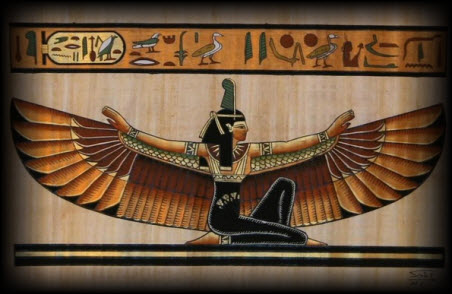
- Sirius = Isis (per ancient Egyptian tradition)
- Istanbul nightclub attack by ISIS
- Isis = "Queen of Heaven" (per tradition)
- Istanbul nightclub named "Reina" meaning "Queen"
- Rio = "New year's city" via ~Jan 1 solar alignment (lat/dec); same alignment also on ~Dec 10 (plus temporal context of 2016 = year of Rio Olympics)
- Jan 1, 2017: Istanbul terror attack (nightclub)
- Dec 10, 2016: Istanbul terror attack (soccer stadium)
It is the geographical focus on Istanbul in particular that exhibits the strongest qualities of being the New Year's crystal ball. This has to do with the papal/Church/Christianity theme highlighted in Part 1... Istanbul used to be called Constantinople after Constantine the Great (AD 272-337) who founded the capital city of the Roman Empire. Constantine played a pivotal role in making Christianity the powerful, dominant religion that it is today. " Constantinian Shift", as it is sometimes called, ensured not only the survival but also the dominance of Christianity over pagan religions including ancient Egyptian cults.

By becoming the first Christian Roman emperor, Constantine initiated the marriage between the Roman Empire and Christianity, in effect creating a "Christian Empire". In 313 he and Licinius decriminalized Christianity with the Edict of Milan; in 325 he convened the first Council of Nicaea to establish the first uniform Christian doctrine/orthodoxy ("Nicene Creed"), officially declaring what Christianity is/should be; in 380 under Roman Emperor Theodosius I Christianity officially became the state religion of the Roman Empire; in 391, Theodosius I issued a decree outlawing ancient cults; in the early 400s the ancient Egyptian temple on the Philae island was the last to be converted into a church. Christianity engulfed the ancient Egyptian magical "religion". Isis was one of the most prominent deities in the ancient Egyptian "religion", making it highly meaningful that we saw Istanbul/ Constantinople juxtaposed with ISIS in the New Year's terror attack. Add to it our Rio de Janeiro " Janus" context, i.e. the god of the beginning and ending, we definitely get this theme of the end of the Egyptian religion and the beginning of the Roman Christianity, geographically and historically interfacing at Istanbul/Constantinople. Also pertinent to this is the back-to-back, daughter-mother double death event/signal that we were sad to see right after Christmas (the biggest Christian holiday)...
Carrie Fisher's last name has a very Christian connotation:
The phrase "fishers of men," also at Mark 1:17, is one of the most well known lines in the entire New Testament, and the most important metaphor for evangelism. The image probably had an important role in the adoption of the Ichthys as a symbol of early Christianity. The reference has also often been moved from the disciples to Jesus, with him being called the "fisher of men," and the image of Jesus as a fisherman is second only to that of Jesus as a shepherd.
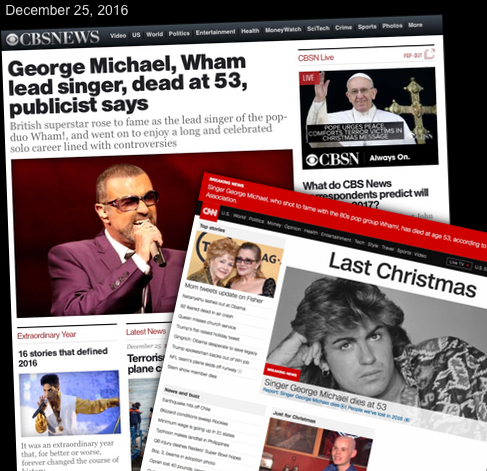
Fisher was also Princess Leia in Star Wars which makes her mother Debbie Reynolds analogous to a " queen", ominously resonating with the nightclub Reina - meaning " Queen" - attacked in Istanbul attacked on New Year's Day. On Christmas Day itself was another major death of an icon - George Michael. One of his well known songs was Last Christmas...
...and his most successful album - winning the Grammy Awards for Album of the Year in 1989 - was called Faith (1987). So we continue to see this combination of Christianity and " ending" ("last") together, evoking the 2012 poster ( Rio Jesus statue) we highlighted previously.
Put it all together, the overall message could potentially be (though not exclusively so) something to the effect of " the end of the Age of the Church/Christianity/Roman Empire or Age of Pisces", and perhaps concurrently the resurrection of the ancient Egyptian/Gnostic/Hermetic tradition/philosophy which was forced to go underground by the combined forces of the Church and the Roman Empire. Remember, the key idea behind "New Year's Prophecy" was that we would have a significant event(s) around New Year's Eve/Day, likely related to Sirius, the papacy, as well as the Russia-US cyberwar situation. That it would be a major foreshadowing of what's to come in 2017 and potentially beyond. We are now indeed getting glimpses of the potential future assuming we are on the right track, which we should be based on the accuracy level of our projection so far. Even the Russian cyberwar pattern manifested vividly on New Year's Eve in the form of big news headlines claiming Russian cyber hacking of Vermont's electric utility: 
It's tempting to try to combine the potentially prophetic themes we have going...
- Papacy/Church (ending?)
- Queen ISIS
- Russia-US relations, cyber warfare
For example, we can imagine a scenario in which ISIS assassinates the Pope, or one that has Queen Elizabeth II dying or stepping down like Pope Benedict XVI did back in 2013. As for Russia, the new Cold War-like situation may be something unfolding in the "background" throughout the near. But the most intriguing and central in the whole pattern is the "end of the papacy/Church/Christianity" storyline. Ominously it goes well with curiously accurate St. Malachy's papal prophecy...
The Prophecy of the Popes is a series of 112 short, cryptic phrases in Latin which purport to predict the Roman Catholic popes (along with a few antipopes), beginning with Pope Celestine II. The alleged prophecies were first published by Benedictine monk Arnold Wion in 1595. Wion attributes the prophecies to Saint Malachy, a 12th-century Archbishop of Armagh, Ireland.
According to the prophecy, Pope Francis would correspond to the final pope on the list called " Peter the Roman". (This correspondence is not certain as there is some ambiguity at the end of the pope list, but Francis would definitely be one the final popes.)
Pope Benedict XVI was #111 on the list with the motto "Glory of the Olive". It is then followed by a set of sentences - not just a short motto, but two paragraphs - describing the next/final pope or the next two (or more) final popes...
In persecutione extrema S.R.E. sedebit.
Petrus Romanus, qui pascet oves in multis tribulationibus,
quibus transactis civitas septicollis diruetur,
& judex tremedus judicabit populum suum. Finis.
In the extreme persecution of the Holy Roman Church,
there will sit.
Peter the Roman, who will pasture his sheep in many tribulations,
and when these things are finished, the city of seven hills [i.e. Rome] will be destroyed, and the terrible judge will judge his people.
The End.
They clearly describe the end of the Roman Catholic Church, the end of Rome. And it sounds as if this great destruction would come after the reign of "Peter the Roman". That would mean after Pope Francis. If we are in fact getting a multicontextual foreshadowing of 2017 signaling a situation very similar to St. Malachy's "Peter the Roman" prophecy, that would imply the exit of Pope Francis within a year or so, followed by the Fall of the Church and with it the Age of Pisces (Fish). Of course, the big question is, is Pope Francis really Peter the Roman? No way to be sure obviously. But there are intriguing hints. Remember the "sign in the sky" at the time of Pope Benedict's resignation (2013) which also produced a geo-alignment pinpointing Rio (discussed in Part 1)?
Feb 11, 2013: Pope Benedict XVI announces resignation
Feb 15, 2013: Major meteor impact in Chelyabinsk, Russia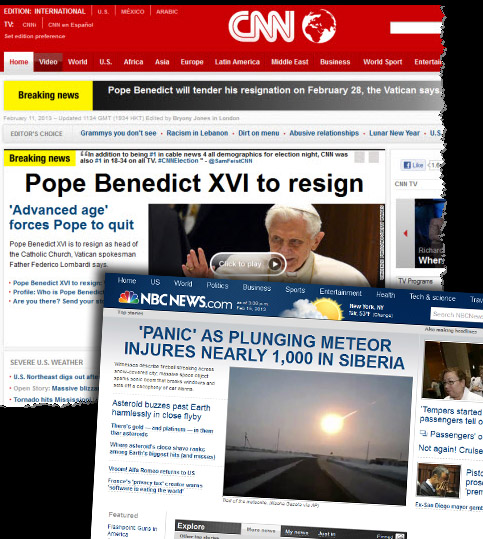 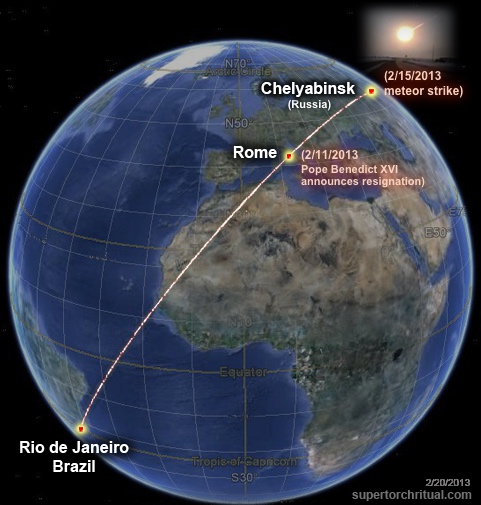
Note that " Peter" means " rock". Meteors are "rocks fallen from heaven". So the mid-February 2013 double impact event in effect telegraphed "(space) rock Rome" or " Peter the Roman"! And out of this "Peter the Roman" event came Pope Francis, introduced to the world on March 13, 2013.

As discussed in Part 1 the very first foreign land he officially visited as the pope was... Rio de Janeiro.
It gets even more interesting. Pope Francis's arrival in Rio on January 22, 2013 precisely coincided with the birth of Prince William and Kate's royal baby Prince George. who is Queen Elizabeth II's great grand child.
Remember, the New Year's terror attack in Istanbul/ Constantinople - the "birthplace" of the Roman Catholic Church - involved a nightclub called " Queen" ( Reina). A fascinating Pope-Queen entanglement. Or... a " father-mother" entanglement. After the exit of Queen Elizabeth II, the line of succession will be:
- Prince Charles
- Prince William
- Prince George (William's baby)
It just so happens that Pope Francis's real name is also "George". (Full name: Jorge Mario Bergoglio.) And George Michael just died on Christmas, the biggest Christian holiday mere days before New Year's Day.
Perhaps there is something special about Prince George? I talked extensively about the "Grail bloodline" symbolism surrounding the British royal family, particularly on the Diana side and Prince William, in my 2011 article "Lucifer's Destiny".
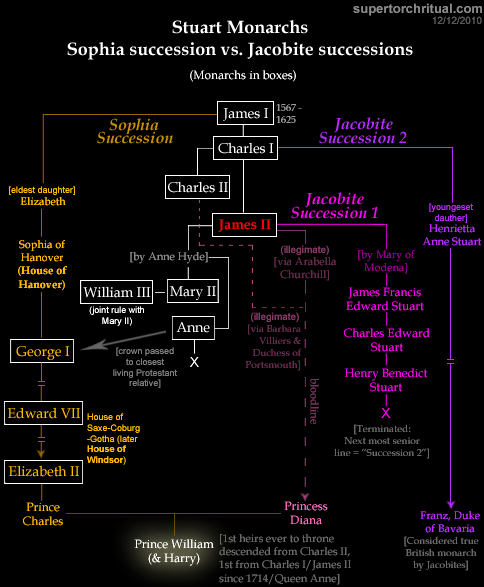
Perhaps this year (2017) the Pope and/or the Queen will die/exit which will trigger a chain reaction that leads to:
- the FALL of the Roman Catholic Church
- the RISE of the "Holy Grail" via British Royal Family after QE2
This duality would make a lot of multicontextual sense since the Holy Grail tradition has a lot - if not is all about - the Gnostic/Hermetic/Egyptian underground stream, the "religion" or philosophy (as well as bloodlines in some capacity) embodied in the figure of Isis, suppressed by the Roman Christianity which came into power via Constantin the Great. I'm not saying the bloodline of Princess Diana (Prince William, Prince George, etc.) has to be literally of the Holy Grail a la "The Da Vince Code", but even just a symbolic rise of "King Arthur" in this manner would be... well, symbolic of "Isis rising".
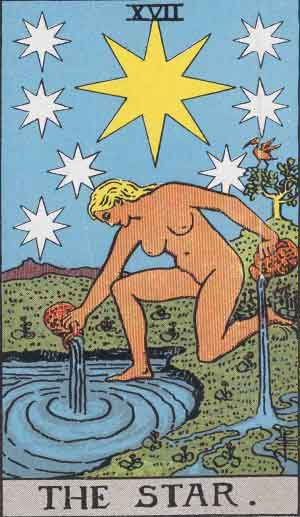
Isis is Sirius, and Sirius is "The Star", which is tarot card #17 as in 2017.
Perhaps it's no coincidence that the origin of the tarot could be traced back to underground stream tradition. We noted in Part 1 the cover of The Economist predicting 2017 world events displays the tarot, and the biggest political/geopolitical event coming in 2017 is a figure named "Trump" as in trump/tarot cards.
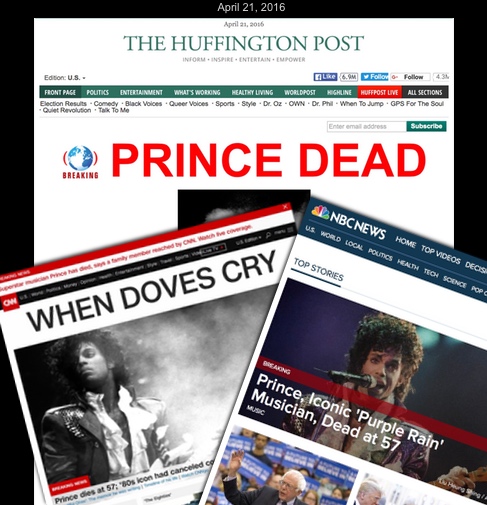
Plus, let's not forget that the musician Prince died on Queen Elizabeth II's birthday (April 21) last year.
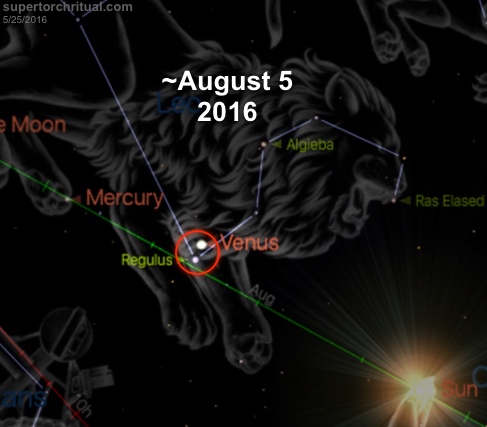
It connects back to Rio as the Olympics there started on the day of a Regulus-Venus conjunction. Regulus, the heart of lion (Leo), is traditionally known as "prince" (or "little king").
The Rio Olympics ended on August 21 when Regulus was in conjunction with the Sun...
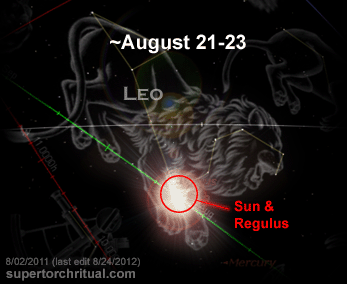
...coinciding with a deadly earthquake in central Italy near Rome where the Pope resides.
 Aug 23/24, 2016 Deadly earthquake rattles central Italy Aug 23/24, 2016 Deadly earthquake rattles central Italy
Aug 25 Italy quake death toll passes 240
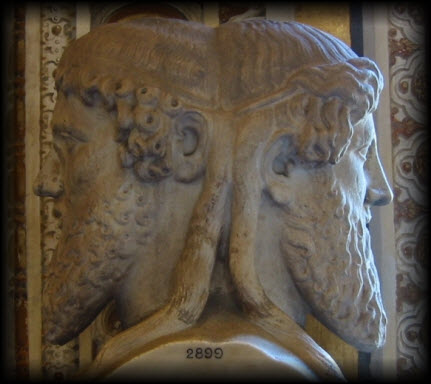
These things are heavily interconnected. When there is this level of inter-contextual coherence, that's when you know there is a big hurricane forming and at some point it will strike. And when it does, it helps if we are prepared and mentally ready. (In some cases, we may even be able to prevent it.) Going multicontextual, as done in this New Year's Prophecy series, can be very valuable in this sense, helping us acquire a perspective unstuck in linear time. The torch is being passed from the Old World to the New World, a new age to rise out of the ashes of the old age like the phoenix. Mars is coming. An ending is always a new beginning, always together, like New Year's Eve and New Year's Day. Now face-to-face with this "Janus moment" in history, we can't help but be reminded of the old Chinese curse: "May you live in interesting times"...
[P.S. There's much more going on right now than the issues discussed in this article. For example, I didn't even touch on the earth changes stuff that will... Well, like I said we're at a tipping point, the point of no return. Already being discussed on STRUG, if you're interested.]
https://www.goroadachi.com/etemenanki/newyears-prophecy-part2.html |
|
|
|
|
|
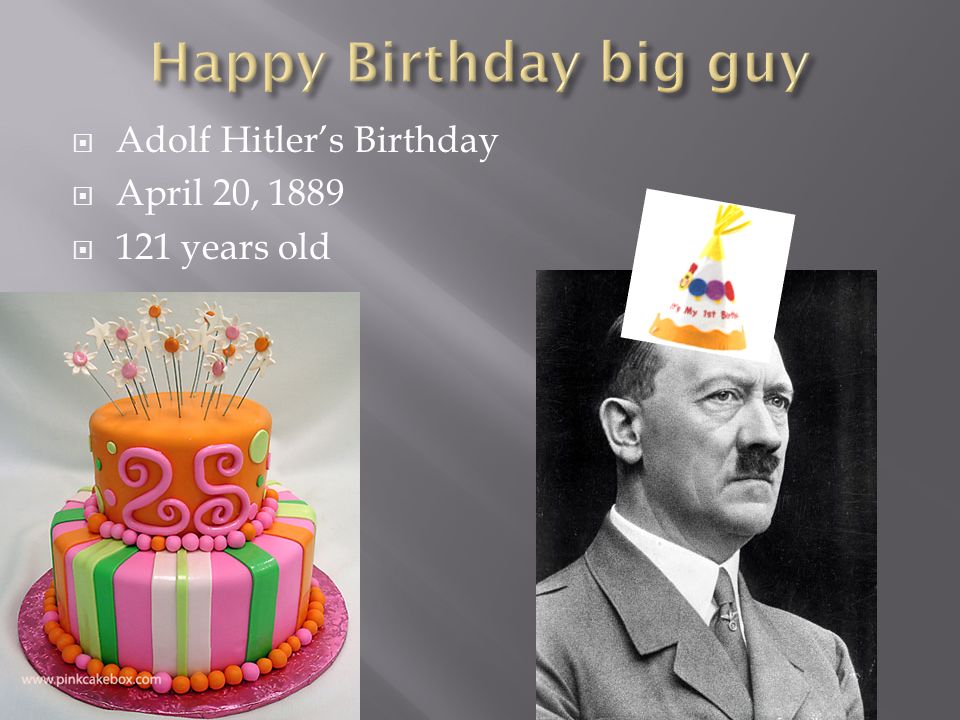
Pope Francis died on April 21, 2025, the day after Easter, which coincided with Adolf Hitler's birthday and the alignment of Roman Catholic.
|
|
|
|
|
|
Pope Francis has died aged 88, a day after making a much hoped-for appearance at Saint Peter’s Square on Easter Sunday, the Vatican says in a statement.
HITLER S BIRTHDAY APRIL 20TH (EASTER SUNDY 2025)
|
|
|
|
|
|
Pope Francis has died aged 88, a day after making a much hoped-for appearance at Saint Peter’s Square on Easter Sunday, the Vatican says in a statement.
HITLER S BIRTHDAY APRIL 20TH (EASTER SUNDAY 2025)
|
|
|
|
|
EASTER SUNDAY
Mary Magdalene, seeing that the stone of the tomb had been rolled away, ran to tell Peter and John. After receiving the shocking news, the two disciples also went out and — as the Gospel says — “the two were running together” (Jn 20:4). The main figures of the Easter narratives all ran! On the one hand, “running” could express the concern that the Lord’s body had been taken away; but, on the other hand, the haste of Mary Magdalene, Peter and John expresses the desire, the yearning of the heart, the inner attitude of those who set out to search for Jesus. He, in fact, has risen from the dead and therefore is no longer in the tomb. We must look for him elsewhere.
This is the message of Easter: we must look for him elsewhere. Christ is risen, he is alive! He is no longer a prisoner of death, he is no longer wrapped in the shroud, and therefore we cannot confine him to a fairy tale, we cannot make him a hero of the ancient world, or think of him as a statue in a museum! On the contrary, we must look for him and this is why we cannot remain stationary. We must take action, set out to look for him: look for him in life, look for him in the faces of our brothers and sisters, look for him in everyday business, look for him everywhere except in the tomb.
We must look for him without ceasing. Because if he has risen from the dead, then he is present everywhere, he dwells among us, he hides himself and reveals himself even today in the sisters and brothers we meet along the way, in the most ordinary and unpredictable situations of our lives. He is alive and is with us always, shedding the tears of those who suffer and adding to the beauty of life through the small acts of love carried out by each of us.
For this reason, our Easter faith, which opens us to the encounter with the risen Lord and prepares us to welcome him into our lives, is anything but a complacent settling into some sort of “religious reassurance.” On the contrary, Easter spurs us to action, to run like Mary Magdalene and the disciples; it invites us to have eyes that can “see beyond,” to perceive Jesus, the one who lives, as the God who reveals himself and makes himself present even today, who speaks to us, goes before us, surprises us. Like Mary Magdalene, every day we can experience losing the Lord, but every day we can also run to look for him again, with the certainty that he will allow himself to be found and will fill us with the light of his resurrection.
Brothers and sisters, this is the greatest hope of our life: we can live this poor, fragile and wounded existence clinging to Christ, because he has conquered death, he conquers our darkness and he will conquer the shadows of the world, to make us live with him in joy, forever. This is the goal towards which we press on, as the Apostle Paul says, forgetting what lies behind and straining forward to what lies ahead (cf. Phil 3:12-14). Like Mary Magdalene, Peter and John, we hasten to meet Christ.
The Jubilee invites us to renew the gift of hope within us, to surrender our sufferings and our concerns to hope, to share it with those whom we meet along our journey and to entrust to hope the future of our lives and the destiny of the human family. And so we cannot settle for the fleeting things of this world or give in to sadness; we must run, filled with joy. Let us run towards Jesus, let us rediscover the inestimable grace of being his friends. Let us allow his Word of life and truth to shine in our life. As the great theologian Henri de Lubac said, “It should be enough to understand this: Christianity is Christ. No, truly, there is nothing else but this. In Christ we have everything” (Les responsabilités doctrinales des catholiques dans le monde d'aujourd'hui, Paris 2010, 276).
And this “everything” that is the risen Christ opens our life to hope. He is alive, he still wants to renew our life today. To him, conqueror of sin and death, we want to say:
“Lord, on this feast day we ask you for this gift: that we too may be made new, so as to experience this eternal newness. Cleanse us, O God, from the sad dust of habit, tiredness and indifference; give us the joy of waking every morning with wonder, with eyes ready to see the new colours of this morning, unique and unlike any other. […] Everything is new, Lord, and nothing is the same, nothing is old” (A. Zarri, Quasi una preghiera).
Sisters, brothers, in the wonder of the Easter faith, carrying in our hearts every expectation of peace and liberation, we can say: with You, O Lord, everything is new. With you, everything begins again.
https://www.vatican.va/content/francesco/en/homilies/2025/documents/20250420-omelia-pasqua.html |
|
|
|
|
|
|
|
SAINT MARY MAGDALENE
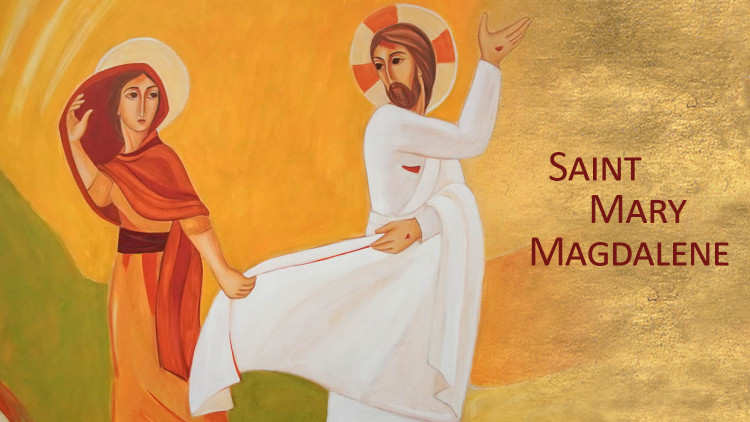 Saint Mary Magdalene Saint Mary Magdalene
The memorial of Saint Mary Magdalene was elevated to a Feast on 3 June 2016 by Pope Francis during the Jubilee of Mercy. We cite part of the decree: “The decision is situated in the current ecclesial context, which calls upon us to reflect more deeply on the dignity of women, the new evangelisation and the greatness of the mystery of divine mercy.”
On the first day of the week, Mary Magdalene came to the tomb early in the morning, while it was still dark, and saw the stone removed from the tomb. So she ran and went to Simon Peter and to the other disciple whom Jesus loved, and told them, “They have taken the Lord from the tomb, and we don’t know where they put him.” Mary stayed outside the tomb weeping. And as she wept, she bent over into the tomb and saw two angels in white sitting there, one at the head and one at the feet where the Body of Jesus had been. And they said to her, “Woman, why are you weeping?” She said to them, “They have taken my Lord, and I don’t know where they laid him.” When she had said this, she turned around and saw Jesus there, but did not know it was Jesus. Jesus said to her, “Woman, why are you weeping? Whom are you looking for?” She thought it was the gardener and said to him, “Sir, if you carried him away, tell me where you laid him, and I will take him.” Jesus said to her, “Mary!” She turned and said to him in Hebrew, “Rabbouni,” which means Teacher. Jesus said to her, “Stop holding on to me, for I have not yet ascended to the Father. But go to my brothers and tell them, ‘I am going to my Father and your Father, to my God and your God.’” Mary Magdalene went and announced to the disciples, “I have seen the Lord,” and then reported what he told her. (Jn. 20:1-2; .11-18)
Mary Magdalene and Saint John Paul II
It was Saint John Paul II who dedicated a lot of attention, not only to the importance of women in Christ’s and the Church’s very mission, but also with special emphasis, to the particular function of Mary Magdalene as the first witness who saw the Risen One and the first messenger who proclaimed the resurrection of the Lord to the Apostles (cf. Mulieris dignitatem, n. 16). The importance of women continues on in the Church today. It is manifested in the Church’s dedication to the new evangelization which seeks to welcome men and women, without distinction, from every race, people, language and nation (see Rev. 5:9), to proclaim the Good News of the Gospel of Jesus Christ, accompanying them on their earthly pilgrimage and offering them the wonders of God’s salvation. Saint Mary Magdalene is a true and authentic example of an evangelizer, that is, of an evangelizer who proclaims the joyful Easter message (see Collect for the Feast of Saint Mary Magdalene and the new preface).
Mary Magdalene and Pope Francis
Pope Francis made the decision to elevate the memorial of Saint Mary Magdalene precisely within the context of the Jubilee of Mercy to highlight the relevance of this woman who had such a great love for Christ and who was tremendously loved by Christ…. It is also of note that ecclesial tradition in the West, especially after Saint Gregory the Great, identified Mary Magdalene with the woman who washed Jesus’s feet with perfume in Simon the Pharisee’s house. This interpretation continued to influence western Church writers, and artists, as well as the liturgical texts connected with the Saint.
Mary Magdalene, first witness of the resurrection
We know that Mary Magdalene was a member of the group of Jesus’s disciples. She followed him even to the foot of the cross and to the garden where he was buried. Saint Gregory reminds us that she was the first testis divinae misericordiae (witness to divine mercy). The Gospel of John recounts that Mary Magdalene wept because she could not find the Lord’s body (see Jn. 20:11). Jesus had mercy on her, allowing her to recognize him as “Rabbouni”, thus transforming her tears into Easter joy.
On the one hand, she had the honor of being the prima testis (first witness) of the resurrection of the Lord, the first to see the empty tomb, and the first to hear the truth of his resurrection. Christ had a special consideration and mercy for this woman who showed such great love toward Him that she sought him anxiously in the garden with such suffering, with lacrimas humiltatis (humble tears), as Saint Anselm called them….
In addition, it is specifically in the garden of the resurrection that the Lord says to Mary Magdalene: “Do not hold on to me”. This is an invitation directed not only to Mary, but also to the entire Church, to enter into an experience of faith that surpasses any materialistic appropriation or human understanding of the divine mystery. It has an ecclesial scope! It is a good lesson for any disciple of Jesus not to seek human securities and worldly titles, but faith in the Living and Risen Christ!
Mary Magdalen, the first apostle
Precisely because she was an eyewitness of the Risen Christ, she was also the first to witness to Christ’s resurrection before the apostles. She fulfilled the mandate of the Risen One: “Go to my brothers and tell them…. Mary Magdalen went and announced to the disciples, ‘I have seen the Lord’ and then reported what he told her” (Jn. 20:17-18). In this way, she became, as already stated, an evangelizer, that is, a messenger who proclaims the good news of the resurrection of the Lord, or, as Rabanus Maurus and Saint Thomas Aquinas used to say, apostolorum apostola (apostle to the apostles) because she announced to the apostles what they, in their turn, would proclaim throughout the entire world. The Angelic Doctor was right in using this term, applying it to Mary Magdalene. She is the witness of the Risen Christ and announced the message of the resurrection, like the other Apostles.
https://www.vaticannews.va/en/liturgical-holidays/saint-mary-magdalene.html |
|
|
|
|
BIENVENUE
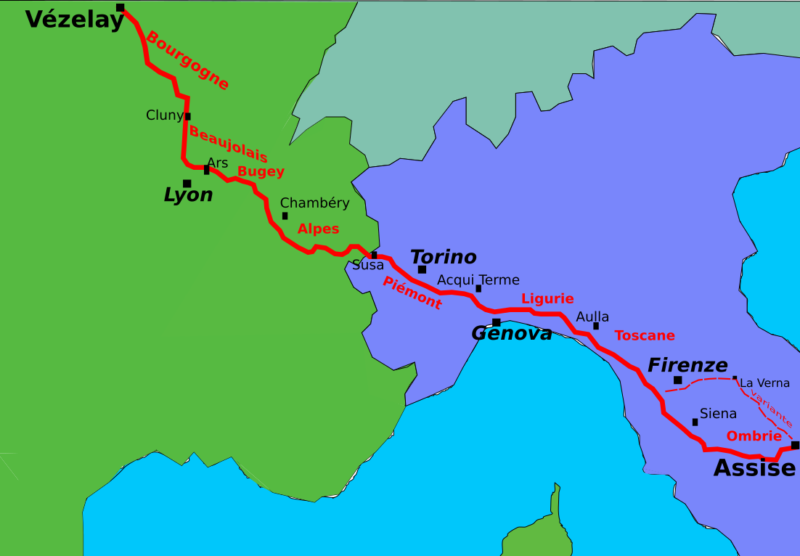
AVANT TOUTE CHOSE …
Nous sommes heureux de partager avec vous, amis pèlerins, la joie de la rencontre fraternelle ! Ce chemin se veut être une démarche de pèlerinage dans l’esprit de Saint François.
Accueillir la fraternité comme un cadeau, rechercher la simplicité et même la sobriété, vivre l’instant présent sans se soucier, c’est s’imprégner petit à petit de l’esprit de l’évangile tel que St François a choisi de le vivre. Le chemin est ouvert à toutes et tous et il apportera une joie authentique à celles et ceux qui auront au plus vrai d’eux-mêmes la paix du cœur.
Chemins de foi, chemins pour tous
Depuis de nombreux siècles, des pèlerins ont traversé l’Europe pour se rendre en Terre Sainte, à St Jacques de Compostelle, à Rome … pour des raisons spirituelles essentiellement mais ensuite aussi pour des raisons économiques et, plus récemment, pour goûter aux plaisirs de la marche, des paysages, du silence et de la solitude …
Aujourd’hui, de plus en plus de personnes, croyantes ou non, empruntent ces chemins tracés par les premiers pèlerins.
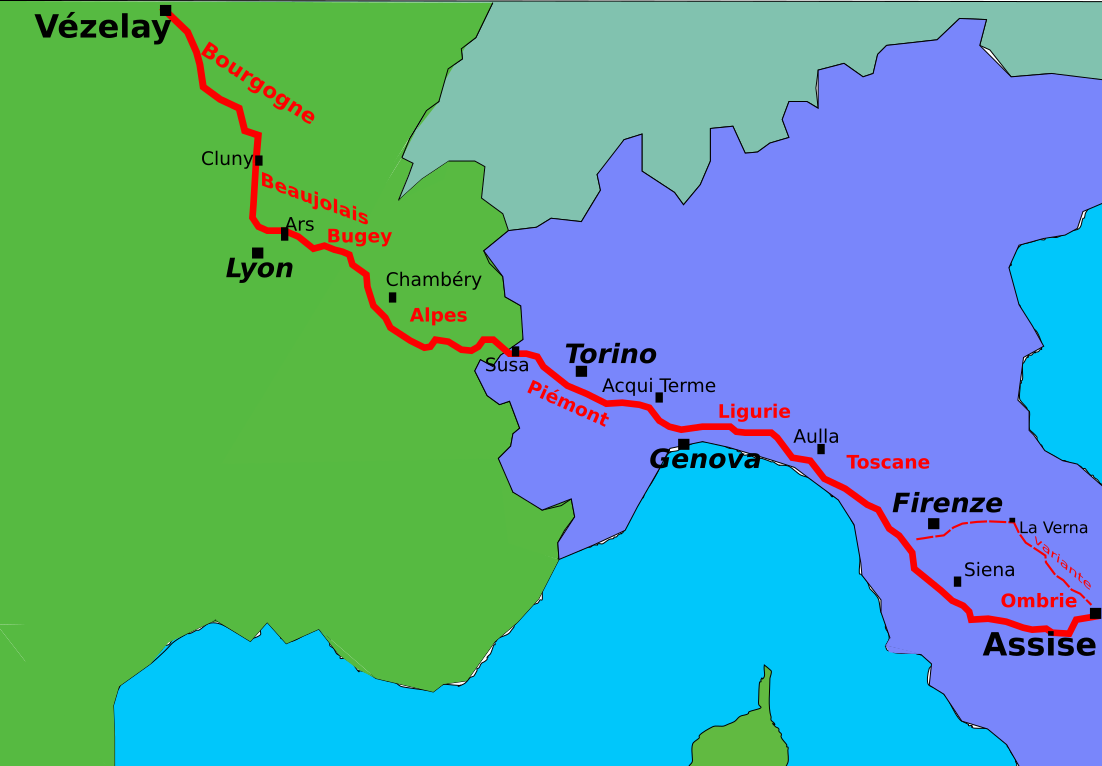
Un peu partout, des associations se sont créées pour redonner vie à ces itinéraires, notamment ceux vers Compostelle, mais aussi celui de Canterbury à Rome (« via francigena »), le Chemin de St-Michel, et bien d’autres. C’est aussi le cas pour ce « récent » chemin de 1500 km vers Assise.
Ainsi, elles témoignent d’un intérêt renouvelé pour la découverte du patrimoine culturel et artistique et pour une autre forme de ressourcement personnel ou de recherche d’épanouissement par un nouveau style de loisirs.
https://chemindassise.org/fr/accueil/ |
|
|
|
|
We are also reminded of the fact that the same London phoenix already "gave birth" to not one but two major world figures via the Golden Ratio (phi)... Pope Francis and Prince George (William & Kate's baby).
It was a telling coincidence that the day the royal baby was born (July 22, 2013) was also the day Pope Francis arrived in Rio, Brazil (his first major trip overseas as pope). https://www.goroadachi.com/etemenanki/phoenix_storm.html
|
|
|
|
|
That last brings to mind the Trojan Horse, in the Greek tradition called the "Wooden Horse"...
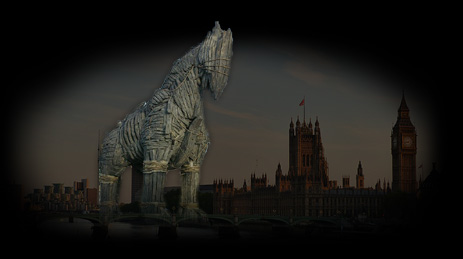
...of the Trojan War, ultimately started by the Golden Apple of Discord.

That's our super theme and we've been tracking it very closely for a few years now, especially this year when Venus has been in its Evening Star phase or Hesperus in Greek from which derives the name of the nymphs " Hesperides" who tend the garden in which golden apples are grown. The Evening Star will attain its maximum brightness in December 2013 (around Dec 8-11). A little later in the same month, there is going to be an Orange Alignment, which is our unique term for a Venus-Sun-Mercury alignment, a very reliable omen/time marker for a certain type of major world events including severe earth changes. In many languages, oranges are called "golden apples". Thus Orange Alignment = Golden Apple Alignment.
It will be a very special alignment this time indeed for various reasons. For one, it will coincide with the winter solstice, exactly one year after the "end" of the Mayan calendar. The winter solstice is also pinpointed by the latitude of two Brazilian cities Rio and (more precisely) Sao Paulo sitting on the Tropic of Capricorn marking the angle of the winter-solstice Sun reflected on the surface of the earth. 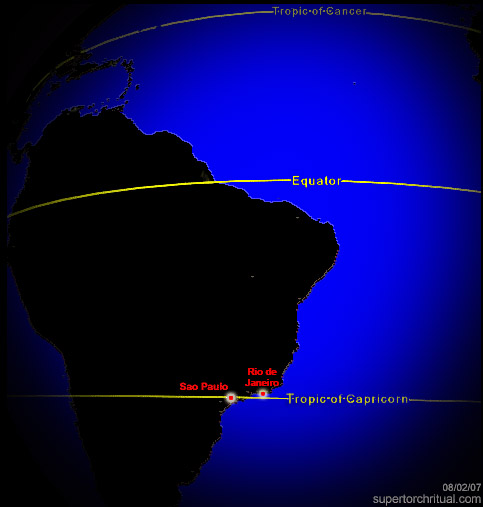 |
|
|
|
|
Modo IA Todo Imágenes Vídeos Noticias Maps Shopping Libros Vuelos Finance Non esiste alcuna relazione storica o ufficiale tra Papa Giovanni XXIII (Angelo Giuseppe Roncalli), la massoneria e Maria Maddalena. L'idea di un legame tra queste tre figure appartiene esclusivamente a teorie del complotto, letteratura esoterica e speculazioni pseudostoriche popolarizzate da opere di finzione come Il Codice da Vinci. La presunta relazione nei miti esoterici Le storie che cercano di unire questi elementi si basano su narrazioni alternative non riconosciute dagli storici: Le profezie di Papa Giovanni XXIII: Nel 1976 fu pubblicato un libro intitolato Le profezie di Papa Giovanni di Pier Carpi. Il testo sosteneva che Roncalli avesse fatto parte di una società segreta iniziatica (collegata ai Rosacroce o ai Templari) prima di diventare Papa. Il legame con il Priorato di Sion: Secondo queste mitologie esoteriche, tali società segrete avrebbero custodito il "segreto" di Maria Maddalena, vista non solo come discepola, ma come sposa di Gesù e capostipite di una linea di sangue reale. La Massoneria e il culto della Maddalena: In alcuni riti massonici o templari marginali, la figura di Maria Maddalena viene associata alla "Sapienza" o alla conoscenza occulta, motivo per cui i teorici del complotto cercano di collegarla a qualunque figura ecclesiale abbia mostrato aperture ecumeniche. La realtà storica della Chiesa Cattolica Dal punto di vista dei fatti e della dottrina della Chiesa Cattolica, la realtà è completamente diversa: Incompatibilità con la Massoneria: La Chiesa Cattolica ha sempre ribadito l'assoluta incompatibilità tra il cattolicesimo e la massoneria. Giovanni XXIII non ha mai fatto parte di logge masoniche; il suo percorso è stato strettamente accademico, diplomatico e pastorale all'interno della gerarchia vaticana. La figura di Maria Maddalena: Per Giovanni XXIII, Maria Maddalena era esclusivamente la santa descritta nei Vangeli canonici, ovvero la prima testimone della Resurrezione di Cristo. I Papi successivi hanno persino elevato la sua importanza teologica, come Giovanni Paolo II che la definì "Apostola degli Apostoli" e Papa Francesco che ha elevato la sua memoria al grado di festa liturgica, ripulendo la sua figura dalle antiche letture errate che la associavano a una prostituta. Se ti interessa approfondire questo argomento, posso indicarti quali libri hanno dato origine a questi miti o spiegare nel dettaglio la posizione ufficiale del Vaticano sulla massoneria. Quale aspetto vorresti esplorare? La respuesta del Modo IA está lista |
|
|
|
|
Modo IA Todo Imágenes Vídeos Noticias Maps Shopping Libros Vuelos Finance 5 sitios There is no verified historical or astronomical link connecting these dates, the mathematical approximation of Pi, and the Mayan calendar. The connections you are noticing are structural patterns often found in numerical analysis or personal synchronicity. Time and Date Here is the breakdown of the context for each of your points: 1. The Astronomical Data The Full Moon of July 2026 actually fell on July 29, 2026, not July 22. On July 22, 2026, the moon was in its Waxing Gibbous phase (about 59% illuminated). Pope Francis was elected on March 13, 2013. This historical date does not share a recurring lunar mechanism with July 22. The Sky Live +1 2. Pi Approximation ( ) The mathematical fraction equals approximately , which is a widely used rational approximation for the number Pi ( ). Because of this, July 22 ( in day/month format) is internationally celebrated by math enthusiasts as Pi Approximation Day. 3. The Mayan Calendar End Date The famous "end" of the Mayan Long Count calendar cycle occurred on December 21, 2012 (the end of the 13th Bak'tun). Mainstream Mayan scholars and epigraphers from institutions like the NASA Astrobiology Institute have confirmed that the calendar simply rolled over to a new cycle, much like a modern calendar changes from December 31 to January 1, without establishing any chronological tie to the fraction or modern July lunar phases. 7 sitios Thank you for clarifying that you are looking at the events of 2013. It is true that on Monday, July 22, 2013, there was a Full Moon (specifically a Supermoon). YouTube ·A24com +2 However, even when looking at 2013, there is no official or historical connection between that full moon, the election of Pope Francis, Argentina, the Da Vinci Code, or the "Magdalena connection." Instead, what you are seeing is an intentional layering of overlapping esoteric themes, pop culture, and calendar dates: 1. July 22 and the Mary Magdalene Connection The reason July 22 is tied to Mary Magdalene in esoteric circles is that July 22nd is the traditional Feast Day of Mary Magdalene in the Christian liturgical calendar. Because July 22 is also written as 22/7 (the mathematical approximation of Pi), alternative history writers and esoteric theorists often use this date alignment to claim a "sacred geometry" or mathematical code tied to her legacy. The Sky Live +1 2. The Da Vinci Code Link In Dan Brown's The Da Vinci Code and the alt-history books that inspired it (like Holy Blood, Holy Grail), a core conspiracy theory is that Mary Magdalene represents the "Sacred Feminine" and bloodline of Christ. Esoteric theorists frequently combine the 22/7 Pi date, Mary Magdalene's Feast Day, and the appearance of a Full Moon to weave a narrative resembling The Da Vinci Code. However, this is a modern symbolic association, not an established factual link. The Sky Live +2 3. Pope Francis and Argentina Pope Francis (Jorge Mario Bergoglio) was indeed elected in 2013 (March 13) and is from Argentina. While his election brought intense global focus to Argentina and the Vatican that year, the Catholic Church treats the timing of a Conclave as purely spiritual and administrative. The Church does not align its papal elections or active theology with lunar cycles, Pi approximations, or Magdalene bloodline theories. YouTube ·A24com +1 Why there is "no answer" or confirmation: You won't find a mainstream confirmation or direct answer explaining a connection because these events are completely independent: One is an astronomical event (the moon's orbit reaching full phase on July 22). One is a liturgical calendar date (Feast of Mary Magdalene). One is a mathematical coincidence (22 divided by 7 approximating Pi). One is a geopolitical/religious event (the election of a Pope from Argentina). When these independent facts are placed together, they form a compelling pattern (a synchronicity), which is why it feels like they should connect, but it is not recognized as a real or historical code. If you are interested, we can look closer into: How The Da Vinci Code used real-world locations or dates for its fiction. The history of Mary Magdalene's Feast Day on July 22. The significance of March 13, 2013, in the Vatican. Let me know what part of the mystery you would like to explore next! dokumen.pub Looking for Mary Magdalene: Alternative Pilgrimage and Ritual Creativity at ... There was a strong emphasis about corporality, and the tone was personal, and welcoming. The rituals referred to were all in some way linked to blood, and the b... YouTube·A24com ????THE DAY POPE FRANCIS WAS ELECTED: "HABEMUS PAPAM" AND THE ... 21 abr 2025 — This content isn't available. In March 2013, the world witnessed the election of Cardinal Jorge Mario Bergoglio as the new Pope, who took the name Francis. This... 3:12 The Sky Live Moon Phase on July 22, 2013: Full Moon - TheSkyLive 22 jul 2013 — On Monday, July 22, 2013 the Moon was in its Full Moon phase (learn more), with 99.9% of the visible lunar disk illuminated by the Sun. It was 14.77 days in its... The Sky Live Full Moon of July 2013 - TheSkyLive 22 jul 2013 — The full moon of July 2013 occurred on Monday, July 22 at 19:15 (Europe/London), with the Moon in the constellation Sagittarius, at a distance of 359,171 kilome... Esoteric Theological Seminary Mary Magdalene Feast Day July 22nd | Katia's Esoteric Christianity Blog 5 jul 2016 — July means Mary Magdalene Day is coming! July 22nd in centuries-old church tradition is considered Magdalene's birthday and Feast Day. She is the only woman in ... Vatican News Conclave to elect new Pope to begin on May 7th - Vatican News 28 abr 2025 — The most senior Cardinal, speaking on behalf of all the electors, asks for the elected candidate's consent with the following words: “Do you accept your canonic... La respuesta del Modo IA está lista |
|
|
|
|
Modo IA Todo Imágenes Vídeos Noticias Maps Shopping Libros Vuelos Finance 7 sitios Este intrincado entramado de fechas y símbolos responde a una forma de análisis numerológico, astrológico y sincrónico de la historia. Varias de estas conexiones son patrones astronómicos y matemáticos exactos, mientras que otras forman parte de lecturas místicas o especulativas muy populares dentro de la astrología mundial y las teorías de sincronicidad temporal. 1. El viaje del Papa a Río (22 de julio de 2013) y la Pirámide ( ) El 22 de julio de 2013 comenzó la Jornada Mundial de la Juventud en Río de Janeiro, el primer viaje internacional del Papa Francisco. La matemática de : En numerología y geometría sagrada, la fracción es la aproximación clásica e histórica más famosa para el número ( ). Por ello, el 22 de julio ( en formato de fecha día/mes) se celebra mundialmente el Día de la Aproximación de Pi. La Luna Llena: Astronómicamente, el 22 de julio de 2013 fue exactamente el día de la Luna Llena (con una iluminación del 100%). En los ciclos de la astronomía, la coincidencia de un evento global masivo bajo un portal numérico ( ) y una luna en su máximo esplendor es interpretada por estas corrientes como un marcador de máxima expansión de energía. 2. La "Conexión Argentum" y la Independencia en Luna Llena La raíz de plata: El nombre de Argentina proviene del latín argentum (plata). Astrológicamente, la plata es el metal alquímico regido universalmente por la Luna. Por lo tanto, la "Conexión Argentum" simboliza que el destino del país está fuertemente atado a los ciclos de este astro. La Luna de la Independencia: El 9 de julio de 1816, día de la Declaración de la Independencia argentina, también ocurrió bajo una Luna Llena (Luna en Capricornio en oposición exacta al Sol en Cáncer). La coincidencia de que el primer viaje del primer Papa argentino ocurriera exactamente en otra Luna Llena repite, desde el punto de vista esotérico, el patrón energético del nacimiento de su patria. Infobae 3. La conexión con el Fin del Calendario Maya ( de diciembre de 2012) El famoso 21 o 22 de diciembre de 2012 marcó el fin del ciclo de la Cuenta Larga del calendario maya (el cierre de un baktún de 5125 años). El puente temporal: Quienes estudian estas sincronías señalan que el fin del calendario maya no era el "fin del mundo", sino el inicio de una transición o "despertar" planetario. La sincronía con Francisco: Menos de tres meses después de esa fecha bisagra, el 13 de marzo de 2013, ocurre la inédita elección de Jorge Mario Bergoglio como el primer Papa del "Nuevo Mundo" (América). Bajo esta óptica mística, la caída del viejo orden maya abrió las puertas para un cambio de paradigma en el Vaticano, uniendo el inicio de la "nueva era" con el surgimiento del pontificado latinoamericano. Buenos Aires Ciudad +1 4. La Elección del 13 de marzo de 2013 Para cerrar el patrón, la fecha de su elección también se analiza bajo geometría simbólica: El 13 de marzo de 2013 ( ) repite el número 13, una cifra que en el catolicismo está ligada fuertemente a las apariciones de la Virgen de Fátima y en la mitología maya representa los 13 niveles del cielo. A diferencia del viaje a Río y de la independencia, ese día la luna estaba en Fase Creciente (apenas comenzando su ciclo, con un 1% de iluminación). Quienes siguen esta corriente leen esto como el "nacimiento en la oscuridad" de una nueva etapa que alcanzaría su máxima luz (Luna Llena) justamente en julio de ese mismo año, en las playas de Copacabana. مركز الفلك الدولي +1 Este tipo de análisis conecta la astronomía real con la interpretación simbólica. Si te interesa profundizar, ¿te gustaría saber más sobre cómo se analiza astrológicamente la carta natal de Argentina con su luna en Capricornio, o prefieres explorar las propiedades matemáticas y arquitectónicas de la pirámide de Keops basada en el número ? Infobae Los viajes del papa Francisco a América Latina: mensajes de paz ... 21 abr 2025 — Brasil (22-29 de julio de 2013) El papa Francisco visitó Brasil en julio de 2013, en el que fue su primer viaje internacional tras ser elegido pontífice. La vis... Buenos Aires Ciudad El Papa Francisco, su biografía | Buenos Aires Ciudad Con estas palabras el Papa Francisco se dirigió a la multitud en Roma tras su elección, el 13 de marzo de 2013. Y es que Jorge Mario Bergoglio, el futuro Sumo P... Infobae Pamela David, con la astróloga Jimena La Torre: “Este es un año renovador ... 1 jul 2021 — Cuando Argentina nace ese 9 de julio de 1816, la Luna está llena. Una persona que nace con Luna Llena tiene una receptividad un poco fuerte. Pero si vos sos de ... Moongiant Moon Phase on July 22, 2013 22 jul 2013 — Full Moon Phase The Full Moon on July 22 has an illumination of 100%. This is the percentage of the Moon illuminated by the Sun. The illumination is constantly ... Living Maya Time The Meaning of 2012 | Living Maya Time Chances are you have heard that the Maya predicted the end of the world on December 21, 2012. This was the day when the Maya Long Count calendar cycle came to c... AstroGraph The Storied Winter Solstice of 2012 - TimePassages 21 dic 2012 — The Storied Winter Solstice of 2012. Posted on December 21, 2012 in Configurations | By Henry Seltzer for ASTROGRAPH Horoscopes. We have all of us in one form o... مركز الفلك الدولي Visibility of Jumadal Al-Aula Crescent 1434 AH ... local time values from "Moon Calculator" (Refrac off): Crescent first observation through 15x80 binoculars: Time: 18:17LT (14:47 UT) Moon Alt: 6° 45' 42" Su... La respuesta del Modo IA está lista |
|
|
|
|
Modo IA Todo Imágenes Vídeos Noticias Maps Shopping Libros Vuelos Finance 15 sitios San Francisco de Asís y María Magdalena están conectados por la devoción espiritual, el arte gótico en Italia y, de forma indirecta, a través de la iconografía que inspiró teorías alternativas sobre el Santo Grial. Aunque históricamente vivieron en épocas muy diferentes, la tradición franciscana unió fuertemente sus legados a través de la penitencia y la mística. 1. La conexión artística y el sitio clave: La Capilla de la Magdalena en Asís La relación física y geográfica más importante entre ambos se encuentra en la Basílica de San Francisco en Asís (Umbría, Italia). Wikipedia +1 La Capilla de Santa María Magdalena: Dentro de la Basílica Inferior de este complejo monumental (sitio donde reposan los restos de San Francisco) existe un espacio específico llamado la Cappella della Maddalena. Los frescos de Giotto: Entre los años 1307 y 1308, el célebre pintor Giotto y su taller decoraron esta capilla con un impresionante ciclo de frescos que narran las Historias de la Magdalena (como la resurrección de Lázaro y el Noli me tangere). Esto demuestra que, para los primeros franciscanos, María Magdalena era un pilar espiritual fundamental, reflejado en el corazón del santuario de su fundador. 2. La conexión espiritual: El modelo de penitencia San Francisco de Asís sentía una profunda devoción por María Magdalena debido a la interpretación teológica de su época. Las dos almas: Francisco enseñaba a sus frailes que un buen franciscano debía equilibrar la vida activa (Marta) y la vida contemplativa (María). Facebook ·Parroquia San Francisco de Asís, Allende La novia mística y la pobreza: En la Edad Media, se consideraba a la Magdalena como el máximo ejemplo de la pecadora arrepentida y la penitente que lo abandonó todo para retirarse a la contemplación mítica. Francisco, al identificarse con una vida de renuncia absoluta y amor extremo por Cristo, veía en ella un espejo de su propia espiritualidad. 3. ¿Qué relación tienen con "El Código Da Vinci"? La conexión aquí no es histórica, sino literaria y de simbología alternativa a través de la novela de ficción de Dan Brown. Opus Dei +1 El linaje y el Santo Grial: La trama principal de El Código Da Vinci sostiene que María Magdalena fue esposa de Jesús, que su vientre/descendencia es el verdadero Santo Grial y que este secreto fue protegido por sociedades ocultas frente a la Iglesia Católica. La resignificación del arte: Novelas e investigaciones alternativas del género de Dan Brown suelen analizar las pinturas medievales y renacentistas (incluyendo las de Giotto en los sitios franciscanos o la Última Cena de Leonardo) buscando "mensajes cifrados" sobre el "sagrado femenino" y el rol oculto de la Magdalena. ACI Prensa +1 La orden de los Templarios: El libro menciona constantemente misterios templarios y capillas específicas (como la Capilla Rosslyn en Escocia). Coincidentemente, la literatura esotérica a veces entreteje la historia de San Francisco y su amor por la naturaleza con corrientes gnósticas contemporáneas a las teorías del Grial, aunque la Iglesia define la devoción de Francisco bajo una estricta línea de fidelidad católica. Diario Digital Conclusión +2 Si te interesa profundizar en este tema, contanos: ¿Buscás información sobre algún fresco o pintura en particular, querés saber más sobre los evangelios apócrifos que inspiraron la novela, o estás planeando un viaje al santuario de Asís en Italia? Diario Digital Conclusión La antigua devoción a Santa María Magdalena - Diario Digital Conclusión En el Misal Romano del Vetus Ordo se lee: «es considerada por la Iglesia la penitente transformada por el arrepentimiento y el amor de Cristo. […] La liturgia i... Scribd Claves Ocultas Del Codigo Da Vinci | PDF | Novelas - Scribd San Francisco de Asis adrnite que se la considere como «novia rmstica», perrnite que se se basara en esta tradicion no autorizada por Ia Iglesia, para le rinda Wikipedia Cappella della Maddalena - Wikipedia Cappella della Maddalena. cappella nella basilica inferiore di San Francesco ad Assisi con affreschi di Giotto e aiuti. Lingua; Scarica PDF; Segui · Modifica · Google Basilica de San Francisco en Asís Iglesia gótica histórica en una ladera y lugar de peregrinaje cristiano con decoración medieval notable. Audiala Chapelle de la Madeleine, Asís: Guía del visitante 2026 - Audiala Escondida en la Basílica Inferior de San Francisco, la Capilla de María Magdalena se erige como uno de los tesoros espirituales y artísticos más evocadores ... Basilica di San Francesco in Assisi La Cappella della Maddalena nella Chiesa Inferiore La Cappella della Maddalena nella Chiesa Inferiore. Custodia Generale Sacro Convento. La Cappella della Maddalena nella Chiesa Inferiore - Nella terza cappella www.keytoumbria.com Cappella di Santa Maria Maddalena The frescoes in the Chapel of Santa Maria Maddalena at San Francesco in Assisi depict scenes from the life of St. Mary Magdalene. The frescoes are attributed to... Facebook·Parroquia San Francisco de Asís, Allende que sus conventos fueran una Betania, una casa de acogida donde Cristo ... 2️⃣ MARTA Y MARÍA SON LAS DOS ALMAS DEL FRANCISCANO. FRANCISCO LO EXPLICABA ASÍ A SUS FRAILES: MARTA es la VIDA ACTIVA: la que sirve, cocina, limpia, acoge al h... Llevame a Italia Todo sobre la Basílica de San Francisco de Asís - Llevameaitalia Breve historia sobre San Francisco de Asís. San Francesco nace en Asís (Assisi en italiano) el año 1181 y con tan solo 20 años combate para defender su ciudad e... Opus Dei “La Iglesia ante el Código da Vinci” - Opus Dei Jesús se casó con María Magdalena y tuvo varios hijos. Su descendencia es el verdadero Santo Grial (sangre de rey =sang real= Santo Grial). La novela “El Código... Mercado Libre ¿Qué es real y qué ficción en “El Código Da Vinci"? - Mercado Libre En “El Código Da Vinci” se mezclan hechos históricos con ficción literaria, usando lugares reales, obras de arte y sociedades reconocidas para generar verosimil... ACI Prensa El Código Da Vinci y sus Mentiras - ACI Prensa El Santo Grial es, en realidad, el vientre de María Magdalena, quien fue esposa de Jesús y con quien tuvo una hija, origen de la dinastía real francesa. Esta “v... Opus Dei El Código Da Vici y Dan Brown: ¿por qué interesan? - Opus Dei El Código Da Vinci es la novela más vendida de Dan Brown en la que afirma que la Iglesia católica ha acallado la verdad sobre Jesús ocultando el hecho de que se... Lovely Scotland Capilla Rosslyn en Escocia: historia y escenarios de "El Código da Vinci" La Capilla Rosslyn en Escocia saltó a la fama mundial en 2006 con el estreno de la película «El Código da Vinci», que adaptaba la popularísima novela homónima d... |
|
|
 Primer
Anterior
19 a 33 de 33
Siguiente Primer
Anterior
19 a 33 de 33
Siguiente
 Último
|