When homeowners start thinking about selling, they almost always ask the same question first: “What’s my house worth?” It feels like a simple question. It isn’t. Two homes on the same street, built the same year, with nearly identical square footage, can sell for wildly different prices and the reason usually has nothing to do with paint color or countertops. It has to do with what the property represents to the person buying it.
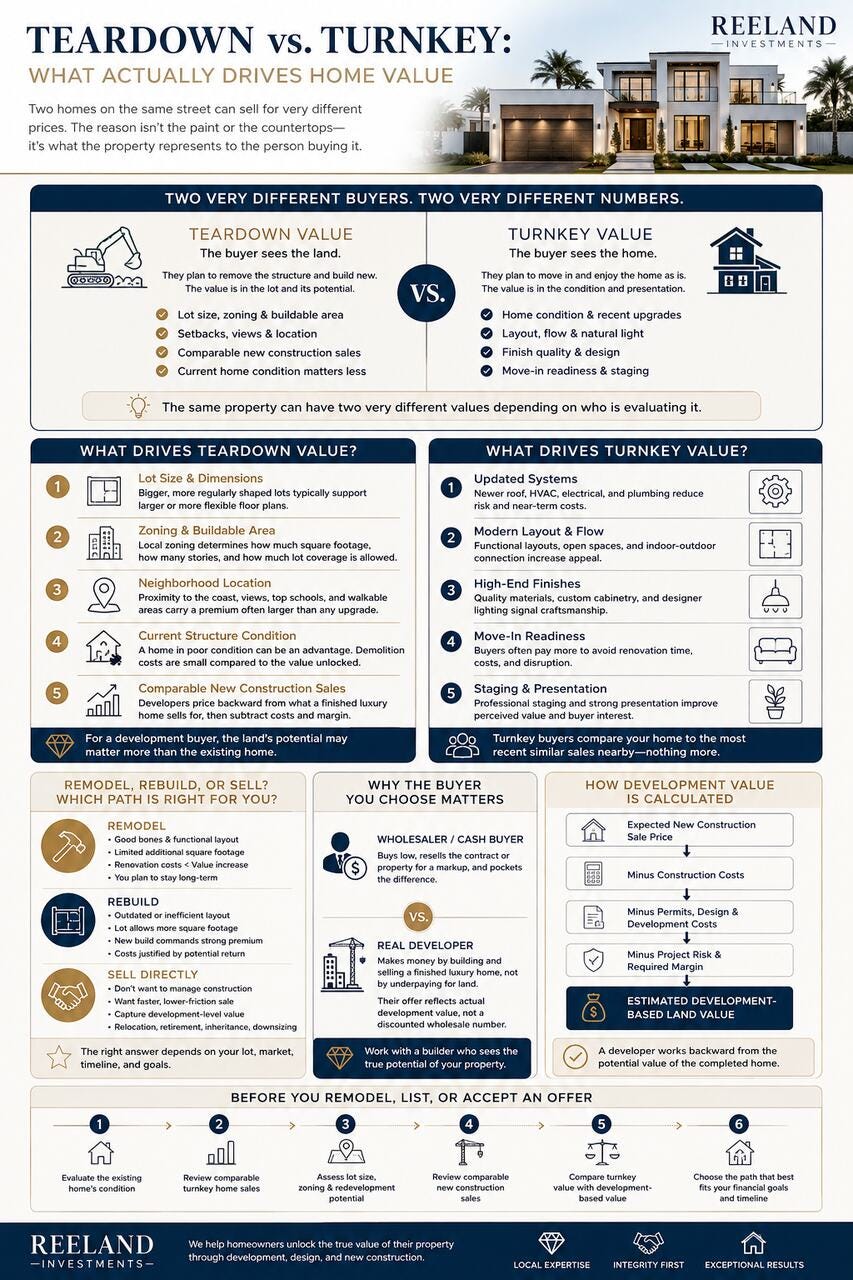
That’s the real divide in today’s high-end real estate market: teardown value versus turnkey value. Understanding which one applies to your property and why is the single most important factor in deciding how, when, and to whom you should sell.
Two Very Different Buyers, Two Very Different Numbers

Every property attracts one of two types of buyers, and each type is doing completely different math.
The turnkey buyer is purchasing a lifestyle. They’re evaluating finishes, layout, natural light, curb appeal, and how quickly they can move in without lifting a hammer. Their offer is anchored to comparable sales of similarly finished homes what real estate agents call “comps.” If your home is updated, well-maintained, and move-in ready, this is the buyer pool you’re competing in, and your home’s condition directly determines your ceiling.
The development buyer isn’t evaluating your home at all. They’re evaluating your lot. Square footage of the existing structure, kitchen finishes, even the age of the roof none of it matters much, because the plan is to remove the structure and build something new. What matters instead is lot size, zoning, setbacks, buildable square footage, views, and location. A worn-down 1962 ranch house can be worth more to this buyer than a beautifully renovated home next door, simply because of what the land underneath it can become.
The mistake many homeowners make is pricing their property or evaluating an offer using only one of these lenses. If you own an older home on a desirable lot and you only compare yourself to other “as-is” fixer sales, you’re almost certainly leaving money on the table. If you own a dated home and assume a full remodel is the only path to unlocking value, you may be ignoring a faster, cleaner option sitting in plain sight: selling directly to a developer who sees what you don’t.
What Actually Drives “Teardown” Value

Teardown value isn’t about the house at all it’s about everything the house is sitting on top of. When a developer evaluates a property for redevelopment, they’re running through a fairly specific checklist:
Lot size and dimensions: Bigger, more regularly shaped lots typically support larger or more flexible floor plans.
Zoning and buildable area: Local zoning determines how much square footage, how many stories, and how much lot coverage is allowed. Two identically sized lots can have very different development potential depending on setback requirements and height limits.
Location within the neighborhood: Proximity to the coast, a view corridor, a top-rated school, or a walkable downtown core all carry a premium often a larger one than any interior upgrade could add.
Current structure condition: Ironically, a home in poor condition can be an advantage here. There’s little sunk cost being “wasted” in a teardown, and demolition costs are relatively minor compared to the value being unlocked.
Comparable new construction sales: Developers price backward from what a finished luxury home sells for in that specific micro-neighborhood, then subtract construction costs and margin to arrive at a land value.
This is why a homeowner will sometimes hear, almost in disbelief, that their “outdated” home is worth more than they expected. The house isn’t being valued. The dirt is.
What Actually Drives “Turnkey” Value

Turnkey value works in the opposite direction it’s built almost entirely on the condition and presentation of the existing structure.
- Recent renovations and updated systems (roof, HVAC, electrical, plumbing) reduce a buyer’s perceived risk and near-term costs.
- Modern layout and flow matter more than raw square footage. Open-concept living, primary suites with private access, and functional indoor-outdoor connection all command a premium in luxury markets.
- Finish quality stone surfaces, custom cabinetry, designer lighting signals craftsmanship and justifies a higher price per square foot.
- Move-in readiness removes friction. A buyer who doesn’t have to manage a renovation project is often willing to pay for that convenience.
- Staging and presentation genuinely affect perceived value, even though they don’t change the underlying structure.
A turnkey buyer is comparing your home to the last five similar homes that sold nearby full stop. There’s no discount for land potential and no premium for it either, because that buyer isn’t planning to build anything.
The Gap Between the Two and Why It’s Often Bigger Than Homeowners Expect


 Tema anterior
 Primer