After a struggle to claim the throne, Isabella reorganized the governmental system, brought the crime rate down, and unburdened the kingdom of the debt, which her half-brother King Henry IV had left behind. Isabella's marriage to Ferdinand in 1469 created the basis of the de facto unification of Spain. Her reforms and those she made with her husband had an influence that extended well beyond the borders of their united kingdoms.[4]
Isabella was born in Madrigal de las Altas Torres to King John II of Castile and his second wife, Isabella of Portugal, on 22 April 1451.[6] At the time of Isabella's birth, she was second in line to the throne after her older half-brother Henry.[5] Henry was 26 at that time and married, but childless. Isabella's younger brother Alfonso was born two years later on 17 November 1453, demoting her position to third in line.[7] When her father died in 1454, her half-brother ascended to the throne as King Henry IV. Isabella and her brother Alfonso were left in King Henry's care.[8] Isabella, her mother, and Alfonso then moved to Arévalo.[5][9]
These were times of turmoil for Isabella. The living conditions at their castle in Arévalo were poor, and they suffered from a shortage of money. Although her father arranged in his will for his children to be financially well taken care of, King Henry did not comply with their father's wishes, either from a desire to keep his half-siblings restricted or from ineptitude.[8] Even though her living conditions were difficult, Isabella was instructed in lessons of practical piety and in a deep reverence for religion under the supervision of her mother.[9]
When the king's wife, Joan of Portugal, was about to give birth to their daughter Joanna, Isabella and her brother Alfonso were summoned to court in Segovia to come under the direct supervision of the king and to finish their education.[5] Alfonso was placed in the care of a tutor while Isabella became part of the queen's household.[10]
Isabella in the Rimado de la Conquista de Granada, from 1482, by Pedro Marcuello
Some of Isabella's living conditions improved in Segovia. She always had food and clothing and lived in a castle that was adorned with gold and silver. Isabella's basic education consisted of reading, spelling, writing, grammar, history, arithmetic, art, chess, dancing, embroidery, music, and religious instruction. She and her ladies-in-waiting entertained themselves with art, embroidery, and music. She lived a relaxed lifestyle, but she rarely left Segovia since King Henry forbade this. Her half-brother was keeping her from the political turmoil going on in the kingdom, though Isabella had full knowledge of what was going on and of her role in the feuds.[11][better source needed]
After a rumor spread that Joanna was not actually the daughter of King Henry but rather of a royal favorite, Beltrán de la Cueva, noblemen confronted King Henry and demanded that the king's younger half-brother Alfonso be named his successor. They even went so far as to ask Alfonso to seize the throne. The nobles, now in control of Alfonso and claiming that he was the true heir, clashed with King Henry's forces at the Second Battle of Olmedo in 1467. The battle was a draw. King Henry agreed to recognize Alfonso as his heir presumptive, provided that he would marry his daughter, Princess Joanna.[5][12] Soon after he was named Prince of Asturias, he died at the age of fourteen in July 1468. The nobles who had supported him suspected poisoning. As she had been named in her brother's will as his successor, the nobles asked Isabella to take his place as champion of the rebellion.[5] However, support for the rebels had begun to wane, and Isabella preferred a negotiated settlement to continuing the war.[13] She met with her elder half-brother Henry at Toros de Guisando and they reached a compromise: the war would stop, King Henry would name Isabella his heir presumptive instead of his daughter Joanna, and Isabella would not marry without her half-brother's consent, but he would not be able to force her to marry against her will.[5][14] Isabella's side came out with most of what the nobles desired, though they did not go so far as to officially depose King Henry; they were not powerful enough to do so, and Isabella did not want to jeopardize the principle of fair inherited succession, since it was upon this idea that she had based her argument for legitimacy as heir-presumptive.
The question of Isabella's marriage was not a new one. She had, at the age of six, a betrothal to Ferdinand, the younger son of John II of Navarre (whose family was a cadet branch of the House of Trastámara). At that time, the two kings, Henry and John, were eager to show their mutual love and confidence and they believed that this alliance would make their eternal friendship obvious to the world.[15] This arrangement, however, did not last long.
The wedding portrait of Ferdinand and Isabella, c. 1469
Ferdinand's uncle Alfonso V of Aragon died in 1458. All of Alfonso's Spanish territories, as well as the islands of Sicily and Sardinia, were left to his brother John II. John now had a stronger position than ever before and no longer needed the security of Henry's friendship. Henry was now in need of a new alliance. He saw the chance for this much-needed new friendship in Charles of Viana, John's elder son.[16] Charles was constantly at odds with his father, and because of this, he secretly entered into an alliance with Henry IV of Castile. A major part of the alliance was that a marriage was to be arranged between Charles and Isabella. When John II learned of this arranged marriage, he was outraged. Isabella had been intended for his favorite younger son, Ferdinand, and in his eyes, this alliance was still valid. John II had his son Charles thrown in prison on charges of plotting against his father's life. Charles died in 1461.[17]
In 1465, an attempt was made to marry Isabella to Afonso V of Portugal, Henry's brother-in-law.[5] Through the medium of the queen and Count of Ledesma, a Portuguese alliance was made.[18] Isabella, however, was wary of the marriage and refused to consent.[19]
A civil war broke out in Castile over King Henry's inability to act as sovereign. Henry now needed a quick way to please the rebels of the kingdom. As part of an agreement to restore peace, Isabella was then to be betrothed to Pedro Girón Acuña Pacheco, Master of the Order of Calatrava and brother to the king's favorite, Juan Pacheco.[18] In return, Don Pedro would pay into the royal treasury an enormous sum of money. Seeing no alternative, Henry agreed to the marriage. Isabella was aghast and prayed to God that the marriage would not come to pass. Her prayers were answered when Don Pedro suddenly fell ill and died while on his way to meet his fiancée.[18][20]
When Henry had recognized Isabella as his heir-presumptive on 19 September 1468, he had also promised that his half-sister should not be compelled to marry against her will, while she in return had agreed to obtain his consent.[5][14] It seemed that the years of failed attempts at political marriages were finally over. There was talk of a marriage to Edward IV of England or to one of his brothers, probably Richard, Duke of Gloucester,[21] but this alliance was never seriously considered.[14] Once again in 1468, a marriage proposal arrived from Afonso V of Portugal. Going against his promises made in September 1468, Henry tried to make the marriage a reality. If Isabella married Afonso, Henry's daughter Joanna would marry Afonso's son John II and thus, after the death of the old king, John and Joanna could inherit Portugal and Castile.[22] Isabella refused and made a secret promise to marry her cousin and very first betrothed, Ferdinand of Aragon.[5]
King Ferdinand and Queen Isabella of Spain issued the Alhambra Decree on March 31, 1492. The decree ordered the expulsion of all Jews from Spanish territories unless they converted to Catholicism.
There were several reasons why Ferdinand and Isabella issued this decree. One reason was religious: Spain was a Catholic country, and the monarchs believed that the presence of Jews in their territory was a threat to the religious unity of the kingdom. They believed that Jews who did not convert to Catholicism would continue to practice Judaism and might try to convert Catholics to their religion.
Another reason was economic. Ferdinand and Isabella believed that expelling the Jews would allow them to seize their property and assets, which could then be used to finance their ongoing war against the Muslim Moors in Granada. By expelling the Jews, they hoped to increase their wealth and power.
The decree was a devastating blow to the Jewish community in Spain, which had been present in the country for centuries. Many Jews chose to convert to Catholicism rather than leave their homes and possessions behind, but even those who did convert often faced discrimination and persecution from their fellow Spaniards. The Alhambra Decree is considered one of the most significant events in the history of Spanish Jewry and had far-reaching consequences for the Jewish diaspora in Europe.
Photo King Ferdinand and Queen Isabella
On 31 march 1889, the Eifel tower in Paris France, was officially inaugurated and opened to the public.
The Eiffel Tower in Paris, France, was officially inaugurated and opened to the public on March 31, 1889. The tower was built as the entrance arch to the 1889 World’s Fair, which was held in Paris to celebrate the 100th anniversary of the French Revolution.
The Eiffel Tower was designed by the French engineer Gustave Eiffel, who also oversaw its construction. It is made of wrought iron and stands 324 meters (1,063 feet) tall, making it one of the tallest structures in the world at the time of its construction. It was originally intended to be a temporary structure, but its popularity with the public and its usefulness for scientific experiments led to it being preserved as a permanent landmark. Today, the Eiffel Tower is one of the most famous landmarks in the world and is a symbol of Paris and France. It is visited by millions of tourists each year and has been the setting for many famous events, including the 1900 World’s Fair, the 1948 Olympic Games, and the millennium celebrations in 2000.
Photo Eiffel Tower
On March 31, 1917, the United States formally took possession of the Virgin Islands from Denmark. The Virgin Islands, a group of islands in the Caribbean Sea, had been under Danish control since the 17th century, but the United States had been interested in acquiring them for some time.
In 1916, the United States entered into negotiations with Denmark to purchase the Virgin Islands, which were strategically located in the Caribbean Sea. The negotiations were successful, and on January 17, 1917, the two countries signed a treaty in which Denmark agreed to sell the Virgin Islands to the United States for $25 million.
The transfer of sovereignty took place on March 31, 1917, when the United States formally took possession of the Virgin Islands. The islands were administered as a U.S. territory and were later granted U.S. citizenship in 1927. Today, the Virgin Islands are a popular tourist destination known for their beaches, crystal-clear waters, and rich cultural heritage.
Photo Virgin Islands
On March 31, 1968, President Lyndon B. Johnson made a televised address to the nation in which he announced that he would not seek reelection as President of the United States.
Johnson had been facing mounting criticism and protests over his handling of the Vietnam War, as well as other domestic issues. The war had become increasingly unpopular, and many Americans were calling for a change in leadership. Johnson’s decision not to seek reelection came as a surprise to many, as he had previously indicated that he would run for another term.
In his address, Johnson said, “I have concluded that I should not permit the presidency to become involved in the partisan divisions that are developing in this political year.” He went on to urge the nation to “reject the politics of despair and the politics of division,” and called for a renewed commitment to the principles of democracy and unity.
Johnson’s announcement set the stage for a tumultuous presidential campaign in 1968, which saw the assassination of Robert F. Kennedy and the election of Republican candidate Richard Nixon. Johnson’s decision not to seek reelection marked the end of a turbulent and transformative era in American politics.
Photo president Lyndon Johnson
On March 31, 1995, Selena Quintanilla-Perez, a popular Tejano singer, was tragically murdered by her fan club president, Yolanda Saldivar, in Corpus Christi, Texas. Selena was only 23 years old at the time of her death and was widely regarded as one of the most talented and successful musicians in the Tejano genre. Saldivar, who had been managing Selena’s fan club and boutique clothing line, was confronted by Selena’s family members about embezzling money from the businesses. After the meeting, Saldivar pulled out a gun and shot Selena in the back. Selena was rushed to a hospital, where she was pronounced dead.
The news of Selena’s death shocked her fans and the music industry. Her funeral was attended by thousands of mourners, and her death was widely covered by the media. In the years since her death, Selena has become a cultural icon, with her music and fashion influencing a new generation of musicians and fans.
Saldivar was eventually convicted of murder and sentenced to life in prison. The tragedy of Selena’s untimely death is still mourned by many and serves as a reminder of the fragility of life and the impact that talented artists can have on the world.
Pope Francis waves to the crowd from the Speakers Balcony at the US Capitol, September 24, 2015, in Washington, DC. Pool/Getty Images
If President Barack Obama had delivered the text of Pope Francis’s speech to Congress Thursday as a State of the Union address, he would have risked being denounced by Republicans as a socialist.
While most Republicans chose not to complain, and Democrats tried not to gloat, Francis’s speech to Congress was stunning in the breadth, depth, and conviction of its progressivism. That might not have been fully and immediately appreciated by everyone in the House chamber because the combination of Francis’s sotto voce delivery and his heavily accented English made it difficult, lawmakers said, to grasp everything he was saying.
But there was no mistaking his thrust. He made detailed arguments for openness to immigrants, addressing the human roots of climate change, closing the gap between the rich and the poor, and ending the death penalty — all of which invigorated the Democrats in the room.
“It was pretty progressive. He had a little right-to-life stuff in it,” Rep. James Clyburn, the third-ranking House Democrat, said as he cracked a smile thinking about how Republicans would receive the speech. “That’s enough for them.”
The pope isn’t going to change many hearts and minds in the badly divided Congress, lawmakers said, but the moment provided a brief respite from political warfare. Several presidential candidates, including Sens. Bernie Sanders, Lindsey Graham, Marco Rubio, and Ted Cruz, as well as Ben Carson, attended.
Rubio, a Roman Catholic, said in a brief interview that Francis “struck the right tone.” Sanders, a self-described socialist, seemed to like the content even more.
“Pope Francis is clearly one of the important religious and moral leaders not only in the world today but in modern history,” he said in a statement released after the speech. “He forces us to address some of the major issues facing humanity: war, income and wealth inequality, poverty, unemployment, greed, the death penalty and other issues that too many prefer to ignore.”
Democrats were eager enough to present Congress as united that they joined a Republican-led standing ovation when Francis told lawmakers of “our responsibility to protect and defend human life at every state of its development.” Several of them said it was out of respect for the pope. But there was another good reason: It strengthened the perception that the whole speech — most of which they liked — carried unifying themes.
Unity was good for Democrats because the speech favored their policies
Francis was interrupted a few times by whoops from the Democratic side of the chamber — by Steve Cohen, a Jewish Memphis Democrat who got excited about Francis’s mention of the Golden Rule; by New York’s Nydia Velázquez when he called for an end to the death penalty; and by Philadelphia Rep. Chaka Fattah when he mentioned his upcoming visit to that city. The Republicans in the room were a bit more staid. Cruz often appeared unmoved during moments when Rubio, who was sitting nearby, applauded. That was the case when Francis asked whether the greater opportunities sought by past generations of immigrants are “not what we want for our own children?”
It was a home crowd. Rep. Paul Gosar (R-AZ) had announced he would boycott the event over climate change, and there was a brief murmur when it became obvious that three conservative Catholic Supreme Court justices — Antonin Scalia, Samuel Alito, and Clarence Thomas — had not shown up. But it seemed that everyone in attendance just wanted to catch a glimpse of Francis and hear what he had to say.
Big-name guests filed into the public galleries above the House chamber long before the pope’s arrival: Former House Speaker Newt Gingrich, former Rep. Gabby Giffords, mega-donor Tom Steyer, and Carson. House members filled the seats in their chamber, followed by the Senate and four Supreme Court justices. At about a minute past 10 am, Francis strode down the center aisle of the House chamber, clad in his familiar white robe and skullcap.
Lawmakers, who had been admonished not to touch the pope, refrained from trying to shake his hand or pat his back. There was no rush to crowd him the way members of Congress try to get into pictures with the president during the annual State of the Union address. When he got to the end of the aisle, he quietly shook hands with Secretary of State John Kerry and then made his way to the rostrum.
Samantha Power, the US ambassador to the UN, pulled out a baby blue iPhone and began snapping pictures. Though she later took to Twitter to commemorate the moment, Power hadn’t posted any of her photos by midday.
For his part, Francis warmed up the audience by describing America as “the land of the free and the home of the brave.” He was slow to move into more politically charged territory but unimpeded when he did. There were 10 standing ovations after his initial greeting, and they were bipartisan.
Francis tackled tough issues at the heart of the US political debate and gently admonished lawmakers to build bridges
At times, Francis seemed to be speaking directly into the headlines and newscasts of the day.
Less than a week after Carson said that America shouldn’t elect a Muslim president, Francis warned that “a delicate balance is required to combat violence perpetrated in the name of a religion, an ideology or an economic system, while also safeguarding religious freedom, intellectual freedom and individual freedoms.”
As Republican presidential frontrunner Donald Trump promises to build a wall between Mexico and the US, and to prevent Syrian refugees from being admitted to America, Francis compared the current refugee crisis to the one that arose in World War II and said that “we the people of this continent are not fearful of foreigners, because most of us were once foreigners.” That drew a standing ovation. Rubio, who has shifted his emphasis on immigration reform over time, leaped to his feet.
And while Democrats continue to bask in this summer’s Supreme Court decision protecting same-sex marriage, the pope said he was concerned that “fundamental relationships are being called into question, as is the very basis of marriage and the family.” The issue that caused the biggest stir before the speech — climate change — factored prominently in Francis’s remarks. He spoke of the human roots of global warming and said, “I am convinced we can make a difference.”
But perhaps the most unexpected run in the speech was an admonishment as gentle as it was clear: Politics is about building bridges, not destroying them. Francis never mentioned the international nuclear nonproliferation deal with Iran by name or the gridlock in American politics, but he seemed to be speak to both matters.
“When countries which have been at odds resume the path of dialogue — a dialogue which may have been interrupted for the most legitimate of reasons — new opportunities open up for all,” he said. “A good political leader is one who, with the interests of all in mind, seizes the moment in a spirit of openness and pragmatism. A good political leader always opts to initiate processes rather than possessing spaces.”
Pennsylvania Republican Rep. Joe Pitts, speaking about the pope’s limited remarks on abortion and same-sex marriage, said he was displeased that Francis had been “unfortunately politically correct.”
For liberals, though, he was simply correct about politics.
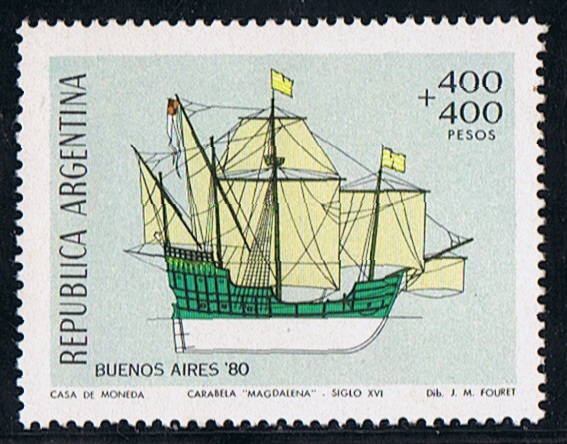
Not much is know about the caravel, where and when built unknown. Tonnage 200 ton, dim. 85 x 25 x 14ft. (draught) Four masts, fore and main mast square rigged, mizzen and Bonaventura mast lateen rigged.
She was the flagship of Don Pedro de Mendoza (1487-1537) expedition to the River Plata. Mendoza held a post in the court of Charles V, when he in 1534 made an offer to Emperor Charles V to make an expedition on his own account for the discovery and conquest of Paraguay and the countries on the Rio La Plata. 24 August 1534 Mendoza on board the MAGDALENA and 13 other vessels, with 3000 men set sail from San Lucar, Spain. Receive from the Emperor before sailing 2.000 ducats, with the condition, when he transported to the new founded colonies 1000 colonists and 100 horses, build a road to the Pacific Ocean, erect three forts within two years he would receive 2.000 ducats more. Also he had to take 8 monks, a physician, a surgeon, and an apothecary, but he was forbidden to introduce a lawyer in the colony. He was to have half the treasure of the chiefs killed and nine-tenths of the ransom. Mendoza was made before sailing military governor of all the territory between the Rio de la Plata and the Strait of Magellan. The office of the Governor was also made hereditary.
Off the coast of Brazil the fleet was scattered in a heavy storm, and Medoza lieutenant Osario, was assassinated, according to some authorities by the orders of Mendoza himself because of suspected disloyalty. 1535 Mendoza sailed up the Rio de la Plata, and founded Buenos Aires on 02 February 1536. He erected two forts there to defend the place. Pestilence broke out and the natives became unfriendly after ill treatment by the Spaniards. His brother Don Diego led a force against the hostile tribes, but was killed with three-fourths of his men. A general conspiracy of the natives was formed, and Buenos Aires was captured and burned by the natives. Mendoza retired to the forth Sanctus-Spiritus, from where he dispatched Juan de Ayolas to explore the upper part of the river. Another brother, Gonzalo arrived with reinforcements and founded the city of Ascención in Paraguay in 1536. Mendoza, disappointed and with a broken health, embarked on board the MAGDALENA for Spain in 1537, leaving Juan de Ayolas in charge. During the long voyage to Spain he died maniac on board the MAGDALENA on 23 June 1537.
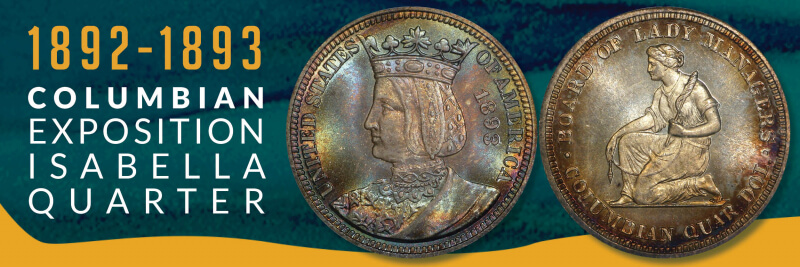
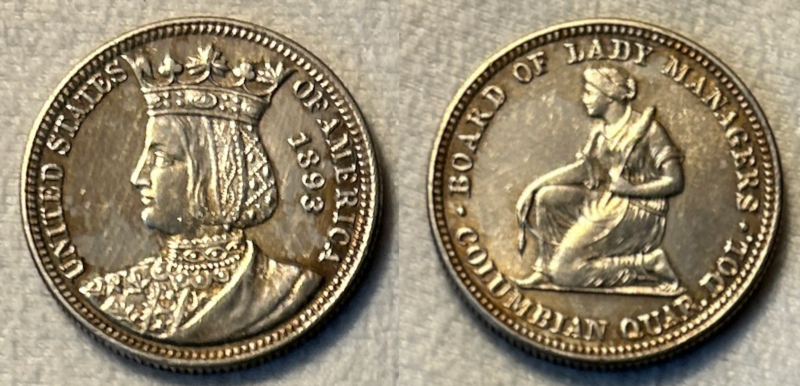
The Board of Lady Managers, headed by Chicago socialite Bertha Palmer, wanted a woman to design the coin and engaged Caroline Peddle, a sculptor. Peddle left the project after disagreements with Mint officials, who then decided to have Barber do the work. The reverse design, showing a kneeling woman spinning flax, with a distaff in her left hand and a spindle in her right, symbolizes women's industry and was based on a sketch by Assistant Engraver George T. Morgan.
The quarter's design was deprecated in the numismatic press. The coin did not sell well at the Exposition; its price of $1 was the same as for the Columbian half dollar, and the quarter was seen as the worse deal. Nearly half of the authorized issue was returned to the Mint to be melted; thousands more were purchased at face value by the Lady Managers and entered the coin market in the early 20th century. Today, they are popular with collectors and are valued in the hundreds to thousands of dollars, depending on condition.
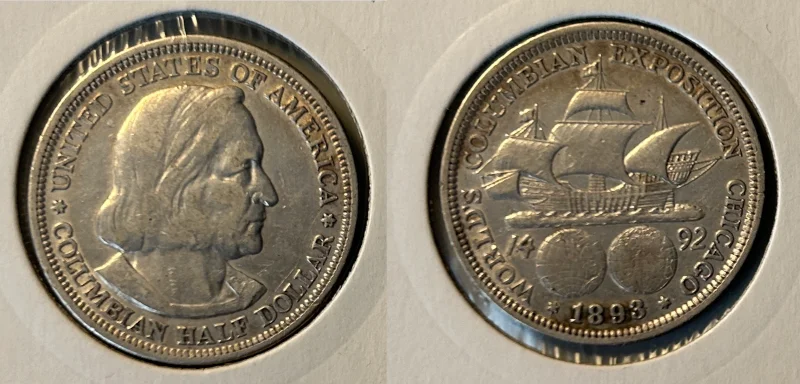
In August 1892, Congress passed an act authorizing the first United States commemorative coin, a half dollar, to be sold at a premium by the managers of the World's Columbian Exposition in Chicago.[1] The event had been authorised by Congress two years previously; that legislation created a Board of Lady Managers and a Board of Gentleman Managers to oversee the fair. The Board of Lady Managers was headed by Bertha Palmer, whose husband Potter owned the Palmer House, the leading hotel in Chicago. The decisions of the Lady Managers were often reversed by their male counterparts on controversial matters: for example, Palmer sought to shut the fair's "Egyptian Girls" dancing show after deeming it obscene. The show was one of the exposition's few successful moneymakers, and the Lady Managers were overruled by the men.[2][3]
Bertha Palmer led the Exposition's Board of Lady Managers
Authorization for the Board of Lady Managers had been included in the 1890 law giving federal authority for the Exposition at the insistence of women's advocate, Susan B. Anthony, who was determined to show that women could successfully assist in the management of the fair. To that end, the Lady Managers sought a coin to sell in competition with the commemorative half dollar at the Exposition, which Congress had approved in 1892.[3] Passage of the half dollar legislation had been difficult, and the Lady Managers decided to wait until the next session of Congress to make their request. When the half dollar appeared in November 1892, the Lady Managers considered it inartistic and determined to do better. Palmer wanted the Lady Managers "to have credit of being the authors of the first really beautiful and artistic coin that has ever been issued by the government of the United States".[4]
In January 1893, Palmer approached the House Appropriations Committee, asking that $10,000 of the funds already designated to be paid over to the Lady Managers by the federal government be in the form of souvenir quarters, which they could sell at a premium. On March 3, 1893, Congress duly passed an act authorising the souvenir coin, which was to be to the specifications of the quarter struck for circulation, and with a design to be approved by the Secretary of the Treasury. Total mintage of the special quarter would be limited to 40,000 specimens.[3][4]
In 1893, Queen Isabella of Spain became the first woman featured on a United States coin, the Queen Isabella Commemorative Quarter. It was almost 100 years later, in 1979, that the first U.S. circulating coin depicted a woman. Since then, there have been a limited number of other circulating coins celebrating women. Although coin designs should represent a country’s values and culture, women are historically under-represented on American coins. But this year, the American Women Quarters™ Program brings recognition to women and their contributions to this country.
Women on Circulating Coins
Although U.S. circulating coins from the 18th to early 20th centuries portrayed female likenesses, they all depicted the mythical figure of Liberty. When creating legislation for a national mint, Congress decided that coins should represent the concept of liberty on the obverse rather than a real person. In early America, symbols of liberty as a Greco-Roman goddess were prevalent. Because of those origins, early coin designs portrayed her with classically styled clothes, facial features, and symbols.
By the early 20th century, opinions about featuring real people on coins changed, and President Abraham Lincoln replaced the figure of Liberty on the penny in 1909. The other circulating coins changed throughout the first half of the 20th century to show different presidents. Legislation still required the obverse of coins to represent the concept of liberty, but instead of a mythical figure, the presidents became that depiction.
Almost 200 years after the Mint produced its first circulating coin, Susan B. Anthony appeared on the dollar. The Susan B. Anthony Dollar was the first circulating coin to depict a non-mythical woman. Her portrait replaced President Dwight D. Eisenhower on the obverse. The reverse continued to include an adaptation of Apollo 11’s insignia used on the Eisenhower Dollar. The Mint produced the Susan B. Anthony Dollar from 1979 to 1981 and again in 1999.
The Sacagawea Golden Dollar replaced the Susan B. Anthony Dollar. The obverse showed Sacagawea carrying her baby Jean Baptiste on her back. Her portrait is unlike the traditional side-facing image; she is in three-quarters profile and looks out at the viewer. The reverse featured a soaring eagle. The Mint made the Sacagawea Golden Dollar from 2000 to 2008, before it transitioned into the Native American $1 Coin Program in 2009.
Both the Susan B. Anthony and Sacagawea dollars are unique because their portraits appear on the obverse. They are the representations of liberty instead of a male president.
1979 Susan B. Anthony Dollar and 2000 Sacagawea Golden Dollar
Circulating coin reverse designs follow different themes named in legislation, including as part of coin programs. Some of these coins show women as part of the design. The 2003 Alabama State Quarter featured Helen Keller. But even though her image was in the design, the quarter was part of the 50 State Quarters Program and honored Alabama, not Helen Keller herself.
American Women Quarters Program
The American Women Quarters Program is the first circulating coin program to exclusively honor women and their contributions to this country as the reverse theme. From 2022 through 2025, the Mint will release five designs each year recognizing a different American woman.
The women will be from ethnically, racially, and geographically diverse backgrounds and from a variety of fields. The program will celebrate familiar names such as author Maya Angelou and Dr. Sally Ride, the first American woman in space. It will also introduce Americans to under-recognized women such as Anna May Wong, the first Chinese American film star in Hollywood.
The obverse of the quarters will still depict George Washington, but in a new design sculpted by famous 20th century artist Laura Gardin Fraser. Her right-facing portrait of Washington was the recommended design for the 1932 quarter when the obverse changed from Liberty to Washington. The Treasury Secretary at the time ultimately selected the familiar left-facing portrait by John Flanagan, which the Mint used on the quarter for 90 years.
Watch for these quarters in circulation or buy American Women Quarters Program products in the Mint’s online catalog.
1893 Queen Isabella Commemorative Quarter. (Image via me)
A few things I’ve picked up from researching early commemorative coins:
The people behind them always hope they can raise a ton of money for a pet project or monument or expo. They rarely do.
The designs usually get denigrated by the numismatic press – oftentimes with a venom critics reserve for Limp Bizkit albums or Michael Bay movies.
The mint melts down the excess/unsold coins. As a result, the ones that did sell end up becoming valuable decades later – screwing over collectors on a budget like yours truly.
Those issues were all in play for the 1893 Isabella Quarter.
The Queen Isabella commemorative quarter traces its beginnings to the World’s Fair: Columbian Exposition, held in Chicago in 1893. Congress had already authorized the minting of a commemorative half dollar featuring Christopher Columbus, but a group of women, led by Bertha Palmer, whose husband, Potter, owned the famed Palmer House hotel in Chicago, thought they could do better.
Spearheaded by renowned women’s rights activist, and future $1 coin subject, Susan B. Anthony, the Board of Lady Managers had been awarded $10,000 in federal funds to help manage the Columbian Expo. In early 1893, the Board went before the House Appropriations Committee to ask that the $10,000 could be paid to them in the form of 40,000 specially designed commemorative quarters, which they could then sell at a profit. Congress obliged and the Board set about becoming “the authors of the first really beautiful and artistic coin that has ever been issued by the government of the United States.”
Obviously, the Board wanted a female on the obverse and decided on Queen Isabella I of Castile, who had provided vital financial support for Columbus’s voyages. Putting a foreign monarch on U.S. currency was unprecedented (indeed, there had a been a revolution over it), but according to Coin Week, the main source of conflict was over design.
Caroline Peddle, a former student of famed artist and coin designer Augustus Saint-Gaudens, was hired by the Board to design the coin. However, her sketches, which included a seated Isabella on the obverse and the inscription “Commemorative coin issued for the Board of Lady Managers of the World’s Columbian Exposition by Act of Congress, 1492–1892” on the reverse, were deemed to look too token-like and rejected. Rather than be allowed to redesign the coin, the Mint took away the reverse side and gave it to one of their in-house artists, Charles Barber, to design.
After some more back-and-forth and additional restrictions imposed by the Mint, Peddle resigned. The Mint then cobbled together some portraits of Isabella and ultimately produced an image of a young Isabella wearing a crown on her head for the obverse. On the reverse, the Mint went with an image of a woman kneeling while holding a distaff and spindle- symbolizing her industry. The Board had suggested an image of the Woman’s Building at the Expo, and Palmer later stated that the Board disliked the Mint’s reverse image because “we did not consider [it] typical of the woman of the present day.” However, the Mint made the final decision and approved the coin design.
To say that the reception for the commemorative quarter was not warm is a bit like saying that the American public didn’t embrace Apple’s Newton. The American Journal of Numsimatics was particularly brutal:
[W]e do not know who designed it, but in this instance, as in the half dollar, the contrast between examples of the numismatic art of the nation, as displayed on the Columbian coins, on the one hand, and the spirited and admirable work of the architects of the buildings, for instance, on the other, is painful. If these coins really represent the highest achievements of our medalist and our mints, under the inspiration of an opportunity without restrictions, the like of which has never been presented hitherto in the history of our national coinage, we might as well despair of its future…
The American Journal of Numismatics in October 1893, quoted by PCGS.
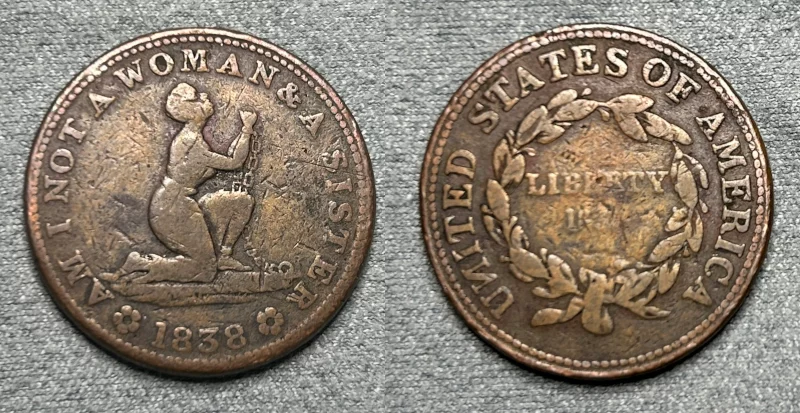
The Journal also drew a “mournful” comparison between the reverse design of the kneeling woman holding the distaff and spindle and the well-known “Am I Not a Woman and a Sister?” anti-slavery Hard Times Token. Surely, the Board felt vindicated by that line – although there’s no evidence Palmer or anyone else affiliated with them ever wrote to the Mint to say: “See? I told you we should gone with the building on the reverse.”
1838 HT-81 “Am I Not A Woman & A Sister?” (Image via me)
Sales figures, meanwhile, were disappointing. Of the 40,000 coins minted, a little more than half (21,180) ended up selling. According to NGC, the quarter’s sales were cannibalized by the Columbian Expo half dollar, which sold for the same price and was more widely available at the fair (5 million Columbian Expo half dollars were minted – 125 times as many compared to the Isabella quarter). While it didn’t come close to selling out, Coin Week points out that the quarters, which sold for $1 each, ended up being profitable for the Board. A $20,000-plus stream of revenue may not have been much, but it was double the original federal appropriation awarded to the Board. Of the remaining 19,000-plus quarters, approximately 15,000 went back to the Mint for melting.
1893 Columbian Expo Half Dollar. (Image via me)
In recent years, the coin’s reputation has been rehabilitated and has become a highly sought-after collector’s item. Contemporary reviewers have praised its quaint design and its uniqueness among U.S. commemorative coins (until the modern commemoratives came around, it held the distinction as the only commemorative quarter in U.S. history – as well as the only one to depict a foreign monarch). Even the reverse of the coin has been somewhat vindicated. Art historian Cornelius Vermeule argued that the design wasn’t necessarily evocative of the anti-slavery token and even traced elements of it back to antiquities. “[S]ome details of drapery to a servant girl from the East Pediment of the Temple of Zeus at Olympia, work of about 460 B.C. with additions and revisions in the first or second centuries A.D.,” he wrote.
I love the design and how it distinguishes this coin from other early commemoratives. Too many coins from that era have a generic male bust on the obverse and either an eagle or state symbol on the reverse. Because of the relative scarcity of this coin, buying one wasn’t cheap (this one had been cleaned, which lowered its value, but it still ended up costing over $100). The price tag was worth it, as this has become one of my favorite coins.
So I guess the lesson here is that I should buy more modern commemoratives – even those that I think are ugly. After all, maybe they’ll skyrocket in value in 100 years…


 Tema anterior



















,_formerly_attributed_to_Titian_(Alte_Pinakothek,_Munich).jpg)




.png)


 1838 HT-81 “Am I Not A Woman & A Sister?” (Image via me)
 1893 Columbian Expo Half Dollar. (Image via me)